
Building Particle Filters and Particle MCMC in NIMBLE
This example shows how to construct and conduct inference on a state space model using particle filtering algorithms. nimblecurrently has versions of the bootstrap filter, the auxiliary particle filter, the ensemble Kalman filter, and the Liu and West filter implemented. Additionally, particle MCMC samplers are available and can be specified for both univariate and multivariate parameters.
Model Creation

## load the nimble library and set seed

library('nimble')

set.seed(1)

## define the model

stateSpaceCode <- nimbleCode({

    a ~ dunif(-0.9999, 0.9999)

    b ~ dnorm(0, sd = 1000)

    sigPN ~ dunif(1e-04, 1)

    sigOE ~ dunif(1e-04, 1)

    x[1] ~ dnorm(b/(1 - a), sd = sigPN/sqrt((1-a*a)))

    y[1] ~ dt(mu = x[1], sigma = sigOE, df = 5)

    for (i in 2:t) {

        x[i] ~ dnorm(a * x[i - 1] + b, sd = sigPN)

        y[i] ~ dt(mu = x[i], sigma = sigOE, df = 5)

    }

})

## define data, constants, and initial values

data <- list(

    y = c(0.213, 1.025, 0.314, 0.521, 0.895, 1.74, 0.078, 0.474, 0.656, 0.802)

)

constants <- list(

    t = 10

)

inits <- list(

    a = 0,

    b = .5,

    sigPN = .1,

    sigOE = .05

)

## build the model

stateSpaceModel <- nimbleModel(stateSpaceCode,

                              data = data,

                              constants = constants,

                              inits = inits,

                              check = FALSE)
## defining model...
## building model...
## setting data and initial values...
## running calculate on model (any error reports that follow may simply

## reflect missing values in model variables) ...
##
## checking model sizes and dimensions...
## note that missing values (NAs) or non-finite values were found in model

## variables: x, lifted_a_times_x_oBi_minus_1_cB_plus_b. This is not an error,

## but some or all variables may need to be initialized for certain algorithms

## to operate properly.
##
## model building finished.
Construct and run a bootstrap filter
We next construct a bootstrap filter to conduct inference on the latent states of our state space model. Note that the bootstrap filter, along with the auxiliary particle filter and the ensemble Kalman filter, treat the top-level parameters a, b, sigPN, and sigOEas fixed. Therefore, the bootstrap filter below will proceed as though a = 0, b = .5, sigPN = .1, and sigOE = .05, which are the initial values that were assigned to the top-level parameters.
The bootstrap filter takes as arguments the name of the model and the name of the latent state variable within the model. The filter can also take a control list that can be used to fine-tune the algorithm’s configuration.
## build bootstrap filter and compile model and filter

bootstrapFilter <- buildBootstrapFilter(stateSpaceModel, nodes = 'x')

compiledList <- compileNimble(stateSpaceModel, bootstrapFilter)
## compiling... this may take a minute. Use 'showCompilerOutput = TRUE' to see C++ compiler details.
## compilation finished.
## run compiled filter with 10,000 particles.

## note that the bootstrap filter returns an estimate of the log-likelihood of the model.

compiledList$bootstrapFilter$run(10000)
## [1] -28.13009
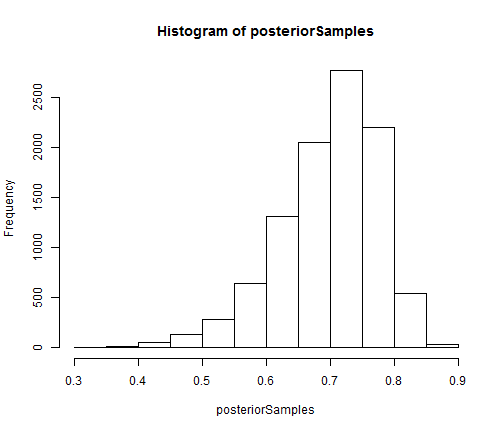
Particle filtering algorithms in nimble store weighted samples of the filtering distribution of the latent states in the mvSamplesmodelValues object. Equally weighted samples are stored in the mvEWSamples object. By default, nimble only stores samples from the final time point.
## extract equally weighted posterior samples of x[10]  and create a histogram

posteriorSamples <- as.matrix(compiledList$bootstrapFilter$mvEWSamples)

hist(posteriorSamples)
The auxiliary particle filter and ensemble Kalman filter can be constructed and run in the same manner as the bootstrap filter.
Conduct inference on top-level parameters using particle MCMC
Particle MCMC can be used to conduct inference on the posterior distribution of both the latent states and any top-level parameters of interest in a state space model. The particle marginal Metropolis-Hastings sampler can be specified to jointly sample the a, b, sigPN, and sigOE top level parameters within nimble‘s MCMC framework as follows:
## create MCMC specification for the state space model

stateSpaceMCMCconf <- configureMCMC(stateSpaceModel, nodes = NULL)

## add a block pMCMC sampler for a, b, sigPN, and sigOE

stateSpaceMCMCconf$addSampler(target = c('a', 'b', 'sigPN', 'sigOE'),

                              type = 'RW_PF_block', control = list(latents = 'x'))

## build and compile pMCMC sampler

stateSpaceMCMC <- buildMCMC(stateSpaceMCMCconf)

compiledList <- compileNimble(stateSpaceModel, stateSpaceMCMC, resetFunctions = TRUE)
## compiling... this may take a minute. Use 'showCompilerOutput = TRUE' to see C++ compiler details.
## compilation finished.
## run compiled sampler for 5000 iterations

compiledList$stateSpaceMCMC$run(5000)
## |-------------|-------------|-------------|-------------|

## |-------------------------------------------------------|
## NULL
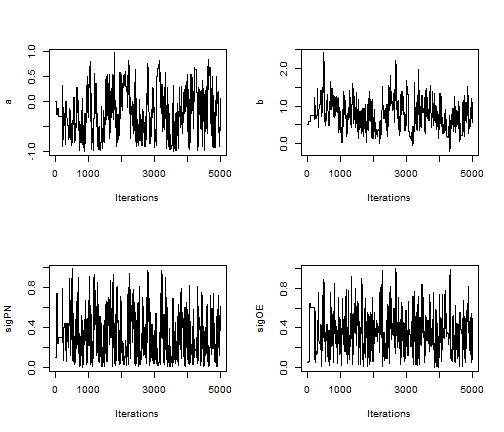
## create trace plots for each parameter

library('coda')
par(mfrow = c(2,2))

posteriorSamps <- as.mcmc(as.matrix(compiledList$stateSpaceMCMC$mvSamples))

traceplot(posteriorSamps[,'a'], ylab = 'a')

traceplot(posteriorSamps[,'b'], ylab = 'b')

traceplot(posteriorSamps[,'sigPN'], ylab = 'sigPN')

traceplot(posteriorSamps[,'sigOE'], ylab = 'sigOE')
The above RW_PF_block sampler uses a multivariate normal proposal distribution to sample vectors of top-level parameters. To sample a scalar top-level parameter, use the RW_PF sampler instead.
转自:https://r-nimble.org/building-particle-filters-and-particle-mcmc-in-nimble-2
Building Particle Filters and Particle MCMC in NIMBLE的更多相关文章
- Particle Filters
|—粒子滤波原理 |—基础代码的建立—|—前进 | |—转弯 | |—噪音(误差 ...
- 基于粒子滤波的物体跟踪 Particle Filter Object Tracking
Video来源地址 一直都觉得粒子滤波是个挺牛的东西,每次试图看文献都被复杂的数学符号搞得看不下去.一个偶然的机会发现了Rob Hess(http://web.engr.oregonstate.edu ...
- Particle filter for visual tracking
Kalman Filter Cons: Kalman filtering is inadequate because it is based on the unimodal Gaussian dist ...
- Particle 粒子效果使用(适配微信小游戏,particle is not defined)
在微信小游戏中使用粒子效果 参考: 1. 粒子库下载地址 2. 粒子官方使用教程 3. 水友解决微信小游戏particle is not defined 一.下载第三方库 Git地址:https:// ...
- Cesium中级教程9 - Advanced Particle System Effects 高级粒子系统效应
Cesium中文网:http://cesiumcn.org/ | 国内快速访问:http://cesium.coinidea.com/ 要了解粒子系统的基础知识,请参见粒子系统入门教程. Weathe ...
- Cesium中级教程8 - Introduction to Particle Systems 粒子系统入门
Cesium中文网:http://cesiumcn.org/ | 国内快速访问:http://cesium.coinidea.com/ What is a particle system? 什么是粒子 ...
- Quick guide for converting from JAGS or BUGS to NIMBLE
Converting to NIMBLE from JAGS, OpenBUGS or WinBUGS NIMBLE is a hierarchical modeling package that u ...
- {ICIP2014}{收录论文列表}
This article come from HEREARS-L1: Learning Tuesday 10:30–12:30; Oral Session; Room: Leonard de Vinc ...
- [SLAM] GMapping SLAM源码阅读(草稿)
目前可以从很多地方得到RBPF的代码,主要看的是Cyrill Stachniss的代码,据此进行理解. Author:Giorgio Grisetti; Cyrill Stachniss http: ...
随机推荐
- Notepad++ 7.3.2 Download 64-bit x64 / 32-bit x86
Notepad++ 7.3.2 Download 32-bit x86 Notepad++ Installer 32-bit x86: Take this one if you have no ide ...
- jQuery使用小结
$(document).ready( function(){} ); 选择器 $("p:first") 第一个元素 $("p.intro" ...
- Linux下deb包安装工具(附带安装搜狗输入法)
环境是在ubuntu14下的 #1.gdebi安装 使用deb安装工具gdebi,这个工具能解决所有依赖问题 sudo apt-get install gdebi #2.搜狗输入法 deb包下载地址: ...
- (function($){….})(jQuery)一种js插件写法
我们先看第一个括号里边的内容:function($){….},这不就是一个匿名的函数吗?但是它的形参比较奇怪,是$,这里主要是为了不与其它的库冲突. 这样我们就比较容易理解第一个括号内的内容就是定义了 ...
- angular购物车
<body ng-app> <div class="container" ng-controller="carController"> ...
- 【Tomcat源码学习】-4.连接管理
前面几节主要针对于Tomcat容器以及内容加载进行了讲解,本节主要针对于连接器-Connector进行细化,作为连接器主要的目的是监听外围网络访问请求,而连接器在启动相关监听进程后,是通过NIO方式进 ...
- 商城项目实战 | 2.2 Android 仿京东商城——自定义 Toolbar (二)
本文为菜鸟窝作者刘婷的连载."商城项目实战"系列来聊聊仿"京东淘宝的购物商城"如何实现. 上一篇文章<商城项目实战 | 2.1 Android 仿京东商城 ...
- c# 基础算法(一) 九九乘法
闲来无事,偶见某贴子里面讨论面试题.突然对一题产生了兴趣,做一道99乘法打印(主要是我工作了2家单位,还没有一家单位在面试时给我出这一道题)于是试着自己写写看.大概逻辑如下 class program ...
- 关于li标签之间的间隔如何消除!
问题:li标签用了display:inline之后虽然成功的合并在一行,但是li标签之间出现了间距. 原因:按enter键换行之后li标签之间存在着空格,正是这些空格占据了li标签之间的空间. 解决方 ...
- kafka java使用
首先添加maven依赖 Kafka <dependency> <groupId>org.apache.kafka</groupId> <artifactId& ...