
SQL Server:使用 PIVOT 行转列和 UNPIVOT 列转行
| ylbtech-SQL Server:使用 PIVOT 行转列和 UNPIVOT 列转行 |
| A,PIVOT 语法 返回顶部 |
PIVOT 提供的语法比一系列复杂的 SELECT...CASE 语句中所指定的语法更简单和更具可读性。有关 PIVOT 语法的完整说明,请参阅 FROM (Transact-SQL)。
以下是带批注的 PIVOT 语法。
SELECT <非透视的列>,

    [第一个透视的列] AS <列名称>,

    [第二个透视的列] AS <列名称>,

    ...

    [最后一个透视的列] AS <列名称>,

FROM

    (<生成数据的 SELECT 查询>)

    AS <源查询的别名>

PIVOT

(

    <聚合函数>(<要聚合的列>)

FOR

[<包含要成为列标题的值的列>]

    IN ( [第一个透视的列], [第二个透视的列],

    ... [最后一个透视的列])

) AS <透视表的别名>

<可选的 ORDER BY 子句>;
| B,PIVOT 示例1返回顶部 |
go

-- ==========================

-- 学生成绩表,ByYuanbo

-- ==========================

-- drop table StudentScores;

create table StudentScores

(

username    varchar(20),        --姓名

[subject]    varchar(30),        --科目

score        float,              --成绩

);

go

-- 01、插入测试数据

insert into StudentScores(username,[subject],score) values('张三', '语文', 80);

insert into StudentScores(username,[subject],score) values('张三', '语文', 90);

insert into StudentScores(username,[subject],score) values('张三', '数学', 90);

insert into StudentScores(username,[subject],score) values('张三', '英语', 70);

insert into StudentScores(username,[subject],score) values('张三', '生物', 85);

insert into StudentScores(username,[subject],score) values('李四', '语文', 70);

insert into StudentScores(username,[subject],score) values('李四', '数学', 92);

insert into StudentScores(username,[subject],score) values('李四', '数学', 100);

insert into StudentScores(username,[subject],score) values('李四', '英语', 76);

insert into StudentScores(username,[subject],score) values('李四', '生物', 88);

insert into StudentScores(username,[subject],score) values('王二', '语文', 60);

insert into StudentScores(username,[subject],score) values('王二', '数学', 82);

insert into StudentScores(username,[subject],score) values('王二', '英语', 96);

insert into StudentScores(username,[subject],score) values('王二', '生物', 78);

go

-- 02、查询数据

select * from StudentScores;

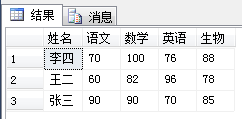
--P1、如果我想知道每位学生的每科成绩,而且每个学生的全部成绩排成一行,这样方便我查看、统计,导出数据

--A1、传统 case 方法

select username as '姓名'

,max(case [subject] when '语文' then score else 0 end) as '语文'

,max(case [subject] when '数学' then score else 0 end) as '数学'

,max(case [subject] when '英语' then score else 0 end) as '英语'

,max(case [subject] when '生物' then score else 0 end) as '生物'

from StudentScores

group by username;

/*

以下是带批注的 PIVOT 语法。

SELECT <非透视的列>,

    [第一个透视的列] AS <列名称>,

    [第二个透视的列] AS <列名称>,

    ...

    [最后一个透视的列] AS <列名称>,

FROM

    (<生成数据的 SELECT 查询>)

    AS <源查询的别名>

PIVOT

(

    <聚合函数>(<要聚合的列>)

FOR

[<包含要成为列标题的值的列>]

    IN ( [第一个透视的列], [第二个透视的列],

    ... [最后一个透视的列])

) AS <透视表的别名>

<可选的 ORDER BY 子句>;

*/

go

-- A2:PIVOT 方法

select username as '姓名',[语文],[数学],[英语],[生物] from StudentScores a

PIVOT

(

max(a.score) for a.subject in([语文],[数学],[英语],[生物])

)b;
示例脚本源
--A1、传统 case 方法

select username as '姓名'

,max(case [subject] when '语文' then score else 0 end) as '语文'

,max(case [subject] when '数学' then score else 0 end) as '数学'

,max(case [subject] when '英语' then score else 0 end) as '英语'

,max(case [subject] when '生物' then score else 0 end) as '生物'

from StudentScores

group by username;
-- A2:PIVOT 方法

select username as '姓名',[语文],[数学],[英语],[生物] from StudentScores a

PIVOT

(

max(a.score) for a.subject in([语文],[数学],[英语],[生物])

)b;
| C,UNPIVOT 示例1返回顶部 |
go

-- ==========================

-- 工程详细表,ByYuanbo

-- ==========================

-- drop table ProjectDetail;

create table ProjectDetail

(

projectName varchar(20),        --功能名称

overseaSupply int,            --海外供应商供给数量

nativeSupply int,            --国内供应商供给数量

southSupply int,            --南方供应商供给数量

northSupply int                --北方供应商供给数量

);

go

-- 01、添加测试数据

insert into ProjectDetail(projectName,overseaSupply,nativeSupply,southSupply,northSupply)

 values('A', 100, 200, 50, 50);

insert into ProjectDetail(projectName,overseaSupply,nativeSupply,southSupply,northSupply)

 values('B', 200, 300, 150, 150);

insert into ProjectDetail(projectName,overseaSupply,nativeSupply,southSupply,northSupply)

 values('C', 159, 400, 20, 320);

 go

 -- 02、查询数据

select * from ProjectDetail;

-- P1:查询项目每个供应商的供给数量?

-- A1:UNPIVOT 方法

select b.projectName,b.supplier,b.supllyNumber from (

select projectName,overseaSupply,nativeSupply,southSupply,northSupply from ProjectDetail) a

UNPIVOT

(

supllyNumber for supplier in(overseaSupply,nativeSupply,southSupply,northSupply)

)b;
示例脚本源
-- P1:查询项目每个供应商的供给数量?

-- A1:UNPIVOT 方法

select b.projectName,b.supplier,b.supllyNumber from (

select projectName,overseaSupply,nativeSupply,southSupply,northSupply from ProjectDetail) a

UNPIVOT

(

supllyNumber for supplier in(overseaSupply,nativeSupply,southSupply,northSupply)

)b;
| D,PIVOT 示例2返回顶部 |
go

-- ==========================

-- 销售季度表,ByYuanbo

-- ==========================

-- drop table SalesByQuarter

create table SalesByQuarter

(

year int,            -- 年份

quarter char(2),    -- 季度

amount money        -- 总额

);

go

-- 01、插入数据

set nocount on

declare @index int

declare @q int

set @index = 0

declare @year int

while (@index < 30)

begin

    set @year = 2005 + (@index % 4)

    set @q = (CasT((RAND() * 500) as int) % 4) + 1

    insert into SalesByQuarter values(@year, 'Q' + CasT(@q as char(1)), RAND() * 10000.00)

    set @index = @index + 1

end;

go

-- 02、查询

select * from SalesByQuarter;

go

-- 03、传统 CASE 方法

select year as 年份

,sum(case when quarter = 'Q1' then amount else 0 end) 一季度

,sum(case when quarter = 'Q2' then amount else 0 end) 二季度

,sum(case when quarter = 'Q3' then amount else 0 end) 三季度

,sum(case when quarter = 'Q4' then amount else 0 end) 四季度

from SalesByQuarter

group by year

order by year desc;

go

-- 04、PIVOT 方法

select year as 年份, Q1 as 一季度, Q2 as 二季度, Q3 as 三季度, Q4 as 四季度 from SalesByQuarter

PIVOT(SUM (amount) FOR quarter IN (Q1, Q2, Q3, Q4) )P

order by year desc;
示例脚本源
| E,返回顶部 |
| F,返回顶部 |
| G,相关资源返回顶部 |
| H,返回顶部 |
 |
作者:ylbtech 出处:http://storebook.cnblogs.com/ 本文版权归作者和博客园共有,欢迎转载,但未经作者同意必须保留此段声明,且在文章页面明显位置给出原文连接,否则保留追究法律责任的权利。 |
SQL Server:使用 PIVOT 行转列和 UNPIVOT 列转行的更多相关文章
- Sql server 中将数据行转列列转行(二)
老规矩,先弄一波测试数据,数据填充代码没有什么意义,先折叠起来: /* 第一步:创建临时表结构 */ CREATE TABLE #Student --创建临时表 ( StuName ), --学生名称 ...
- SQL Server里PIVOT运算符的”红颜祸水“
在今天的文章里我想讨论下SQL Server里一个特别的T-SQL语言结构——自SQL Server 2005引入的PIVOT运算符.我经常引用这个与语言结构是SQL Server里最危险的一个——很 ...
- SQL Server数据库PIVOT函数的使用详解(一)
http://database.51cto.com/art/201108/285250.htm SQL Server数据库中,PIVOT在帮助中这样描述滴:可以使用 PIVOT 和UNPIVOT 关系 ...
- SQL server 2005 PIVOT运算符的使用
原文:SQL server 2005 PIVOT运算符的使用 PIVOT,UNPIVOT运算符是SQL server 2005支持的新功能之一,主要用来实现行到列的转换.本文主要介绍PIVOT运算符的 ...
- SQL Server 2014新特性探秘(3)-可更新列存储聚集索引
简介 列存储索引其实在在SQL Server 2012中就已经存在,但SQL Server 2012中只允许建立非聚集列索引,这意味着列索引是在原有的行存储索引之上的引用了底层的数据,因此会 ...
- 通过DBCC Page查看在SQL Server中哪行数据被锁住了?
原文:通过DBCC Page查看在SQL Server中哪行数据被锁住了? 如何查看被锁的是哪行数据?通过dbcc page可以. 要想明白这个问题: 首先,需要模拟阻塞问题,这里直接模拟了阻塞问题的 ...
- SQL Server删除重复行的6个方法
SQL Server删除重复行是我们最常见的操作之一,下面就为您介绍六种适合不同情况的SQL Server删除重复行的方法,供您参考. 1.如果有ID字段,就是具有唯一性的字段 delect ta ...
- SQL Server获取指定行的数据
SQL Server获取指定行(如第二行)的数据 --SQL Server获取指定行(如第二行)的数据-- --法一(对象法)-- select * from ( select * , numbe ...
- SQL SERVER 判断是否存在数据库、表、列、视图
SQL SERVER 判断是否存在数据库.表.列.视图 --1. 判断数据库是否存在 IF EXISTS (SELECT * FROM SYS.DATABASES WHERE NAME = '数据库名 ...
随机推荐
- Web Service(一):初识
1. 前言 cxf 在项目中应用好久了,一直没有写总结,现在补上. 由于cxf 属于Web Service的一个实现,所以先学习和总结一下Web Service,作为学习cxf的基础. 2. WebS ...
- View 的滑动
View 的滑动 学习自 <Android开发艺术探索> 滑动漫谈 因为Android手机屏幕大小的原因,所以为了显式更多的信息,我们必须采用滚动的方式来处理,因为滚动就涉及到了滑动,有的 ...
- [python]接口签名
一个主机中的数据要通过外网发送数据给另外一个主机,为了保证接口安全,需要对接口进行签名,由于重放攻击貌似对这种接口无效,所以没有加入时间戳 直接放代码: #!/usr/bin/env python # ...
- SPOJ11414 COT3 博弈论 + Trie树合并
考虑对于每个子树从下往上依次考虑 对于叶子节点而言,如果可以染色,那么其\(sg\)值为\(1\),否则为\(0\) 考虑往上合并 如果选择了\(x\),那么后继状态就是其所有子树 如果选了其他子树中 ...
- Android activity之间数据传递和共享的方式之Application
1.基于消息的通信机制 Intent ---bundle ,extra 数据类型有限,比如遇到不可序列化的数据Bitmap,InputStream,或者LinkedList链表等等数据类型就不太好用 ...
- Codeforces Round #312 (Div. 2) E. A Simple Task 线段树
E. A Simple Task 题目连接: http://www.codeforces.com/contest/558/problem/E Description This task is very ...
- hdu 5821 Ball 贪心
Ball 题目连接: http://acm.hdu.edu.cn/showproblem.php?pid=5821 Description ZZX has a sequence of boxes nu ...
- mobile开发备忘
css -webkit-tap-highlight-color webkit点击时会反色,可以清楚 -webkit-appearance 设为none时自带组建样式清除
- Odoo8出现Internal Server Error的解决办法之一
转载地址:http://blog.sina.com.cn/s/blog_7cb52fa80102vaf3.html 问题: 不知怎么回事,我的Odoo8出错了,重装也一样出错信息如下 Inte ...
- 将Excel中的数据批量导入数据库表
private boolean import_to_database(String excel_path) throws BiffException, IOException, HsException ...