
Codefroces432 div2 A,B,C
Arpa is researching the Mexican wave.
There are n spectators in the stadium, labeled from 1 to n. They start the Mexican wave at time 0.
- At time 1, the first spectator stands.
- At time 2, the second spectator stands.
- ...
- At time k, the k-th spectator stands.
- At time k + 1, the (k + 1)-th spectator stands and the first spectator sits.
- At time k + 2, the (k + 2)-th spectator stands and the second spectator sits.
- ...
- At time n, the n-th spectator stands and the (n - k)-th spectator sits.
- At time n + 1, the (n + 1 - k)-th spectator sits.
- ...
- At time n + k, the n-th spectator sits.
Arpa wants to know how many spectators are standing at time t.
The first line contains three integers n, k, t (1 ≤ n ≤ 109, 1 ≤ k ≤ n, 1 ≤ t < n + k).
Print single integer: how many spectators are standing at time t.
10 5 3
3
10 5 7
5
10 5 12
3
In the following a sitting spectator is represented as -, a standing spectator is represented as ^.
- At t = 0 ----------
 number of standing spectators = 0.
 - At t = 1 ^--------- number of standing spectators = 1.
- At t = 2 ^^-------- number of standing spectators = 2.
- At t = 3 ^^^------- number of standing spectators = 3.
- At t = 4 ^^^^------ number of standing spectators = 4.
- At t = 5 ^^^^^----- number of standing spectators = 5.
- At t = 6 -^^^^^---- number of standing spectators = 5.
- At t = 7 --^^^^^--- number of standing spectators = 5.
- At t = 8 ---^^^^^-- number of standing spectators = 5.
- At t = 9 ----^^^^^- number of standing spectators = 5.
- At t = 10 -----^^^^^ number of standing spectators = 5.
- At t = 11 ------^^^^ number of standing spectators = 4.
- At t = 12 -------^^^ number of standing spectators = 3.
- At t = 13 --------^^ number of standing spectators = 2.
- At t = 14 ---------^ number of standing spectators = 1.
- At t = 15 ---------- number of standing spectators = 0.
分情况讨论
#include <iostream>

#include <algorithm>

#include <cstring>

#include <cstdio>

#include <vector>

#include <queue>

#include <stack>

#include <cstdlib>

#include <iomanip>

#include <cmath>

#include <cassert>

#include <ctime>

#include <map>

#include <set>

using namespace std;

#define lowbit(x) (x&(-x))

#define max(x,y) (x>y?x:y)

#define min(x,y) (x<=y?x:y)

#define MAX 100000000000000000

#define MOD 1000000007

#define pi acos(-1.0)

#define ei exp(1)

#define PI 3.141592653589793238462

#define ios() ios::sync_with_stdio(false)

#define INF 1044266558

#define mem(a) (memset(a,0,sizeof(a)))

typedef long long ll;

int n,m,k;

int main()

{

    scanf("%d%d%d",&n,&m,&k);

    if(k>= && k<=m) printf("%d\n",k);

    else if(k>m && k<=n) printf("%d\n",m);

    else if(k>n && k<=n+m) printf("%d\n",m-k+n);

    else printf("0\n");

    return ;

}
Arpa is taking a geometry exam. Here is the last problem of the exam.
You are given three points a, b, c.
Find a point and an angle such that if we rotate the page around the point by the angle, the new position of a is the same as the old position of b, and the new position of b is the same as the old position of c.
Arpa is doubting if the problem has a solution or not (i.e. if there exists a point and an angle satisfying the condition). Help Arpa determine if the question has a solution or not.
The only line contains six integers ax, ay, bx, by, cx, cy (|ax|, |ay|, |bx|, |by|, |cx|, |cy| ≤ 109). It's guaranteed that the points are distinct.
Print "Yes" if the problem has a solution, "No" otherwise.
You can print each letter in any case (upper or lower).
三点共线一定不存在,除此之外,若a到b的距离等于b到c的距离存在。
#include <iostream>

#include <algorithm>

#include <cstring>

#include <cstdio>

#include <vector>

#include <queue>

#include <stack>

#include <cstdlib>

#include <iomanip>

#include <cmath>

#include <cassert>

#include <ctime>

#include <map>

#include <set>

using namespace std;

#define lowbit(x) (x&(-x))

#define max(x,y) (x>y?x:y)

#define min(x,y) (x<=y?x:y)

#define MAX 100000000000000000

#define MOD 1000000007

#define pi acos(-1.0)

#define ei exp(1)

#define PI 3.141592653589793238462

#define ios() ios::sync_with_stdio(false)

#define INF 1044266558

#define mem(a) (memset(a,0,sizeof(a)))

typedef long long ll;

struct point

{

    ll x;

    ll y;

}node[];

ll dist(point a,point b)

{

    return ((a.y-b.y)*(a.y-b.y))+((a.x-b.x)*(a.x-b.x));

}

bool check()

{

    int ans=;

    if(dist(node[],node[])==dist(node[],node[])) ans=;

    if(ans) return true;

    else return false;

}

bool solve()

{

    double a=((node[].y-node[].y)*1.0)/((node[].x-node[].x)*1.0);

    double b=((node[].y-node[].y)*1.0)/((node[].x-node[].x)*1.0);

    if(a==b) return true;

    return false;

}

int main()

{

    for(int i=;i<;i++)

    {

        scanf("%lld%lld",&node[i].x,&node[i].y);

    }

    if(solve()) puts("No");

    else if(check()) puts("Yes");

    else puts("No");

    return ;

}
You are given set of n points in 5-dimensional space. The points are labeled from 1 to n. No two points coincide.
We will call point a bad if there are different points b and c, not equal to a, from the given set such that angle between vectors  and
and  is acute (i.e. strictly less than
  ). Otherwise, the point is called good.
The angle between vectors  and
and  in 5-dimensional space is defined as
  , where
  is the scalar product and
  is length of .
Given the list of points, print the indices of the good points in ascending order.
The first line of input contains a single integer n (1 ≤ n ≤ 103) — the number of points.
The next n lines of input contain five integers ai, bi, ci, di, ei (|ai|, |bi|, |ci|, |di|, |ei| ≤ 103) — the coordinates of the i-th point. All points are distinct.
First, print a single integer k — the number of good points.
Then, print k integers, each on their own line — the indices of the good points in ascending order.
6
0 0 0 0 0
1 0 0 0 0
0 1 0 0 0
0 0 1 0 0
0 0 0 1 0
0 0 0 0 1
1
1
3
0 0 1 2 0
0 0 9 2 0
0 0 5 9 0
0
In the first sample, the first point forms exactly a angle with all other pairs of points, so it is good.
In the second sample, along the cd plane, we can see the points look as follows:
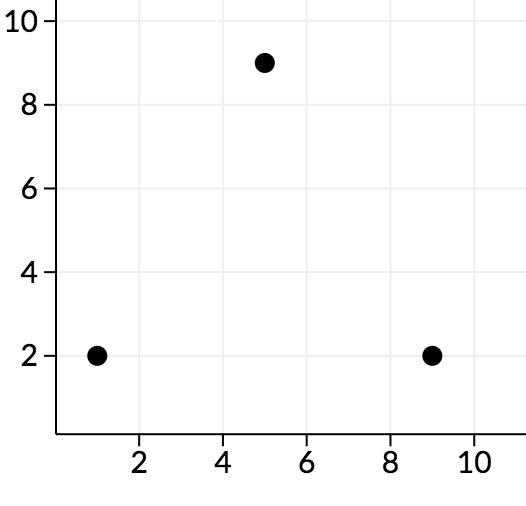
We can see that all angles here are acute, so no points are good.
暴力枚举
#include <iostream>

#include <algorithm>

#include <cstring>

#include <cstdio>

#include <vector>

#include <queue>

#include <stack>

#include <cstdlib>

#include <iomanip>

#include <cmath>

#include <cassert>

#include <ctime>

#include <map>

#include <set>

using namespace std;

#define lowbit(x) (x&(-x))

#define max(x,y) (x>y?x:y)

#define min(x,y) (x<=y?x:y)

#define MAX 100000000000000000

#define MOD 1000000007

#define pi acos(-1.0)

#define ei exp(1)

#define PI 3.141592653589793238462

#define ios() ios::sync_with_stdio(false)

#define INF 1044266558

#define mem(a) (memset(a,0,sizeof(a)))

typedef long long ll;

ll a[][];

int n,vis[];

set<ll>s;

bool check(int x,int y,int z)

{

    ll pos=;

    for(int i=;i<;i++)

        pos+=(a[y][i]-a[x][i])*(a[z][i]-a[x][i]);

    if(pos>) return false;

    return true;

}

int main()

{

    scanf("%d",&n);

    for(int i=;i<n;i++)

    {

        s.insert(i+);

        for(int j=;j<;j++)

            scanf("%lld",&a[i][j]);

    }

    int l=n;

    for(int i=;i<n;i++)

    {

        for(int j=;j<n;j++)

        {

            for(int k=j+;k<n;k++)

            {

                if(i!=j && i!=k)

                {

                    if(!check(i,j,k))

                    {

                        l--;

                        s.erase(i+);

                        goto eg;

                    }

                }

            }

        }

        eg:;

    }

    printf("%d\n",l);

    if(s.size())

    {

        for(set<ll>::iterator it=s.begin();it!=s.end();it++)

        {

            printf("%lld\n",*it);

        }

    }

    return ;

}
Codefroces432 div2 A,B,C的更多相关文章
- bc#54 div2
用小号做的div2 A:竟然看错了排序顺序...白白WA了两发 注意读入一整行(包括空格):getline(cin,st) [gets也是资瓷的 #include<iostream> us ...
- $('div a') 与$('div>a'),.div+.div2与.div~.div2
$('div a'):div标签下所有层次a元素的jquery对象 $('div>a'):div标签下子元素层次a元素的jquery对象 <body> <div class=' ...
- SRM 657 DIV2
-------一直想打SRM,但是感觉Topcoder用起来太麻烦了.题目还是英文,不过没什么事干还是来打一打好了.但是刚注册的号只能打DIV2,反正我这么弱也只适合DIV2了.. T1: 题目大意: ...
- CodeForces Round 192 Div2
This is the first time I took part in Codeforces Competition.The only felt is that my IQ was contemp ...
- Codeforce Round #211 Div2
真的是b到不行啊! 尼玛C题一个这么简单的题目没出 aabbccddee 正确的是aabccdee 我的是 aabcdee 硬是TM的不够用,想半天还以为自己的是对的... A:题... B:题. ...
- Topcoder srm 632 div2
脑洞太大,简单东西就是想复杂,活该一直DIV2; A:水,基本判断A[I]<=A[I-1],ANS++; B:不知道别人怎么做的,我的是100*N*N;没办法想的太多了,忘记是连续的数列 我们枚 ...
- TopCoder 603 div1 & div2
div2 250pts MiddleCode 题意:s串长度为奇数时,将中间字符取掉并添加到t末尾:长度为偶数时,将中间两个较小的字符取掉并添加到末尾. 分析:直接做,学习了一下substr(s, p ...
- TopCoder 649 div1 & div2
最近一场TC,做得是在是烂,不过最后challenge阶段用一个随机数据cha了一个明显错误的代码,最后免于暴跌rating,还涨了一点.TC题目质量还是很高的,非常锻炼思维,拓展做题的视野,老老实实 ...
- 220 DIV2 B. Inna and Nine
220 DIV2 B. Inna and Nine input 369727 output 2 input 123456789987654321 output 1 题意:比如例子1:369727--& ...
随机推荐
- 2015 Multi-University Training Contest 2 hdu 5308 I Wanna Become A 24-Point Master
I Wanna Become A 24-Point Master Time Limit: 2000/1000 MS (Java/Others) Memory Limit: 65536/65536 ...
- jquery validate验证remote时的多状态问题
因为远程验证用户名时可能会出现几种错误情况: 1.用户名字符非法: 2.长度超限: 3.用户名已经存在: 但remote返回的内容只能是布尔型的,即使用dataFilter来过滤也不知道如何对应的把错 ...
- linux程序设计——个人总结
linux程序设计--个人总结 到今天为止,<linux程序设计>学习基本完毕了.从五月下旬開始接触linux,学习安装Ubuntu14.04,六月份開始学习<linux程序设计&g ...
- 后缀自己主动机(SAM)学习指南
*在学习后缀自己主动机之前须要熟练掌握WA自己主动机.RE自己主动机与TLE自己主动机* 什么是后缀自己主动机 后缀自己主动机 Suffix Automaton (SAM) 是一个用 O(n) 的复杂 ...
- ASIHTTPRequest 框架的导入
刚接触ios 对一切都不熟悉 记录一下ASIHTTPRequest 框架的导入 步骤 以便日后再用 1.首先下载ASIHTTPRequest:点击下载 2.在project中导入下面文件: 导入方式 ...
- nodejs02---demo
1.Hello World 打一个一个文本编辑器,在其中输入 console.log('Hello World'); 并保存为helloworld.js.打开dos窗口进入该文件的目录运行 node ...
- BsonDocument
http://api.mongodb.com/csharp/current/html/T_MongoDB_Bson_BsonDocument.htm 如何取出document中的数据 BsonDocu ...
- iOS数据持久化 -- Core Data
Core Data是一个功能强大的层,位于SQLite数据库之上,它避免了SQL的复杂性,能让我们以更自然的方式与数据库进行交互.Core Data将数据库行转换为OC对象(托管对象)来实现,这样无需 ...
- array_unique和array_flip 这两个函数的区别
array_unique和array_flip 这两个函数的区别 标签(空格分隔): php array_unique 和 array_flip 验证 1 没有排序的数组 2 array_unique ...
- Hive框架基础(一)
* Hive框架基础(一) 一句话:学习Hive有毛用? 那么解释一下 毛用: * 操作接口采用类SQL语法,提供快速开发的能力(不会Java也可以玩运算) * 避免了去写MapReduce,减少开发 ...