
FROM USE CASES TO TEST CASES
FROM USE CASES TO TEST CASES
-Test note of “Essential Software Test Design”
2015-08-31
Content:
12.1 What are Use Cases?
12.2 Use cases
12.2.1 Example: Use Case – Withdraw Money
12.3 The Model – Compiling the Flow Graph
12.4 Creating Base Test Cases
12.4.1 List All Scenarios
TO DESCRIBE THE requirements on a system, a technique is often used which is called use cases.
12.1 What are Use Cases?
Use cases are a step-by-step description of a flow, where an actor interact with a system. An actor may be one of a number of different user types, the system itself, or other external systems.
The commonest flow – normal use – is called the main flow (also called the normal flow or Happy Path) and variations of this are termed alternative flows.
The overarching work procedure is this:
- Compile an activity diagram. If this is already in place, the first step is to review it.
- List all scenarios
- Analyze and prioritize the scenarios according to risk – which are most important, commonest
- Identify the operational variables which can affect the expected result
- Write one or more test cases for each scenario
12.2 Use cases
Let us go back to the example of an ATM machine. A simple use case may look like this:
12.2.1 Example: Use Case – Withdraw Money
Assumptions:
- The customer’s bank is one which is connected to the ATM system.
- The customer has a correct and functioning magnetic strip card.
- The ATM is switched on and is in ready mode.
- The ATM is situated in Sweden so all withdrawals will be in swedish crowns,
- SEK, and bills that can be withdrawn are 100 or 500 only.
Actors
- Customer
- ATM (network)
Main Flow:
H-1. The use case begins when the customer inserts the card.
H-2. The ATM verifies the card and requests the PIN number.
H-3. The customer types in the correct PIN (4 digits).
H-4. The ATM verifies the PIN and asks the customer to type in an amount.
H-5. The customer types in the amount (100-2000 SEK manually or by using the multiple choice keys).
H-6. The ATM verifies that the amount is available in the customer’s account and ejects the card, the money and the receipt, and registers the transaction in the customer’s account.
H-7. The customer takes the card, the money and the receipt.
H-8. The ATM returns to standby mode.
H-9. End of use case.
Results
The customer has carried out a successful withdrawal of money.
The customer’s account is updated with the transaction.
Alternative Flows
Alternative flow – A1 Invalid card
A1-1. At step H-1, the customer inserts an invalid card.
A1-2. The ATM aborts the transaction and the card is ejected.
Alternative flow – A2 Wrong PIN
A2-1. At step H-3, the customer types in the wrong PIN.
A2-2. The ATM registers an incorrect PIN and asks the user to try again.
A2-3. The use case continues with step H-3.
Alternative flow – A3 Wrong PIN, 3 times
A3-1. At step H-3, the customer types in the wrong PIN three times in a row.
A3-2. The ATM swallows the card and the transaction is aborted.
A3-3. End of use case.
Alternative flow – A4 Incorrect input of amount
A4-1. At step H-5, the customer makes an incorrect entry (not divisible by a hundred, funds are not in the account, exceeds permitted maximum withdrawal…)
A4-2. The ATM disallows the entered amount and asks the user to try again.
A4-3. The use case continues with step H-5.
Alternative flow – A5 Customer does not take the money
A5-1. At step H-7, the customer takes the card, but not the money or the receipt within 20 seconds.
A5-2. The ATM leaves the receipt hanging out of the machine and retracts the money, places it in a separate container and writes the amount, account number and cause of defect into a defect log.
A5-3. The use case continues with step H-8.
Alternative flow – A6 The customer’s bank is not on-line (other than Handelsbanken)
A6-1. At step H-6, the ATM cannot verify whether the amount is available in the customer’s account. A message shows that contact with the customer’s bank is being established and the card is ejected.
A6-2. The use case continues with step H-8.
Alternative flow – A7 Customer aborts the withdrawal
A7-1. At all times in the Main flow, apart from steps H-6 and H-7, the customer can choose to abort the transaction
A7-2. The ATM aborts the transaction and ejects the card, and no withdrawal is recorded on the customer’s account.
A7-3. The use case continues with step H-8.
12.3 The Model – Compiling the Flow Graph
If there is not one already, you compile a flow diagram based on the use case.
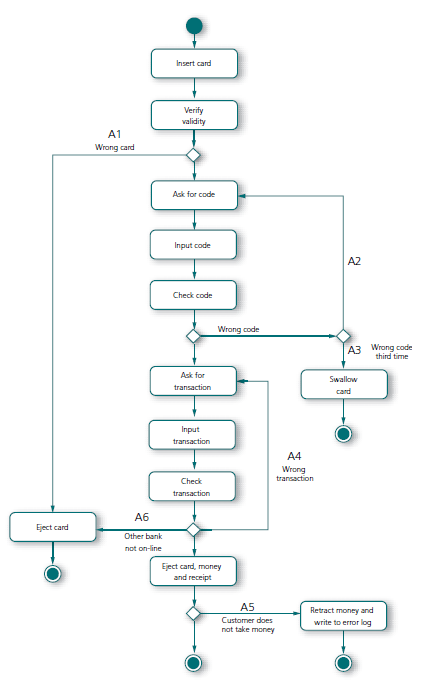
Figure 12.1: Activity diagram of the flow in the use case «Withdraw Money». We have a starting point but several different end points, with different results.
12.4 Creating Base Test Cases
12.4.1 List All Scenarios
To cover the graph, we generate base test cases for the different flows at hand
- Start with the Main flow, which you use for the Happy Day test.
- Continue with the alternative flows – one at a time.
- There are different combinations of alternative flows. It is not always possible to draw up all the combinations: there may be infinite loops.
FROM USE CASES TO TEST CASES的更多相关文章
- USER STORIES AND USE CASES - DON’T USE BOTH
We’re in Orlando for a working session as part of the Core Team building BABOK V3 and over dinner th ...
- 深入理解openstack网络架构(2)----Basic Use Cases
原文地址: https://blogs.oracle.com/ronen/entry/diving_into_openstack_network_architecture1 译文转自: http:// ...
- Security Test Cases
https://www.owasp.org/index.php/OWASP_Testing_Guide_v4_Table_of_Contents Username Enumeration Vulner ...
- SSAS CUBE TEST CASES
经过周末两天和今天的努力,基本上完成并修复了一些bug并且集成到我的MSBIHelper项目中去,可以进行数据测试了.效果图如下: 可以帮助开发人员快速生成等值的Tsql和mdx查询,辅助测试人员快速 ...
- 算法最坏,平均和最佳情况(Worst, Average and Best Cases)-------geeksforgeeks 翻译
最坏,平均和最佳运行时间(Worst, Average and Best Cases) 在上一篇文章中,我们讨论到了渐进分析可以解决分析算法的问题,那么在这一篇中,我们用线性搜索来举例说明一下如何用渐 ...
- As of ADT 14, resource fields cannot be used as switch cases
在导入Android Sample的ApiDemos的时候,发现R.id.xx的文件不能够在 switch cases 中使用 在google查询了下,找到以下答案: As of ADT 14 ...
- Unsupervised Learning: Use Cases
Unsupervised Learning: Use Cases Contents Visualization K-Means Clustering Transfer Learning K-Neare ...
- MapReduce 模式、算法和用例(MapReduce Patterns, Algorithms, and Use Cases)
在新文章“MapReduce模式.算法和用例”中,Ilya Katsov提供了一个系统化的综述,阐述了能够应用MapReduce框架解决的问题. 文章开始描述了一个非常简单的.作为通用的并行计算框架的 ...
- Cannot declare class app\home\controller\Cases because the name is already in use
Cannot declare class app\home\controller\Cases because the name is already in use 命名空间冲突了 use 模型类的时候 ...
随机推荐
- 003.Kickstart部署之HTTP架构
一 准备 1.1 完整架构:Kickstart+DHCP+HTTP+TFTP+PXE 1.2 组件应用 Kickstart服务端IP:172.24.8.12 DHCP:提供客户端IP,网关,镜像路径等 ...
- muduo网络库架构总结
目录 muduo网络库简介 muduo网络库模块组成 Recator反应器 EventLoop的两个组件 TimerQueue定时器 Eventfd Connector和Acceptor连接器和监听器 ...
- vue+axios实现移动端图片上传
在利用vue做一些H5页面时,或多或少会遇到有图片上传的操作,主要是运用html5里面的input[type=file]来实现,传递到后端的数据是以二进制的格式传递,所以上传图片的请求与普通的请求稍微 ...
- 说出ArrayList,Vector, LinkedList的存储性能和特性
ArrayList和Vector都是使用数组方式存储数据,此数组元素数大于实际存储的数据以便增加和插入元素,它们都允许直接按序号索引元素,但是插入元素要涉及数组元素移动等内存操作,所以索引数据快而插 ...
- 4558: [JLoi2016]方
4558: [JLoi2016]方 https://lydsy.com/JudgeOnline/problem.php?id=4558 分析: 容斥原理+各种神奇的计数. 如果没有被删除了的点的话,直 ...
- linux中 判断变量中是否有给定元素
grep find都是查找文件 所以shell编程时使用=~ 来进行变量中的匹配. 注意:if条件后面是两个[]. #!/bin/basha="abc.txt bde.txt ccc.txt ...
- mysql 时间类型精确到毫秒、微秒及其处理
一.MySQL 获得毫秒.微秒及对毫秒.微秒的处理 MySQL 较新的版本中(MySQL 6.0.5),也还没有产生微秒的函数,now() 只能精确到秒. MySQL 中也没有存储带有毫秒.微秒的日期 ...
- 检测三种不同操作系统的Bash脚本
检测三种不同操作系统(GNU/Linux, Mac OS X, Windows NT)的Bash脚本. 设计: 1.使用“uname”命令获取系统信息,带上“-s”参数个打印内核名称. 2.使用“ex ...
- centos7安装postgres-10
目录 安装 下载yum repo 安装server和客户端 初始化db 启动Postgres 设置开机启动 修改data目录 停止服务 迁移data目录 重启 连接测试 修改允许远程其他IP连接 前一 ...
- 【Storm】一张图搞定Storm的运行架构