
《Python数据可视化之matplotlib实践》 源码 第二篇 精进 第五章
图 5.1
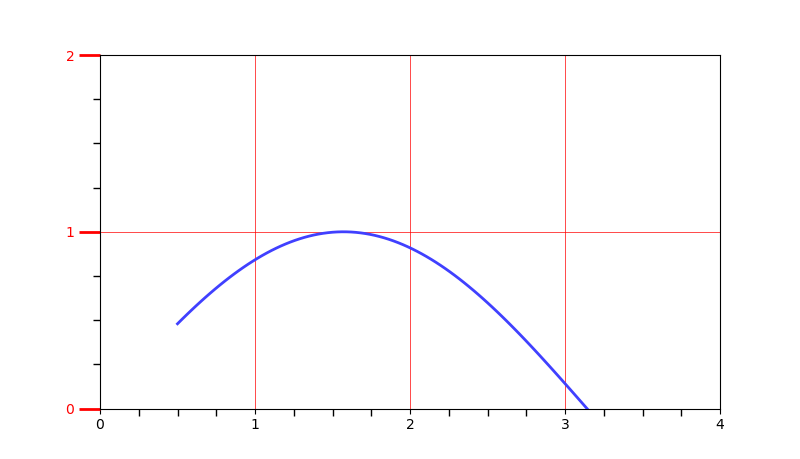


import matplotlib.pyplot as plt

import numpy as np

from matplotlib.ticker import AutoMinorLocator, MultipleLocator, FuncFormatter

x=np.linspace(0.5, 3.5, 100)

y=np.sin(x)

fig=plt.figure(figsize=(8, 8))

ax=fig.add_subplot(111)

ax.xaxis.set_major_locator(MultipleLocator(1.0))

ax.yaxis.set_major_locator(MultipleLocator(1.0))

ax.xaxis.set_minor_locator(AutoMinorLocator(4))

ax.yaxis.set_minor_locator(AutoMinorLocator(4))

def minor_tick(x, pos):

    if not x%1.0:

        return ""

    return "%.2f"%x

ax.xaxis.set_minor_formatter(FuncFormatter(minor_tick))

ax.tick_params("y", which='major',length=15, width=2.0, colors='r')

ax.tick_params(which='minor', length=5, width=1.0, labelsize=10, labelcolor='0.25')

ax.set_xlim(0, 4)

ax.set_ylim(0, 2)

ax.plot(x, y, c=(0.25, 0.25, 1.00), lw=2, zorder=10)

# ax.plot(x, y, c=(0.25, 0.25, 1.00), lw=2, zorder=0)

ax.grid(linestyle='-', linewidth=0.5, color='r', zorder=0)

# ax.grid(linestyle='-', linewidth=0.5, color='r', zorder=10)

# ax.grid(linestyle='--', linewidth=0.5, color='0.25', zorder=0)

plt.show()
-------------------------------------------------------------------------------------
图 5.2

import matplotlib.pyplot as plt

import numpy as np

fig=plt.figure(facecolor=(1.0, 1.0, 0.9412))

ax=fig.add_axes([0.1, 0.4, 0.5, 0.5])

for ticklabel in ax.xaxis.get_ticklabels():

    ticklabel.set_color("slateblue")

    ticklabel.set_fontsize(18)

    ticklabel.set_rotation(30)

for ticklabel in ax.yaxis.get_ticklabels():

    ticklabel.set_color("lightgreen")

    ticklabel.set_fontsize(20)

    ticklabel.set_rotation(2)

plt.show()
-------------------------------------------------------------------------------------
图 5.3
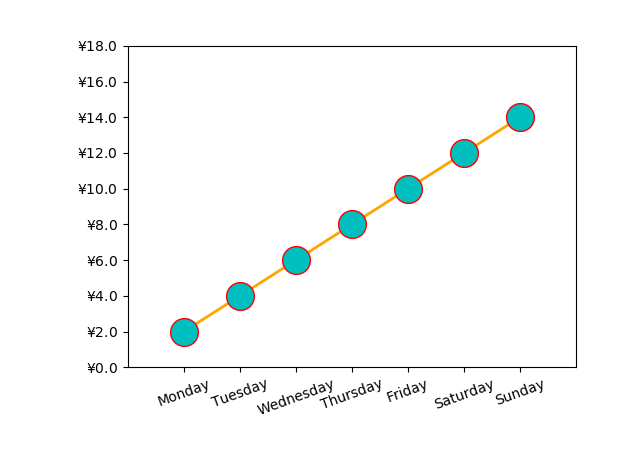
import matplotlib.pyplot as plt

import numpy as np

from calendar import month_name, day_name

from matplotlib.ticker import FormatStrFormatter

fig=plt.figure()

ax=fig.add_axes([0.2, 0.2, 0.7, 0.7])

x=np.arange(1, 8, 1)

y=2*x

ax.plot(x, y, ls='-', lw=2, color='orange', marker='o',

                                    ms=20, mfc='c', mec='r')

ax.yaxis.set_major_formatter(FormatStrFormatter(r"$\yen%1.1f$"))

plt.xticks(x, day_name[0:7], rotation=20)

ax.set_xlim(0, 8)

ax.set_ylim(0, 18)

plt.show()
-------------------------------------------------------------------------------------
图 5.4
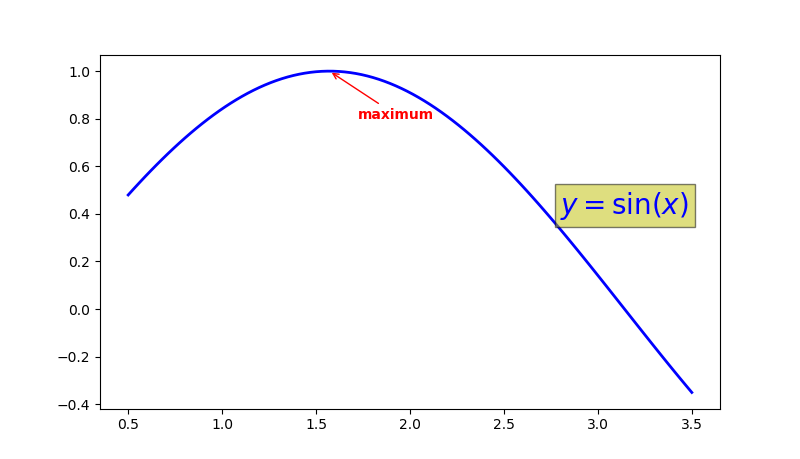
import matplotlib.pyplot as plt

import numpy as np

x=np.linspace(0.5, 3.5, 100)

y=np.sin(x)

fig=plt.figure(figsize=(8, 8))

ax=fig.add_subplot(111)

ax.plot(x, y, c='b', ls='-', lw=2)

ax.annotate("maximum", xy=(np.pi/2, 1.0), xycoords='data',

            xytext=((np.pi/2)+0.15, 0.8), textcoords="data",

            weight="bold", color='r',

            arrowprops=dict(arrowstyle='->', connectionstyle='arc3', color='r'))

ax.text(2.8, 0.4, "$y=\sin(x)$", fontsize=20, color='b',

               bbox=dict(facecolor='y', alpha=0.5))

plt.show()
-------------------------------------------------------------------------------------
图 5.5
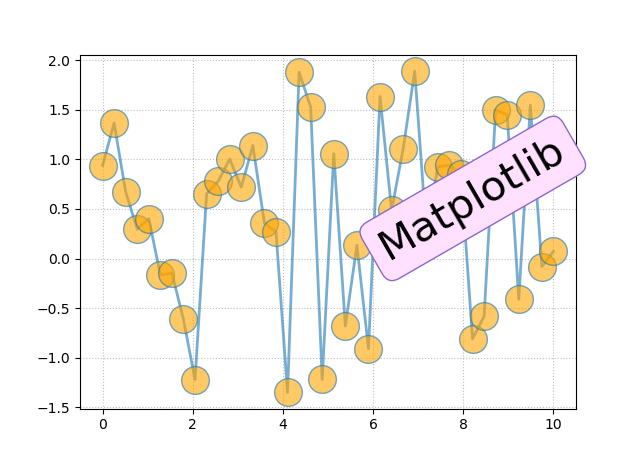
import matplotlib.pyplot as plt

import numpy as np

x=np.linspace(0.0, 10, 40)

y=np.random.randn(40)

plt.plot(x, y, ls='-', lw=2, marker='o', ms=20, mfc='orange', alpha=0.6)

plt.grid(ls=':', color='gray', alpha=0.5)

plt.text(6, 0, 'Matplotlib', size=30, rotation=30.0,

         bbox=dict(boxstyle='round', ec='#8968CD', fc='#FFE1FF'))

plt.show()
-------------------------------------------------------------------------------------
图 5.6
import matplotlib.pyplot as plt

import numpy as np

x=np.linspace(0.0, 10, 40)

y=np.random.randn(40)

plt.plot(x, y, ls='-', lw=2, marker='o', ms=20, mfc='orange', alpha=0.6)

plt.grid(ls=':', color='gray', alpha=0.5)

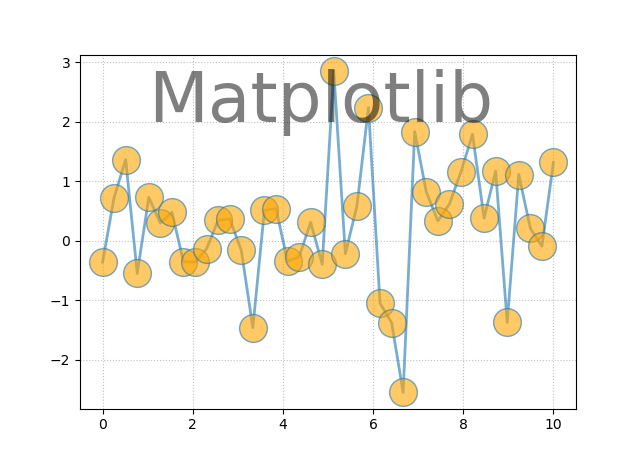
plt.text(1, 2, 'Matplotlib', size=50, alpha=0.5)

plt.show()
-------------------------------------------------------------------------------------
图 5.7
import matplotlib.pyplot as plt

import numpy as np

x=np.linspace(0, 10, 2000)

y=np.sin(x)*np.cos(x)

fig=plt.figure()

ax=fig.add_subplot(111)

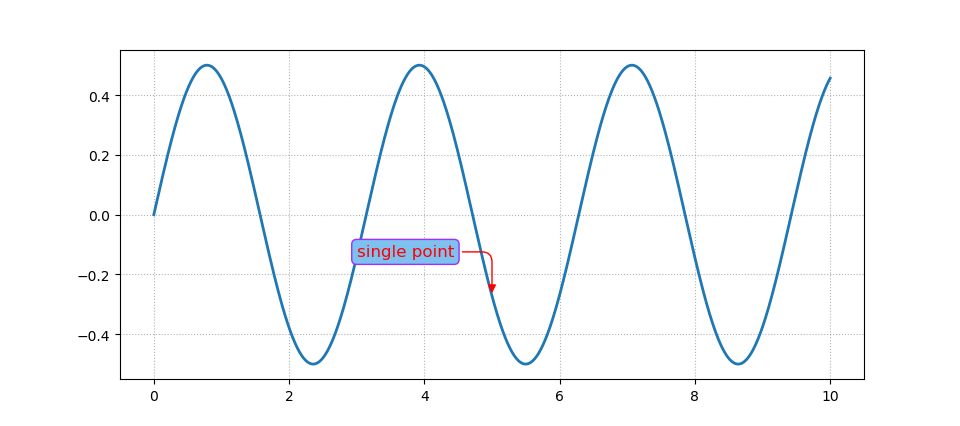
ax.plot(x, y, ls='-', lw=2)

bbox=dict(boxstyle='round', fc='#7EC0EE', ec='#9B30FF')

arrowprops=dict(arrowstyle='-|>', color='r',

                connectionstyle='angle, angleA=0, angleB=90, rad=10')

ax.annotate("single point", (5, np.sin(5)*np.cos(5)),

            xytext=(3, np.sin(3)*np.cos(3)),

            fontsize=12, color='r', bbox=bbox, arrowprops=arrowprops)

ax.grid(ls=":", color='gray', alpha=0.6)

plt.show()
-------------------------------------------------------------------------------------
图 5.8
import matplotlib.pyplot as plt

import numpy as np

x=np.linspace(0, 10, 2000)

y=np.sin(x)

fig=plt.figure()

ax=fig.add_subplot(111)

ax.plot(x, y, ls='-', lw=2)

ax.set_ylim(-1.5, 1.5)

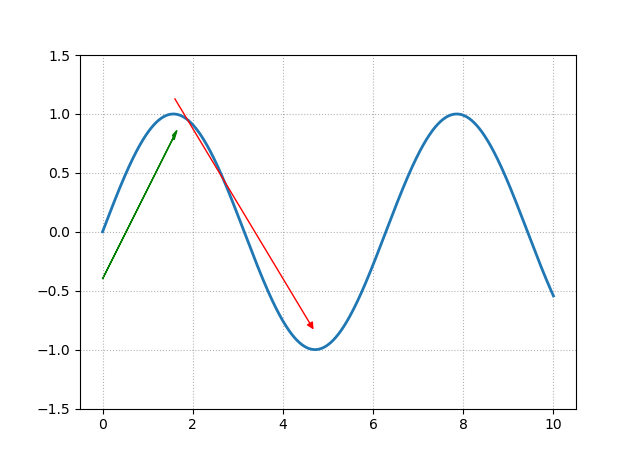
arrowprops=dict(arrowstyle='-|>', color='r')

ax.annotate("", (3*np.pi/2, np.sin(3*np.pi/2)+0.15),

            xytext=(np.pi/2, np.sin(np.pi/2)+0.15), color='r', arrowprops=arrowprops)

ax.arrow(0.0, -0.4, np.pi/2, 1.2, head_width=0.05, head_length=0.1, fc='g', ec='g')

ax.grid(ls=':', color='gray', alpha=0.6)

plt.show()
-------------------------------------------------------------------------------------
图 5.9
import matplotlib.pyplot as plt

import matplotlib as mpl

import numpy as np

from matplotlib.sankey import Sankey

mpl.rcParams["font.sans-serif"]=['FangSong']

mpl.rcParams['axes.unicode_minus']=False

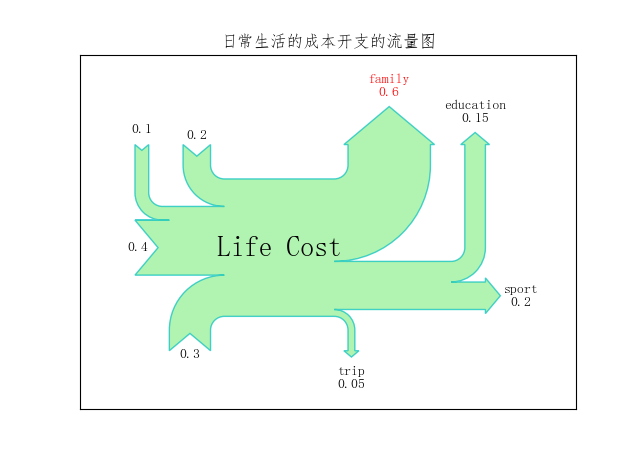
flows=[0.2, 0.1, 0.4, 0.3, -0.6, -0.05, -0.15, -0.2]

labels=['', '', '', '', 'family', 'trip', 'education', 'sport']

orientations=[1, 1, 0, -1, 1, -1, 1, 0]

sankey=Sankey()

sankey.add(flows=flows, labels=labels, orientations=orientations, color='c',

           fc='lightgreen', patchlabel='Life Cost', alpha=0.7)

diagrams=sankey.finish()

diagrams[0].texts[4].set_color('r')

diagrams[0].texts[4].set_weight('bold')

diagrams[0].text.set_fontsize(20)

diagrams[0].text.set_fontweight('bold')

plt.title("日常生活的成本开支的流量图")

plt.show()
-------------------------------------------------------------------------------------
图 5.10

import matplotlib.pyplot as plt

import matplotlib.patheffects as pes

import numpy as np

x=np.linspace(0.5, 3.5, 100)

y=np.sin(x)

fontsize=23

plt.plot(x, y, ls='--', lw=2)

title='$y=\sin({x})$'

xaxis_label='$x\_axis$'

yaxis_label="$y\_axis$"

title_text_obj=plt.title(title, fontsize=fontsize, va='bottom')

xaxis_label_text_obj=plt.xlabel(xaxis_label,

                                fontsize=fontsize-3, alpha=1.0)

yaxis_label_text_obj=plt.ylabel(yaxis_label,

                                fontsize=fontsize-3, alpha=1.0)

title_text_obj.set_path_effects([pes.withSimplePatchShadow()])

pe=pes.withSimplePatchShadow(offset=(1, -1), shadow_rgbFace='r', alpha=0.3)

xaxis_label_text_obj.set_path_effects([pe])

yaxis_label_text_obj.set_path_effects([pe])

plt.show()
-------------------------------------------------------------------------------------
图 5.11
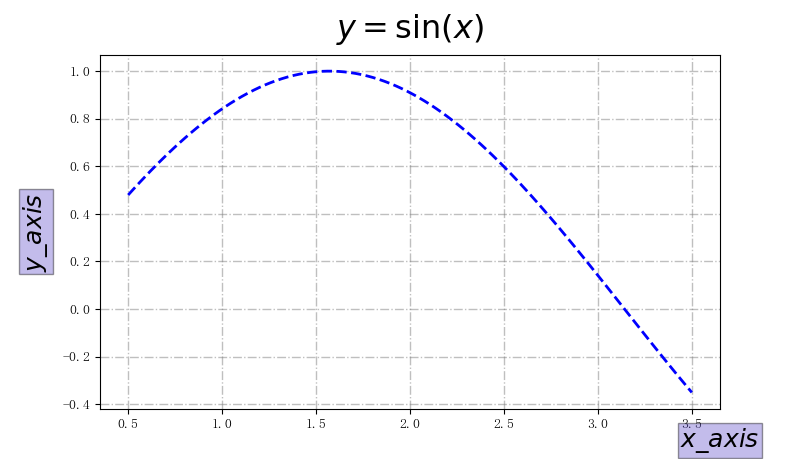
import matplotlib.pyplot as plt

import numpy as np

x=np.linspace(0.5, 3.5, 100)

y=np.sin(x)

fig=plt.figure(figsize=(8, 8))

ax=fig.add_subplot(111)

box=dict(facecolor='#6959CD', pad=2, alpha=0.4)

ax.plot(x, y, c='b', ls='--', lw=2)

title='$y=\sin({x})$'

xaxis_label='$x\_axis$'

yaxis_label="$y\_axis$"

ax.set_xlabel(xaxis_label, fontsize=18, bbox=box)

ax.set_ylabel(yaxis_label, fontsize=18, bbox=box)

ax.set_title(title, fontsize=23, va='bottom')

ax.yaxis.set_label_coords(-0.08, 0.5)

ax.xaxis.set_label_coords(1.0, -0.05)

ax.grid(ls='-.', lw=1, color='gray', alpha=0.5)

plt.show()
-------------------------------------------------------------------------------------
《Python数据可视化之matplotlib实践》 源码 第二篇 精进 第五章的更多相关文章
- Python数据可视化——使用Matplotlib创建散点图
Python数据可视化——使用Matplotlib创建散点图 2017-12-27 作者:淡水化合物 Matplotlib简述: Matplotlib是一个用于创建出高质量图表的桌面绘图包(主要是2D ...
- python 数据可视化(matplotlib)
matpotlib 官网 :https://matplotlib.org/index.html matplotlib 可视化示例:https://matplotlib.org/gallery/inde ...
- Python数据可视化库-Matplotlib(一)
今天我们来学习一下python的数据可视化库,Matplotlib,是一个Python的2D绘图库 通过这个库,开发者可以仅需要几行代码,便可以生成绘图,直方图,功率图,条形图,错误图,散点图等等 废 ...
- Python数据可视化之Matplotlib实现各种图表
数据分析就是将数据以各种图表的形式展现给领导,供领导做决策用,因此熟练掌握饼图.柱状图.线图等图表制作是一个数据分析师必备的技能.Python有两个比较出色的图表制作框架,分别是Matplotlib和 ...
- 重温《STL源码剖析》笔记 第五章
源码之前,了无秘密 ——侯杰 序列式容器 关联式容器 array(build in) RB-tree vector set heap map priority-queue multiset li ...
- Python数据可视化利器Matplotlib,绘图入门篇,Pyplot介绍
Pyplot matplotlib.pyplot是一个命令型函数集合,它可以让我们像使用MATLAB一样使用matplotlib.pyplot中的每一个函数都会对画布图像作出相应的改变,如创建画布.在 ...
- Python数据可视化库-Matplotlib(二)
我们接着上次的继续讲解,先讲一个概念,叫子图的概念. 我们先看一下这段代码 import matplotlib.pyplot as plt fig = plt.figure() ax1 = fig.a ...
- Python数据可视化之matplotlib
常用模块导入 import numpy as np import matplotlib import matplotlib.mlab as mlab import matplotlib.pyplot ...
- python数据可视化(matplotlib)
- python数据可视化-matplotlib入门(7)-从网络加载数据及数据可视化的小总结
除了从文件加载数据,另一个数据源是互联网,互联网每天产生各种不同的数据,可以用各种各样的方式从互联网加载数据. 一.了解 Web API Web 应用编程接口(API)自动请求网站的特定信息,再对这些 ...
随机推荐
- 像 Google SRE 一样 OnCall
在 Google SRE 的著作<Google运维解密>(原作名:Site Reliability Engineering: How Google Runs Production Syst ...
- (六)基于Scrapy爬取网易新闻中的新闻数据
需求:爬取这国内.国际.军事.航空.无人机模块下的新闻信息 1.找到这五个板块对应的url 2.进入每个模块请求新闻信息 我们可以明显发现''加载中'',因此我们判断新闻数据是动态加载出来的. 3. ...
- 如果你也用过 struts2.简单介绍下 springMVC 和 struts2 的区别有哪些?
a.springmvc 的入口是一个 servlet 即前端控制器,而 struts2 入口是一个 filter 过虑器. b.springmvc 是基于方法开发(一个 url 对应一个方法),请求参 ...
- spring jpa restful请求示例
创建项目 导入jar包mysql 数据库和连接池jar <dependency> <groupId>org.springframework.boot</groupId&g ...
- Navicat Premium v16.0.6 绿色破解版
这里版本:Navicat Premium v16.0.6.0 ,这个是绿色版,不需要安装,启动Navicat.exe即可用 破解工具:NavicatKeygenPatch(其它版本也能破解) 1.下载 ...
- Windows CSC提权漏洞复现(CVE-2024-26229)
漏洞信息 Windows CSC服务特权提升漏洞. 当程序向缓冲区写入的数据超出其处理能力时,就会发生基于堆的缓冲区溢出,从而导致多余的数据溢出到相邻的内存区域.这种溢出会损坏内存,并可能使攻击者能够 ...
- python 注册nacos 进行接口规范定义
背景: 一般场景 python服务经常作为java下游的 算法服务或者 数据处理服务 但是使用http 去调用比较不灵活,通过注册到nacos上进行微服务调用才是比较爽的 1.定义feginapi的接 ...
- HBCK2修复hbase2的常见场景
上一文章已经把HBCK2 怎么在小于hbase2.0.3版本的编译与用法介绍了,解决主要场景 查看hbase存在的问题 一.使用hbase hbck命令 hbase hbck命令是对hbase的元数据 ...
- IS-IS总结
IS-IS 管理距离115 ISIS是链路状态协议 封装在数据链路层,所以没有协议号 使用SPF算法计算最短路径 没有骨干区的概念 使用IIH(ISIS ...
- MySQL自定义函数(User Define Function)开发实例——发送TCP/UDP消息
开发背景 当数据库中某个字段的值改为特定值时,实时发送消息通知到其他系统. 实现思路 监控数据库中特定字段值的变化可以用数据库触发器实现.还需要实现一个自定义的函数,接收一个字符串参数,然后将这个字符 ...