
Big Data Security Part One: Introducing PacketPig
Series Introduction
Packetloop CTO Michael Baker (@cloudjunky) made a big splash when he presented ‘Finding Needles in Haystacks (the Size of Countries)‘ at Blackhat Europe earlier this year. The paper outlines a toolkit based onApache Pig, Packetpig @packetpig (available on github), for doing network security monitoring and intrusion detection analysis on full packet captures using Hadoop.
In this series of posts, we’re going to introduce Big Data Security and explore using Packetpig on real full packet captures to understand and analyze networks. In this post, Michael will introduce big data security in the form of full data capture, Packetpig and Packetloop.
Introducing Packetpig
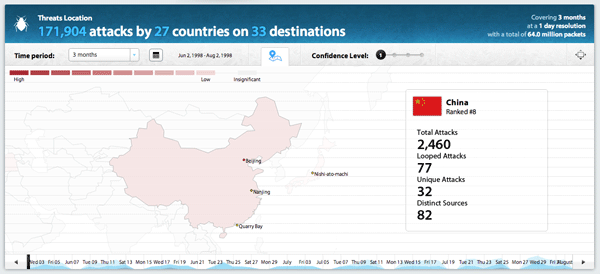
Intrusion detection is the analysis of network traffic to detect intruders on your network. Most intrusion detection systems (IDS) look for signatures of known attacks and identify them in real-time. Packetpig is different. Packetpig analyzes full packet captures – that is, logs of every single packet sent across your network – after the fact. In contrast to existing IDS systems, this means that using Hadoop on full packet captures, Packetpig can detect ‘zero day’ or unknown exploits on historical data as new exploits are discovered. Which is to say that Packetpig can determine whether intruders are already in your network, for how long, and what they’ve stolen or abused.
Packetpig is a Network Security Monitoring (NSM) Toolset where the ‘Big Data’ is full packet captures. Like a Tivo for your network, through its integration with Snort, p0f and custom java loaders, Packetpig does deep packet inspection, file extraction, feature extraction, operating system detection, and other deep network analysis. Packetpig’s analysis of full packet captures focuses on providing as much context as possible to the analyst. Context they have never had before. This is a ‘Big Data’ opportunity.
Full Packet Capture: A Big Data Opportunity
What makes full packet capture possible is cheap storage – the driving factor behind ‘big data.’ A standard 100Mbps internet connection can be cheaply logged for months with a 3TB disk. Apache Hadoop is optimized around cheap storage and data locality: putting spindles next to processor cores. And so what better way to analyze full packet captures than with Apache Pig – a dataflow scripting interface on top of Hadoop.
In the enterprise today, there is no single location or system to provide a comprehensive view of a network in terms of threats, sessions, protocols and files. This information is generally distributed across domain-specific systems such as IDS Correlation Engines and data stores, Netflow repositories, Bandwidth optimisation systems or Data Loss Prevention tools. Security Information and Event Monitoring systems offer to consolidate this information but they operate on logs – a digest or snippet of the original information. They don’t provide full fidelity information that can be queried using the exact copy of the original incident.
Packet captures are a standard binary format for storing network data. They are cheap to perform and the data can be stored in the cloud or on low-cost disk in the Enterprise network. The length of retention can be based on the amount of data flowing through the network each day and the window of time you want to be able to peer into the past.
Pig, Packetpig and Open Source Tools
In developing Packetpig, Packetloop wanted to provide free tools for the analysis network packet captures that spanned weeks, months or even years. The simple questions of capture and storage of network data had been solved but no one had addressed the fundamental problem of analysis. Packetpig utilizes the Hadoop stack for analysis, which solves this problem.
For us, wrapping Snort and p0f was a bit of a homage to how much security professionals value and rely on open source tools. We felt that if we didn’t offer an open source way of analysing full packet captures we had missed a real opportunity to pioneer in this area. We wanted it to be simple, turn key and easy for people to take our work and expand on it. This is why Apache Pig was selected for the project.
Understanding your Network
One of the first data sets we were given to analyse was a 3TB data set from a customer. It was every packet in and out of their 100Mbps internet connection for 6 weeks. It contained approximately 500,000 attacks. Making sense of this volume of information is incredibly difficult with current tooling. Even Network Security Monitoring (NSM) tools have difficult with this size of data. However it’s not just size and scale. No existing toolset allowed you to provide the same level of context. Packetpig allows you to join together information related to threats, sessions, protocols (deep packet inspection) and files as well as Geolocation and Operating system detection information.
We are currently logging all packets for a website for six months. This data set is currently around 0.6TB and because all the packet captures are stored in S3 we can quickly scan through the dataset. More importantly, we can run a job every nightly or every 15 minutes to correlate attack information with other data from Packetpig to provide an ultimate amount of context related to security events.
Items of interest include:
- Detecting anomalies and intrusion signatures
- Learn timeframe and identity of attacker
- Triage incidents
- “Show me packet captures I’ve never seen before.”
“Never before seen” is a powerful filter and isn’t limited to attack information. First introduced by Marcus Ranum,“never before seen” can be used to rule out normal network behaviour and only show sources, attacks, and traffic flows that are truly anomalous. For example, think in terms of the outbound communications from a Web Server. What attacks, clients and outbound communications are new or have never been seen before? In an instant you get an understanding that you don’t need to look for the normal, you are straight away looking for the abnormal or signs of misuse.
Agile Data
Packetloop uses the stack and iterative prototyping techniques outlined in the forthcoming book by Hortonworks’ ownRussell Jurney, Agile Data (O’Reilly, March 2013). We use Hadoop, Pig, Mongo and Cassandra to explore datasets and help us encode important information into d3 visualisations. Currently we use all of these tools to aid in our research before we add functionality to Packetloop. These prototypes become the palette our product is built from.
Big Data Security Part One: Introducing PacketPig的更多相关文章
- Cross-Domain Security For Data Vault
Cross-domain security for data vault is described. At least one database is accessible from a plural ...
- Automotive Security的一些资料和心得(5):Privacy
1. Introduction 1.1 "Customers own their data and we can be no more than the trsted stewards of ...
- Magic Quadrant for Security Information and Event Management
https://www.gartner.com/doc/reprints?id=1-4LC8PAW&ct=171130&st=sb Summary Security and risk ...
- Enabling granular discretionary access control for data stored in a cloud computing environment
Enabling discretionary data access control in a cloud computing environment can begin with the obtai ...
- Data Management Technology(1) -- Introduction
1.Database concepts (1)Data & Information Information Is any kind of event that affects the stat ...
- Use SQL to Query Data from CDS and Dynamics 365 CE
from : https://powerobjects.com/2020/05/20/use-sql-to-query-data-from-cds-and-dynamics-365-ce/ Have ...
- Awesome Hadoop
A curated list of amazingly awesome Hadoop and Hadoop ecosystem resources. Inspired by Awesome PHP, ...
- {ICIP2014}{收录论文列表}
This article come from HEREARS-L1: Learning Tuesday 10:30–12:30; Oral Session; Room: Leonard de Vinc ...
- CNCF CloudNative Landscape
cncf landscape CNCF Cloud Native Interactive Landscape 1. App Definition and Development 1. Database ...
随机推荐
- java下载csv文件,中文标题
@RequestMapping(value = "/export.do") public void exportpushuserByareacode(HttpServletRequ ...
- java排序算法-交换排序
public class ExchangeSortUtils { // 冒泡 public static void bubbleSort(int[] array) { int length = arr ...
- jQuery.holdReady()方法用法实例
调用此方法可以延迟jQuery的ready事件,也就是说尽管文档已经加载完成,也不会执行ready事件处理方法.可以多次调用jQuery.holdReady()方法,以延迟jQuery的ready事件 ...
- Sublime代码折叠
一.显示折叠小三角 1.点击Sublime的Preferences->Setting-Default菜单,打开它的配置文件. 2.找到行 // Fold buttons are the tria ...
- EMV/PBOC 解析(一) 卡片文件结构
刚到公司老大便发我一份文档<智能卡ISO7816-4规范(中文版)>,然后就让我研究下IC智能卡数据读取和支付.身为一直做.NET开发的我对硬件啥的一无所知,各种无头绪啊,研究了两天后,稍 ...
- 【ICIP2013】MULTI-SOURCE IMAGE AUTO-ANNOTATION
题目:多来源图像自动标注 文中利用了不同来源的图像组内和组间的关系来增强自动标注的效果. 一方面认为,相似的图像预测的也应该是相似的,利用kNN图的关系进行组内的正则化,以此增强底层特征的联系. 另一 ...
- ViewPager 详解(五)-----使用Fragment实现ViewPager滑动
前言:前几篇文章讲解了ViewPager的普通实现方法,但Android官方最推荐的一种实现方法却是使用fragment,下面我们使用fragment来重新实现一下第一篇<ViewPager 详 ...
- 支持向量机通俗导论(理解SVM的三层境地)
支持向量机通俗导论(理解SVM的三层境地) 作者:July :致谢:pluskid.白石.JerryLead.出处:结构之法算法之道blog. 前言 动笔写这个支持向量机(support vector ...
- 源代码解读Cas实现单点登出(single sign out)功能实现原理--转
关于Cas实现单点登入(single sing on)功能的文章在网上介绍的比较多,想必大家多多少少都已经有所了解,在此就不再做具体介绍.如果不清楚的,那只能等我把single sign on这块整理 ...
- Win10系统修改MAC地址
本地管理地址,输入想修改的MAC地址后,点确定即完成修改.在CMD窗口中,使用ipconfig 命令可以查看新的MAC地址. 再次钩选不存在,则还原为原来的MAC地址.