
Codeforces 758C-Unfair Poll
1 second
256 megabytes
standard input
standard output
On the Literature lesson Sergei noticed an awful injustice, it seems that some students are asked more often than others.
Seating in the class looks like a rectangle, where n rows with m pupils in each.
The teacher asks pupils in the following order: at first, she asks all pupils from the first row in the order of their seating, then she continues to ask pupils from the next row. If the teacher asked the last row, then the direction of the poll changes, it means that she asks the previous row. The order of asking the rows looks as follows: the 1-st row, the 2-nd row, ..., the n - 1-st row, the n-th row, the n - 1-st row, ..., the 2-nd row, the 1-st row, the 2-nd row, ...
The order of asking of pupils on the same row is always the same: the 1-st pupil, the 2-nd pupil, ..., the m-th pupil.
During the lesson the teacher managed to ask exactly k questions from pupils in order described above. Sergei seats on the x-th row, on the y-th place in the row. Sergei decided to prove to the teacher that pupils are asked irregularly, help him count three values:
- the maximum number of questions a particular pupil is asked,
- the minimum number of questions a particular pupil is asked,
- how many times the teacher asked Sergei.
If there is only one row in the class, then the teacher always asks children from this row.
The first and the only line contains five integers n, m, k, x and y (1 ≤ n, m ≤ 100, 1 ≤ k ≤ 1018, 1 ≤ x ≤ n, 1 ≤ y ≤ m).
Print three integers:
- the maximum number of questions a particular pupil is asked,
- the minimum number of questions a particular pupil is asked,
- how many times the teacher asked Sergei.
Note
The order of asking pupils in the first test:
- the pupil from the first row who seats at the first table, it means it is Sergei;
- the pupil from the first row who seats at the second table;
- the pupil from the first row who seats at the third table;
- the pupil from the first row who seats at the first table, it means it is Sergei;
- the pupil from the first row who seats at the second table;
- the pupil from the first row who seats at the third table;
- the pupil from the first row who seats at the first table, it means it is Sergei;
- the pupil from the first row who seats at the second table;
The order of asking pupils in the second test:
- the pupil from the first row who seats at the first table;
- the pupil from the first row who seats at the second table;
- the pupil from the second row who seats at the first table;
- the pupil from the second row who seats at the second table;
- the pupil from the third row who seats at the first table;
- the pupil from the third row who seats at the second table;
- the pupil from the fourth row who seats at the first table;
- the pupil from the fourth row who seats at the second table, it means it is Sergei;
- the pupil from the third row who seats at the first table;
题意:n行m列的学生,老师从头开始点名第一排和最后一排每个周期只点一次。周期如图
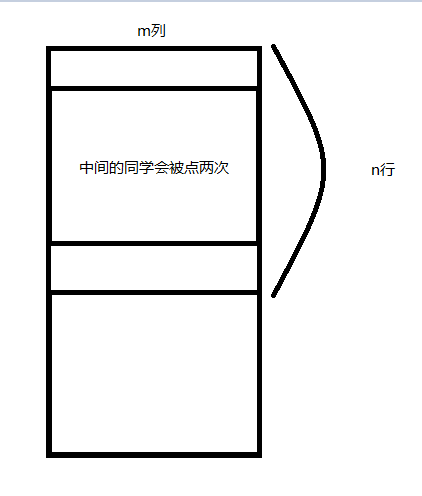
题解:n==1 和 n==2单独处理,其他情况先算出有多少个周期,再讨论剩下部分能给三个答案加多少,特别注意一个周期都没有的情况。
#include<iostream>

#include<cstring>

#include<cstdio>

#include<algorithm>

using namespace std;

long long n,m;

long long k;

long long x,y;

long long maxx,minn,ans;

long long T,t;

long long res = ;

long long time = ;

void solve()

{

    T=*m*n - *m;

    t=n*m;

    time = k/T;

    res = k%T;

    if(res == )

        maxx = time*;

    if(res <= m)

        maxx = max(time*,time+);

    else if(res <= t)

        maxx = time*+;

    else if(res < T)

        maxx = time*+;

    if(res < t )

        minn = time;

    else

        minn = time+;

    if(x ==  || x == n)

        ans+=time;

    else

        ans+=time*;

    long long cnt = ;

    for(long long i=;i<=n;i++){

        for(long long j=;j<=m;j++){

            cnt++;

            if(cnt > res)

                break;

            if(x == i && y == j)

                ans++;

        }

    }

    for(long long i=n-;i>=;i--){

        for(long long j=;j<=m;j++){

            cnt++;

            if(cnt > res)

                break;

            if(x == i && y == j)

                ans++;

        }

    }

}

int main()

{

    cin>>n>>m>>k>>x>>y;

    if( n== ){

        T=m;

        res = k%T;

        time = k/T;

        maxx = ((res==)?(time):(time+));

        minn = time;

        ans  = ((res>=y)?(time+):time);

    }

    else if(n == ){

        T=n*m;

        res = k%T;

        time = k/T;

        maxx = ((res==)?(time):(time+));

        minn = time;

        ans  = ((res>=(x-)*y+y)?(time+):time);

    }

    else{

        solve();

    }

    cout<<maxx<<" "<<minn<<" "<<ans<<endl;

    return ;

}
Codeforces 758C-Unfair Poll的更多相关文章
- CodeFroces 758C - Unfair Poll
题意: 老师点名,顺序是1 -- n -- 1 排为一个循环,每列为1 -- m的顺序, 问点到最多次数和最少次数的人的次数以及(x,y)被点的次数. 分析: 由于点名有循环,故可先判断出每一个循环每 ...
- 【找规律】Codeforces Round #392 (Div. 2) C. Unfair Poll
C. Unfair Poll time limit per test 1 second memory limit per test 256 megabytes input standard input ...
- Codeforces Round #392 (Div. 2) Unfair Poll
C. Unfair Poll time limit per test 1 second memory limit per test 256 megabytes input standard input ...
- CodeForces 758 C Unfair Poll
Unfair Poll 题意:一共有n排同学每排同学有m个人, 老师问问题有一个顺序, 先从第一排开始问,问完第一排的所有同学之后,再问第2排的,对于所有排的访问顺序为 1,2,3……n-1,n,n- ...
- C. Unfair Poll
http://codeforces.com/problemset/problem/758/C C. Unfair Poll time limit per test 1 second memory li ...
- Codeforces758C Unfair Poll 2017-01-20 10:24 95人阅读 评论(0) 收藏
C. Unfair Poll time limit per test 1 second memory limit per test 256 megabytes input standard input ...
- 【codeforces 758C】Unfair Poll
time limit per test1 second memory limit per test256 megabytes inputstandard input outputstandard ou ...
- Codeforces 758C:Unfair Poll(思维+模拟)
http://codeforces.com/problemset/problem/758/C 题意:教室里有n列m排,老师上课点名从第一列第一排开始往后点,直到点到第一列第m排,就从第二列第一排开始点 ...
- Codeforces 392 C Unfair Poll(模拟)
题意:老师点名顺序规则如下:第1排,第2排,……,第n-1排,第n排,第n-1排,……,第2排,第1排,第2排,……,第n-1排,第n排,……对于每排都是从左到右依次点名,问点名k个人后,所有人中最多 ...
- CF758C Unfair Poll
题意: On the Literature lesson Sergei noticed an awful injustice, it seems that some students are aske ...
随机推荐
- 通过action传过来的值在option获取进行验证
通过action传过来的值在option获取进行验证的方法: for(var i=0;i<document.getElementById("ufacilityType").o ...
- Spark机器学习(2):逻辑回归算法
逻辑回归本质上也是一种线性回归,和普通线性回归不同的是,普通线性回归特征到结果输出的是连续值,而逻辑回归增加了一个函数g(z),能够把连续值映射到0或者1. MLLib的逻辑回归类有两个:Logist ...
- http头文件User-Agent详解【转载】
原文地址:http://blog.csdn.net/andybbc/article/details/50587359 http头文件User-Agent详解 什么是User-Agent User-Ag ...
- RabbitMQ ——“Hello World”
介绍 RabbitMQ是一个消息实体服务(broker):它接收及转发消息.你可以把它想象成一个邮局:当你把你想要寄送的邮件放进邮箱里时,你能够确信邮局的派送员最终会把你的这封邮局送到这信的收件者手中 ...
- Redis之AOF重写及其实现原理
Reference: https://blog.csdn.net/hezhiqiang1314/article/details/69396887 AOF 重写AOF 持久化是通过保存被执行的写命令来记 ...
- Ramda函数式编程之PHP
0x00 何为函数式编程 网上已经有好多详细的接受了,我认为比较重要的有: 函数是"第一等公民",即函数和其它数据类型一样处于平等地位 使用"表达式"(指一个单 ...
- mercurial的几个易用性小技巧
其实这两年,能够采用mercurial的项目我都尽量用,甚至有些上游是git的,或者需要托管到公司内gitlab上与别人协作的,我都装上hg-git.无它,只是因为mercurial易用性比git好得 ...
- 【iCore1S 双核心板_ARM】例程五:IWDG看门狗实验——复位ARM
实验原理: STM32内部包含独立看门狗,通过看门狗可以监控程序运行,程序错误 时,未在规定时间喂狗,自动复位ARM.本实验通过按键按下,停止喂狗, 制造程序运行 错误,从而产生复位 . 实验现象: ...
- android ROM刷机updater-script单刷补丁包脚本
ui_print(""); ui_print("-------------------------"); ui_print(" Let's Go &q ...
- Vue.js常用指令:v-show和v-if
一.v-show指令 v-show指令可以用来动态的控制DOM元素的显示或隐藏.v-show后面跟的是判断条件,语法如下: v-show="判断变量" 例如: v-show=&qu ...