
中国剩余定理+扩展中国剩余定理 讲解+例题(HDU1370 Biorhythms + POJ2891 Strange Way to Express Integers)
0.引子
每一个讲中国剩余定理的人,都会从孙子的一道例题讲起
有物不知其数,三三数之剩二,五五数之剩三,七七数之剩二。问物几何?
1.中国剩余定理
引子里的例题实际上是求一个最小的x满足
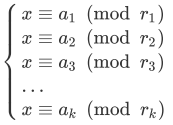
关键是,其中r1,r2,……,rk互质
这种问题都有多解,每一个解都为最小的解加上若干个lcm(r1,r2,...,rk),这个不用我证了吧(-_-||)
解决这个问题的方法是构造法,
先构造k个数
满足,
这样就保证 ,但是由于 bi 乘了除 ri 以外所有 r,所以bi模其它的 r 都为 0,
再把所有 bi 加起来,得到的数就满足方程了。
例题
UVA756 Biorhythms
HDU1370 Biorhythms
非常裸的一道剩余定理的题,但是某些OJ题面出了问题,以至于让同学们白白wa了很多遍
首先是luogu的翻译,并不是“保证 x 不超过 21252”,而是“保证 x-d 不超过 21252”
然后是(屑)HDU的数据,一开始得输入一个数后才能开始输入,看样例应该就知道了
题目把r1~r3都给出来了,相当于可以直接手算得出
直接代入算b
最后判断x是否<=d,是就+=21252
CODE
#include<cstdio>

#include<cstring>

#include<iostream>

#include<cmath>

#include<queue>

#include<stack>

#include<map>

#include<vector>

#include<algorithm>

#define ENDL putchar('\n')

#define LL long long

#define DB double

#define lowbit(x) ((-x)&(x))

//#define int LL

using namespace std;

inline LL read() {

	LL f = 1,x = 0;char s = getchar();

	while(s < '0' || s > '9') {if(s == '-')f = -1;s = getchar();}

	while(s >= '0' && s <= '9') {x = x * 10 + (s - '0');s = getchar();}

	return x * f;

}

int main() {

//	read();  //HDU的把这句加上

	int p,e,i,d,lc = 21252,ad1 = 5544,ad2 = 14421,ad3 = 1288;

	int Case = 0;

	while(scanf("%d%d%d%d",&p,&e,&i,&d) == 4) {

		if(p == -1 || e == -1 || i == -1 || d == -1) break;

		int x = (p *1ll* ad1 + e *1ll* ad2 + i *1ll* ad3) % lc;

		if(x <= d) x += lc;

		printf("Case %d: the next triple peak occurs in %d days.\n",++ Case,x - d);

	}

	return 0;

}
2.扩展中国剩余定理
这个就比普通中国剩余定理好用多了
还是求这个方程
但是不保证互质了
既然不保证互质,他们就有最大公约数
我们依次合并两个方程
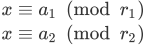
把它变一下,设k、p,满足
即
移个项:
于是它就变成了“ax+by=c”的形式,可以用扩展欧几里得求出特解k(若无解就整个方程无解了)
它的任意解都满足
由于x等于通解中的一个,
所以
成功合并成一个方程!
最后剩下一个方程时,最小的解就为式子右边的值
例题
POJ2891 Strange Way to Express Integers
这题是扩展中国剩余定理的板题,不用我讲了吧(众所周知,板题≠水题)
CODE
#include<cstdio>

#include<cstring>

#include<iostream>

#include<cmath>

#include<queue>

#include<stack>

#include<map>

#include<vector>

#include<algorithm>

#define MAXN 2000005

#define MAXM 3000005

#define ENDL putchar('\n')

#define LL long long

#define DB double

#define lowbit(x) ((-x)&(x))

#define int LL

using namespace std;

inline LL read() {

	LL f = 1,x = 0;char s = getchar();

	while(s < '0' || s > '9') {if(s == '-')f = -1;s = getchar();}

	while(s >= '0' && s <= '9') {x = x * 10 + (s - '0');s = getchar();}

	return x * f;

}

const int jzm = 1000000007;

int n,m,i,j,s,o,k;

LL exgcd(LL a,LL b,LL &x,LL &y) {

	if(b == 0) {

		x = 1;y = 0;

		return a;

	}

	LL r = exgcd(b,a%b,y,x);

	y -= x*(a/b);

	return r;

}

signed main() {

	while(scanf("%lld",&n) == 1) {

		LL r1 = read(),a1 = read();

		bool flag = 1;

		for(int i = 2;i <= n;i ++) {

			LL r2 = read(),a2 = read(),k,p;

			if(a2 > a1) swap(a1,a2),swap(r1,r2);

			if(!flag) continue;

			LL gc = exgcd(r1,r2,k,p),lc = r1 / gc * r2;

			if((a1-a2) % gc) {

				flag = 0;continue;

			}

			LL tym = r2/gc;

			((k = (k * (a1-a2) / gc) % tym) += tym) %= tym;

			a1 = (a1 + lc - k * r1 % lc) % lc;

			r1 = lc;

		}

		if(!flag) printf("-1\n");

		else printf("%lld\n",a1 == 0 ? r1:a1);

	}

	return 0;

}
中国剩余定理+扩展中国剩余定理 讲解+例题(HDU1370 Biorhythms + POJ2891 Strange Way to Express Integers)的更多相关文章
- P4777 【模板】扩展中国剩余定理(EXCRT)/ poj2891 Strange Way to Express Integers
P4777 [模板]扩展中国剩余定理(EXCRT) excrt模板 我们知道,crt无法处理模数不两两互质的情况 然鹅excrt可以 设当前解到第 i 个方程 设$M=\prod_{j=1}^{i-1 ...
- [poj2891]Strange Way to Express Integers(扩展中国剩余定理)
题意:求解一般模线性同余方程组 解题关键:扩展中国剩余定理求解.两两求解. $\left\{ {\begin{array}{*{20}{l}}{x = {r_1}\,\bmod \,{m_1}}\\{ ...
- POJ2891 Strange Way to Express Integers【扩展中国剩余定理】
题目大意 就是模板...没啥好说的 思路 因为模数不互质,所以直接中国剩余定理肯定是不对的 然后就考虑怎么合并两个同余方程 \(ans = a_1 + x_1 * m_1 = a_2 + x_2 * ...
- POJ2891 Strange Way to Express Integers [中国剩余定理]
不互质情况的模板题 注意多组数据不要一发现不合法就退出 #include <iostream> #include <cstdio> #include <cstring&g ...
- POJ-2891 Strange Way to Express Integers(拓展中国剩余定理)
放一个写的不错的博客:https://www.cnblogs.com/zwfymqz/p/8425731.html POJ好像不能用__int128. #include <iostream> ...
- POJ2891 Strange Way to Express Integers (扩展欧几里德)
本文为博主原创文章,欢迎转载,请注明出处 www.cnblogs.com/yangyaojia 题目大意 求解一组同余方程 x ≡ r1 (mod a1) x ≡ r2 (mod a2) x ≡ r ...
- POJ2891 Strange Way to Express Integers 扩展欧几里德 中国剩余定理
欢迎访问~原文出处——博客园-zhouzhendong 去博客园看该题解 题目传送门 - POJ2891 题意概括 给出k个同余方程组:x mod ai = ri.求x的最小正值.如果不存在这样的x, ...
- 数论F - Strange Way to Express Integers(不互素的的中国剩余定理)
F - Strange Way to Express Integers Time Limit:1000MS Memory Limit:131072KB 64bit IO Format: ...
- poj 2981 Strange Way to Express Integers (中国剩余定理不互质)
http://poj.org/problem?id=2891 Strange Way to Express Integers Time Limit: 1000MS Memory Limit: 13 ...
随机推荐
- 《SQL Server基础——SQL语句》
SQL Server基础--SQL语句 一.创建和删除数据库: 1.创建数据库(默认化初始值) 格式: CREATE DATABASE 数据库名称 例如: CREATE DATABASE ...
- 18.Tomcat部署及优化
Tomcat部署及优化 目录 Tomcat部署及优化 Tomcat简介 Tomcat核心组件 Web容器 什么是 servlet? 什么是 JSP? Container 结构分析 Tomcat 请求过 ...
- ACM-由数据范围反推算法复杂度以及算法内容
一般ACM或者笔试题的时间限制是1秒或2秒. 在这种情况下,C++代码中的操作次数控制在 \(10^7\) 为最佳. 下面给出在不同数据范围下,代码的时间复杂度和算法该如何选择: 数据范围 算法选择 ...
- ABAP CDS DDHEADANNO
- Spring Data JPA系列3:JPA项目中核心场景与进阶用法介绍
大家好,又见面了. 到这里呢,已经是本SpringData JPA系列文档的第三篇了,先来回顾下前面两篇: 在第1篇<Spring Data JPA系列1:JDBC.ORM.JPA.Spring ...
- ansible安装配置及基本用法
ansiblle具有如下特点: 1.部署简单,只需在主控端部署Ansible环境,被控端无需做任何操作: 2.默认使用SSH协议对设备进行管理: 3.主从集中化管理: 4.配置简单.功能强大.扩展性强 ...
- 【Python基础教程】三种常用、效率最高的Python字符串拼接方法
python字符串连接的方法,一般有以下三种: **方法1:**直接通过加号(+)操作符连接website=& 39;python& 39;+& 39;tab& 39; ...
- 论文解读(ValidUtil)《Rethinking the Setting of Semi-supervised Learning on Graphs》
论文信息 论文标题:Rethinking the Setting of Semi-supervised Learning on Graphs论文作者:Ziang Li, Ming Ding, Weik ...
- java的方法(类似与C语言函数)
package www.nihao; import java.util.Scanner; public class demo02 { public static void main(String[] ...
- umask计算创建文件、目录的默认权限
很多人以为 创建文件默认权限就是 666-umask=创建文件的默认权限 创建目录的默认权限就是 777-umask=创建目录的默认权限 这种计算其实是不严谨的 为什么我们创建的文件的权限是 64 ...