
创建实体数据模型【Create Entity Data Model】(EF基础系列5)
现在我要来为上面一节末尾给出的数据库(SchoolDB)创建实体数据模型;
SchoolDB数据库的脚本我已经写好了,如下:
USE master
GO
IF EXISTS(SELECT * FROM sys.sysdatabases WHERE name='SchoolDB')
DROP DATABASE SchoolDB;
GO
CREATE DATABASE SchoolDB
GO
USE SchoolDB;

GO
--创建Standard表
IF EXISTS (SELECT * FROM sysobjects WHERE name='Standard')
DROP TABLE [Standard];
GO
CREATE TABLE  [Standard]
(
StandardID INT PRIMARY KEY ,
StandardName NVARCHAR(),
[Description] NVARCHAR()
);

GO

--创建Student表
IF EXISTS (SELECT * FROM sysobjects WHERE name='Student')
DROP TABLE Student;
GO
CREATE TABLE  Student
(
StudentID INT PRIMARY KEY,
StudentName NVARCHAR() NOT NULL,
StandardID INT  REFERENCES [Standard](StandardID),
[RowVersion] NVARCHAR()

);

GO

--创建StudentAddress表
IF EXISTS (SELECT * FROM sysobjects WHERE name='StudentAddress')
DROP TABLE StudentAddress;
GO
CREATE TABLE  StudentAddress
(
StudentID INT PRIMARY KEY,
Address1 NVARCHAR() ,
Address2 NVARCHAR(),
City NVARCHAR(),
[State] NVARCHAR(),
CONSTRAINT StudentID_FK FOREIGN KEY(StudentID) REFERENCES dbo.Student(StudentID)
);

GO

--创建Teacher表
IF EXISTS (SELECT * FROM sysobjects WHERE name='Teacher')
DROP TABLE Teacher;
GO
CREATE TABLE  Teacher
(
TeacherID INT PRIMARY KEY ,
TeacherName NVARCHAR(),
StandardID INT  REFERENCES [Standard](StandardID),
TeacherType NVARCHAR ()

);
GO

--创建Course表
IF EXISTS (SELECT * FROM sysobjects WHERE name='Course')
DROP TABLE Course;
GO
CREATE TABLE  Course
(
CourseID INT PRIMARY KEY ,
CourseName NVARCHAR(),
Location NVARCHAR(),
TeacherID INT REFERENCES dbo.Teacher(TeacherID)

);

GO

--创建StudentCourse表
IF EXISTS (SELECT * FROM sysobjects WHERE name='StudentCourse')
DROP TABLE StudentCourse;
GO
CREATE TABLE  StudentCourse
(
StudentID INT  REFERENCES Student(StudentID),
CourseID INT  REFERENCES dbo.Course(CourseID),
CONSTRAINT StudentID_CourseID PRIMARY KEY(StudentID,CourseID),

);

GO
首先我们打开上面一节创建的项目,选中“项目名称”,右键选择”属性“,我们要确保使用的.NET framework版本是4.5;

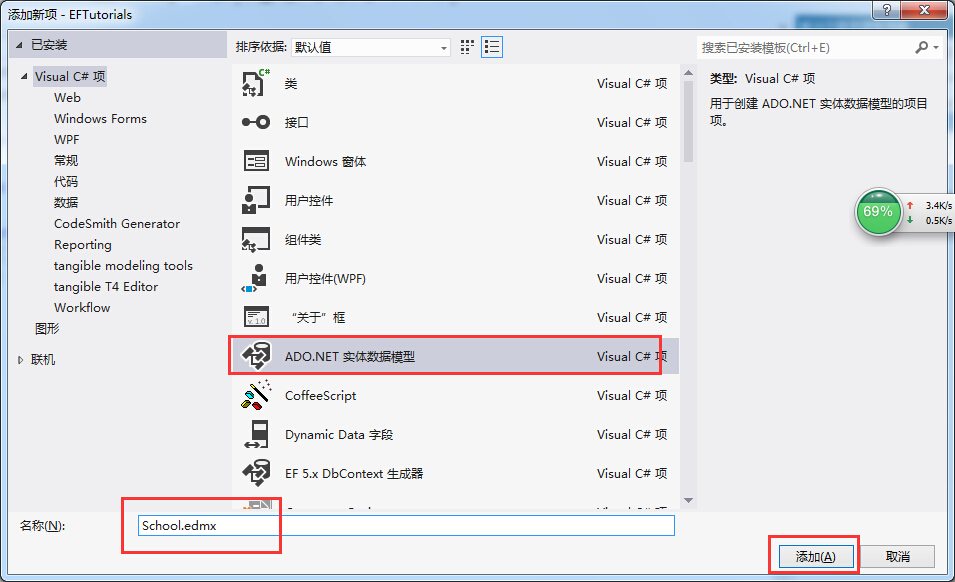
接下来,就是创建实体数据模型了:选中项目名称:



Note:
Pluralize or singularize generated object names checkbox singularizes an entityset name, if the table name in the database is plural. For example, if SchoolDB has Students table name then entityset would be singular Student. Similarly, relationships between the models will be pluralized if the table has one-to-many or many-to-many relationship with other tables. For example, Student has many-to-many relationship with Course table so Student entity set will have plural property name 'Courses' for the collection of courses.
The second checkbox, Include foreign key columns in the model, includes foreign key property explicitly to represent the foreign key. For example, Student table has one-to-many relationship with Standard table. So every student is associated with only one standard. To represent this in the model, Student entityset includes StandardId property with Standard navigation property. If this checkbox is unchecked then it will only include the Standard property, but not the StandardId in the Student entityset.
The third checkbox, Import selected stored procedures and functions into entity model, automatically creates Function Imports for the stored procedures and functions. You don't need to manually import this, as was necessary prior to Entity Framework 5.0.
7. After clicking on 'Finish', a School.edmx file will be added into your project.
Open EDM designer by double clicking on School.edmx. This displays all the entities for selected tables and the relationships between them as shown below:

现在我们以XML编译器的方式打开EDMX文件看看:

这篇没什么用,纯属扯淡的。可以略过。。。
创建实体数据模型【Create Entity Data Model】(EF基础系列5)的更多相关文章
- EntityFramework 学习 一 创建实体数据模型 Create Entity Data Model
1.用vs2012创建控制台程序 2.设置项目的.net 版本 3.创建Ado.net实体数据模型 3.打开实体数据模型向导Entity Framework有四种模型选择 来自数据库的EF设计器(Da ...
- Entity Framework Tutorial Basics(5):Create Entity Data Model
Create Entity Data Model: Here, we are going to create an Entity Data Model (EDM) for SchoolDB datab ...
- Create Entity Data Model
http://www.entityframeworktutorial.net/EntityFramework5/create-dbcontext-in-entity-framework5.aspx 官 ...
- EF中的实体类型【Types of Entity in Entity】(EF基础系列篇8)
We created EDM for existing database in the previous section. As you have learned in the previous se ...
- 3.翻译:EF基础系列--EF怎么工作的?
原文链接:http://www.entityframeworktutorial.net/basics/how-entity-framework-works.aspx 这里,你将会大概了解到EF是怎么工 ...
- 实体之间的关系【Entity Relationships】(EF基础系列篇9)
Here, you will learn how entity framework manages the relationships between entities. Entity framewo ...
- 1.翻译:EF基础系列--什么是Entity Framework?
大家好,好久不见,EF系列之前落下了,还是打算重新整理一下. 先说说目前的打算:先简单了解一下EF基础系列-->然后就是EF 6 Code-First系列-->接着就是EF 6 DB-Fi ...
- 数据上下文【 DnContext】【EF基础系列7】
DBContext: As you have seen in the previous Create Entity Data Model section, EDM generates the Scho ...
- Entity Framework 教程——创建实体数据模型
创建实体数据模型: 本文将带你创建实体数据模型(EDM)SchoolDB数据库和理解基础建设模块. 实体数据模型(EDM)是用于描述实体之间关系的一种模型,以下将使用Visual Studio 201 ...
随机推荐
- iOS开发系列--Objective-C之类和对象
概述 前面已经简单介绍过ObjC的基础知识,让大家对ObjC有个大致的印象,今天将重点解释ObjC面向对象的特性.ObjC相对于C语言多了面向对象特性,但是ObjC又没有其他面向对象语言那么多语法特性 ...
- 高灵活度,高适用性,高性能,轻量级的 ORM 实现
ORM(Object-Relational Mapping 对象关系映射),它的作用是在关系型数据库和业务实体对象之间作一个映射,目的是提供易于理解的模型化数据的方法. ORM虽然有诸多好处,但是在实 ...
- JWS.Mono如何进行“在线安装”
这里话就不多说了,使用方法如下: wget http://jhonge.net/down4load/1413998270361/jwsmono_net.sh chmod a+x jwsmono_net ...
- Module Zero概览
返回<Module Zero学习目录> 介绍 ABP框架的设计是独立于任何数据库模式的且尽可能地使用泛型.因此,它避开了一些要求数据存储的抽象和可选的概念(如审计日志,session管理和 ...
- css水平居中那点事
昨晚深夜写了css垂直居中那点事,今晚该写他的兄弟篇:css水平居中那点事了..…^^ 其实本来这两个可以连在一起写,可是为了不要搞混,为了让思路更清晰,最后决定还是分开来些比较好...这样以后也有利 ...
- PHP钩子机制
什么是钩子 大家想必听过插件,wordpress插件特别多,这个就是用钩子机制实现的. 当代码在运行的过程中,我们预先在运行的几个特殊点里执行一些特殊方法:例如在运行方法(例如Blog::add的ad ...
- 学习nodejs有感
接触nodejs一段时间了,不断的去接触接触,nodejs是一个能让前端程序员做后台开发的一项技术. 随着学习,让我更好的理解了前后端,以及浏览器是如何运作的
- Sql Server系列:数据控制语句
数据控制语句用来设置.更改用户或角色的权限,包括GRANT.DENY.REVOKE等语句. GRANT用来对用户授予权限,REVOKE可用于删除已授权的权限,DENY用于防止主体通过GRANT获得特定 ...
- WPF MVVM下做发送短信小按钮
最近做一个项目,因为涉及到注册,因此需要发送短信,一般发送短信都有一个倒计时的小按钮,因此,就做了一个,在此做个记录. 一.发送消息 没有调用公司的短信平台,只是模拟前台生成一串数字,将此串数字输出一 ...
- ASP.NET MVC5 网站开发实践(二) Member区域 - 用户部分(3)修改资料、修改密码
在上一篇博客中实现了用户的注销和登录,其实代码里落了点东西,就是用户登录要更新最后一次登录时间和登录IP,这次补上.今天做修改资料和修改密码,TryUpdateModel是新用到的东西. 目录: AS ...