
poj 2007 凸包构造和极角排序输出(模板题)
| Time Limit: 1000MS | Memory Limit: 30000K | |
| Total Submissions: 10841 | Accepted: 5085 |
Description
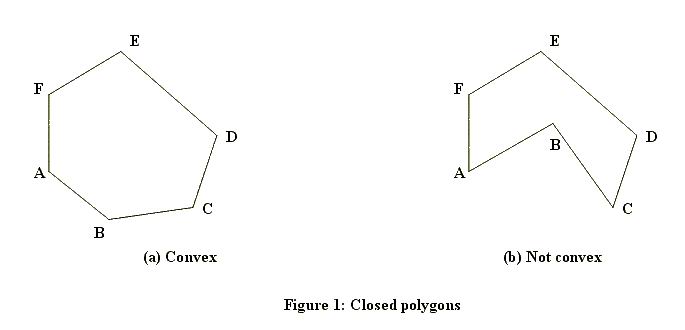
A closed polygon is called convex if the line segment joining any two points of the polygon lies in the polygon. Figure 1 shows a closed polygon which is convex and one which is not convex. (Informally, a closed polygon is convex if its border doesn't have any "dents".)
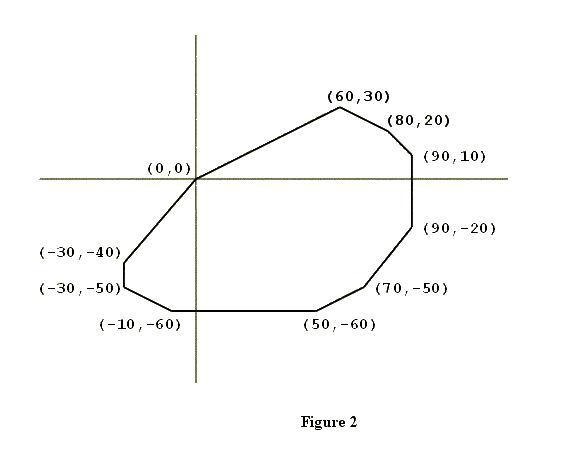
The subject of this problem is a closed convex polygon in the coordinate plane, one of whose vertices is the origin (x = 0, y = 0). Figure 2 shows an example. Such a polygon will have two properties significant for this problem.
The first property is that the vertices of the polygon will be confined to three or fewer of the four quadrants of the coordinate plane. In the example shown in Figure 2, none of the vertices are in the second quadrant (where x < 0, y > 0).
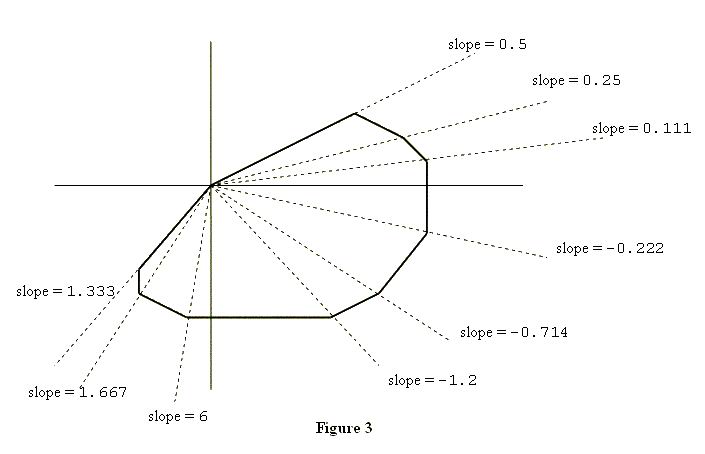
To describe the second property, suppose you "take a trip" around the polygon: start at (0, 0), visit all other vertices exactly once, and arrive at (0, 0). As you visit each vertex (other than (0, 0)), draw the diagonal that connects the current vertex with (0, 0), and calculate the slope of this diagonal. Then, within each quadrant, the slopes of these diagonals will form a decreasing or increasing sequence of numbers, i.e., they will be sorted. Figure 3 illustrates this point.
Input
Output
Sample Input
0 0

70 -50

60 30

-30 -50

80 20

50 -60

90 -20

-30 -40

-10 -60

90 10
Sample Output
(0,0)

(-30,-40)

(-30,-50)

(-10,-60)

(50,-60)

(70,-50)

(90,-20)

(90,10)

(80,20)

(60,30)
#include<iostream>

#include<cmath>

#include<algorithm>

#include<cstdio>

using namespace std;

const int MAXN =55;

const double PI= acos(-1.0);

//精度

double eps=1e-8;

//避免出现-0.00情况,可以在最后加eps

//精度比较

int sgn(double x)

{

    if(fabs(x)<=eps)return 0;

    if(x<0)return -1;

    return 1;

}

//点的封装

struct Point

{

    double x,y;

    Point (){}

    //赋值

    Point (double _x,double _y)

    {

        x=_x;

        y=_y;

    }

    //点相减

    Point operator -(const Point &b)const

    {

    return Point (x-b.x,y-b.y);

    }

    //点积

    double  operator *(const Point &b)const

    {

        return x*b.x+y*b.y;

    }

    //叉积

    double operator ^(const  Point  &b)const

    {

        return x*b.y-y*b.x;

    }

} ;

//线的封装

struct Line

{

    Point s,e;

    Line (){}

    Line (Point _s,Point _e)

    {

        s=_s;

        e=_e;

    }

//平行和重合判断 相交输出交点

//直线相交和重合判断,不是线段,

    Point operator &(const Line &b)const{

    Point res=b.s;

    if(sgn((e-s)^(b.e-b.s))==0)

    {

        if(sgn((e-s)^(e-b.e))==0)

        {

            //重合

            return Point(0,0);

        }

        else

            {

               //平行

                return Point(0,0);

            }

    }

    double t=((e-s)^(s-b.s))/((e-s)^(b.e-b.s));

    res.x+=(b.e.x-b.s.x)*t;

    res.y+=(b.e.y-b.s.y)*t;

    return res;

    }

};

//向量叉积

double xmult(Point p0,Point p1,Point p2)

{

    return (p0-p1)^(p2-p1);

}

//线段和线段非严格相交,相交时true

//此处是线段

bool seg_seg(Line l1,Line l2)

{

    return sgn(xmult(l1.s,l2.s,l2.e)*xmult(l1.e,l2.s,l2.e))<=0&&sgn(xmult(l2.s,l1.s,l1.e)*xmult(l2.e,l1.s,l1.e))<=0;

}

//两点之间的距离

double dist(Point a,Point b)

{

    return sqrt((a-b)*(a-b));

}

//极角排序;对100个点进行极角排序

int pos;//极点下标

Point p[MAXN];

int Stack[MAXN],top;

bool cmp(Point a,Point b)

{

    double tmp=sgn((a-p[pos])^(b-p[pos]));//按照逆时针方向进行排序

    if(tmp==0)return dist(a,p[pos])<dist(b,p[pos]);

    if(tmp<0)return false ;

    return true;

}

void Graham(int n)

{

    Point p0;

    int k=0;

    p0=p[0];

    for(int i=1;i<n;i++)//找到最左下边的点

    {

        if(p0.y>p[i].y||(sgn(p0.y-p[i].y))==0&&p0.x>p[i].x)

        {

            p0=p[i];

            k=i;

        }

    }

    swap(p[k],p[0]);

    sort(p+1,p+n,cmp);

    if(n==1)

    {

        top=2;

        Stack[0]=0;

        return ;

    }

    if(n==2)

    {

        top=2;

        Stack[0]=0;

        Stack[1]=1;

        return ;

    }

    Stack[0]=0;Stack[1]=1;

    top=2;

    for(int i=2;i<n;i++)

    {

        while(top>1&&sgn((p[Stack[top-1]]-p[Stack[top-2]])^(p[i]-p[Stack[top-2]]))<=0)

            top--;

        Stack[top++]=i;

    }

}

int main ()

{

    int t=0;

    while(~scanf("%lf%lf",&p[t].x,&p[t].y))

        t++;

    Graham(t);

    for(int i=0;i<t;i++)

    {

        if(p[i].x==0&&p[i].y==0)

        {

            swap(p[i],p[0]);

            break;

        }

    }

    sort(p,p+t,cmp);

    for(int i=0;i<t;i++)

    printf("(%.f,%.f)\n",p[i].x,p[i].y);

    return 0;

}
极角排序:
根据逆时针顺序进行排序
poj 2007 凸包构造和极角排序输出(模板题)的更多相关文章
- poj 2007 Scrambled Polygon(极角排序)
http://poj.org/problem?id=2007 Time Limit: 1000MS Memory Limit: 30000K Total Submissions: 6701 A ...
- poj 1696:Space Ant(计算几何,凸包变种,极角排序)
Space Ant Time Limit: 1000MS Memory Limit: 10000K Total Submissions: 2876 Accepted: 1839 Descrip ...
- poj 1696 Space Ant (极角排序)
链接:http://poj.org/problem?id=1696 Space Ant Time Limit: 1000MS Memory Limit: 10000K Total Submissi ...
- POJ 1696 Space Ant 【极角排序】
题意:平面上有n个点,一只蚂蚁从最左下角的点出发,只能往逆时针方向走,走过的路线不能交叉,问最多能经过多少个点. 思路:每次都尽量往最外边走,每选取一个点后对剩余的点进行极角排序.(n个点必定能走完, ...
- POJ 1696 Space Ant(极角排序)
Space Ant Time Limit: 1000MS Memory Limit: 10000K Total Submissions: 2489 Accepted: 1567 Descrip ...
- POJ 2280 Amphiphilic Carbon Molecules 极角排序 + 扫描线
从TLE的暴力枚举 到 13313MS的扫描线 再到 1297MS的简化后的扫描线,简直感觉要爽翻啦.然后满怀欣喜的去HDU交了一下,直接又回到了TLE.....泪流满面 虽说HDU的时限是2000 ...
- 【计算几何】【凸包】【极角排序】【二分】Gym - 101128J - Saint John Festival
平面上n个红点,m个黑点,问你多少个黑点至少在一个红三角形内. 对红点求凸包后,转化为询问有多少个黑点在凸包内. 点在凸多边形内部判定,选定一个凸包上的点作原点,对凸包三角剖分,将其他的点极角排序之后 ...
- poj 3683 2-sat建图+拓扑排序输出结果
发现建图的方法各有不同,前面一题连边和这一题连边建图的点就不同,感觉这题的建图方案更好. 题意:给出每个婚礼的2个主持时间,每个婚礼的可能能会冲突,输出方案. 思路:n个婚礼,2*n个点,每组点是对称 ...
- POJ 1981 最大点覆盖问题(极角排序)
Circle and Points Time Limit: 5000MS Memory Limit: 30000K Total Submissions: 8346 Accepted: 2974 ...
随机推荐
- 【Flutter】布局类组件之对齐和相对定位
前言 如果只想简单的调整一个子元素在父元素中的位置的话,使用Align组件会更简单一些. 接口描述 const Align({ Key key, // 需要一个AlignmentGeometry类型的 ...
- Vue基础语法与指令
项目初始化 用vscode打开终端,输入npm init -y生成package.json 然后安装vue npm install vue 需要注意的是,我遇到了这个问题 出现原因:文件夹名和生成的p ...
- XSS-labs通关挑战(xss challenge)
XSS-labs通关挑战(xss challenge) 0x00 xss-labs 最近在看xss,今天也就来做一下xss-labs通过挑战.找了好久的源码,终于被我给找到了,因为在GitHub上 ...
- python学习笔记 | PyCharm出现卡顿解决方法
问题:使用pycharm时常出现 the IDE is running low on memory 的问题 表示pycharm这款IDE使用内存不足 需要在系统内存充足的情况下扩充IDE memory ...
- ctfhub技能树—RCE—过滤cat
打开靶机 查看页面信息 构造payload 127.0.0.1 || ls 题目提示过滤了cat,但我还是想试试 果然不行 网页访问没有结果,应该和上题一样被注释了,使用和同样的方法进行解题 利用命令 ...
- 运行.bat执行sql文件 —— mysql
参考地址:https://www.cnblogs.com/dingjiaoyang/p/9990188.html 运行test.bat 执行 test.sql文件 test.bat: @ECHO OF ...
- 关于安装版JDK1.8 1.7更改多个JDK环境变量 不生效
配置maven(apache-maven-3.3.9)时提示异常:'mvn' 不是内部或外部命令,上网查找得知 它不支持jdk1.8,所以重新安装jdk1.7,后来就出现下面的问题 现象: 当使用安装 ...
- centos7 开放指定端口
centos7 开放指定端口 #开放8080端口 firewall-cmd --zone=public --add-port=8080/tcp --permanent #重载防火墙 firewall- ...
- django 中连接mysql数据库的操作步骤
django中连接mysql数据库的操作步骤: 1 settings配置文件中 DATABASES = { 'default': { 'ENGINE': 'django.db.backends.mys ...
- Angular入门到精通系列教程(14)- Angular 编译打包 & Docker发布
目录 1. 概要 2. 编译打包 2.1. 基本打包命令 2.2. 打包部署到二级目录 3. Angular站点的发布 3.1. web服务器发布 3.2. 使用docker发布 4. 总结 环境: ...