
201771010113 李婷华 《面向对象程序设计(Java)》第十七周总结
一.理论知识部分
Java 的线程调度采用优先级策略:优先级高的先执行,优先级低的后执行;多线程系统会自动为每个线程分配一个优先级,缺省时,继承其父类的优先级; 任务紧急的线程,其优先级较高; 同优先级的线程按“先进先出”的队列原则。
调用setPriority(int a)重置当前线程的优先级,a取值可以是前述的三个静态量。调用getPriority()获得当前线程优先级。
多线程并发运行不确定性问题解决方案:引入线程同步机制,使得另一线程要使用该方法,就只能等待。
在Java中解决多线程同步问题的方法有两种:J ava SE 5.0中引入ReentrantLock类。 在共享内存的类方法前加synchronized修饰符。
有关锁对象和条件对象的关键要点:锁用来保护代码片段,保证任何时刻只能有一个线程执行被保护的代码。锁管理试图进入被保护代码段的线程。锁可拥有一个或多个相关条件对象。每个条件对象管理那些已经进入被保护的代码 段但还不能运行的线程。
synchronized关键字作用: 某个类内方法用synchronized 修饰后,该方法被称为同步方法;只要某个线程正在访问同步方法,其他线程欲要访问同步方法就被阻塞,直至线程从同 步方法返回前唤醒被阻塞线程,其他线程方可能进入同步方法。
在同步方法中使用wait()、notify 和notifyAll()方法:一个线程在使用的同步方法中时,可能根据问题的需要,必须使用wait()方法使本线程等待,暂时让出CPU的使用权,并允许其它线程使用这个同步方法。线程如果用完同步方法,应当执行notifyAll()方 法通知所有由于使用这个同步方法而处于等待的线程结束等待。
二.实验部分
1、实验目的与要求
(1) 掌握线程同步的概念及实现技术;
(2) 线程综合编程练习
2、实验内容和步骤
实验1:测试程序并进行代码注释。
测试程序1:
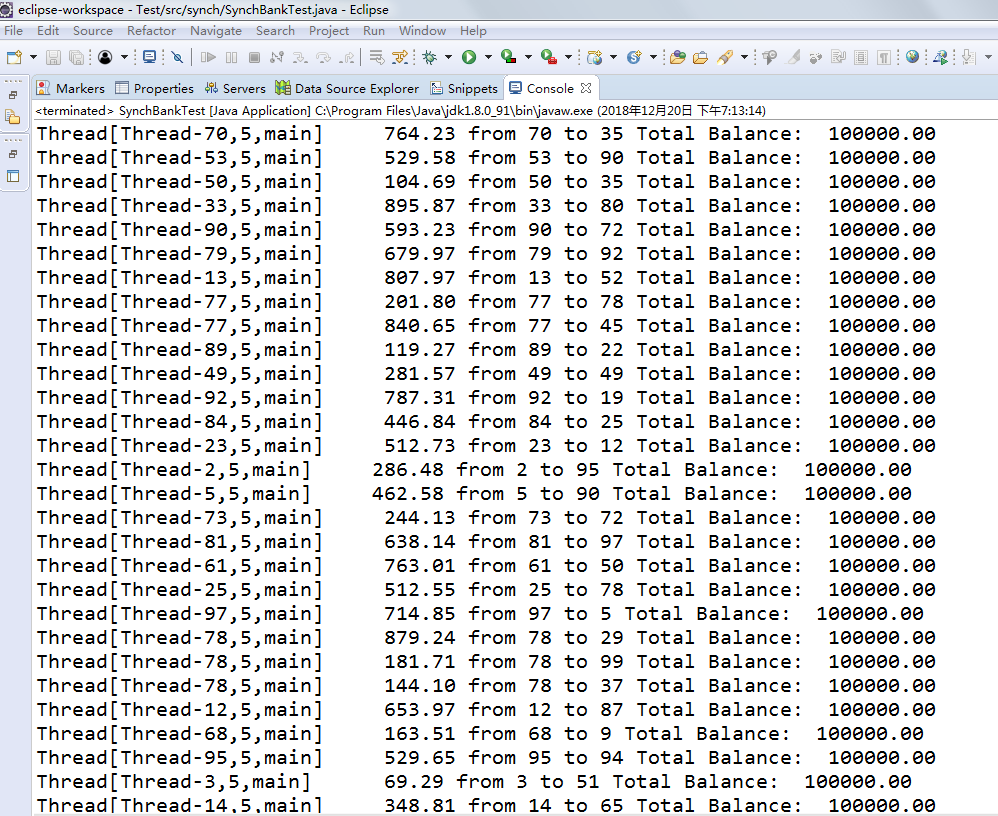
l 在Elipse环境下调试教材651页程序14-7,结合程序运行结果理解程序;
l 掌握利用锁对象和条件对象实现的多线程同步技术。
 package synch;

 /**

  * This program shows how multiple threads can safely access a data structure.

  * @version 1.31 2015-06-21

  * @author Cay Horstmann

  */

 public class SynchBankTest

 {

    public static final int NACCOUNTS = 100;

    public static final double INITIAL_BALANCE = 1000;

    public static final double MAX_AMOUNT = 1000;

    public static final int DELAY = 10;

    public static void main(String[] args)

    {

       Bank bank = new Bank(NACCOUNTS, INITIAL_BALANCE);

       for (int i = 0; i < NACCOUNTS; i++)

       {

          int fromAccount = i;

          Runnable r = () -> {

             try

             {

                while (true)

                {

                   int toAccount = (int) (bank.size() * Math.random());

                   double amount = MAX_AMOUNT * Math.random();

                   bank.transfer(fromAccount, toAccount, amount);

                   Thread.sleep((int) (DELAY * Math.random()));//随机生成时间,使正在执行的线程休眠

                }

             }

             catch (InterruptedException e)

             {

             }

          };

          Thread t = new Thread(r);

          t.start();//开始线程

       }

    }

 }
SynchBankTest
 package synch;

 import java.util.*;

 import java.util.concurrent.locks.*;

 /**

  * A bank with a number of bank accounts that uses locks for serializing access.

  * @version 1.30 2004-08-01

  * @author Cay Horstmann

  */

 public class Bank

 {

    private final double[] accounts;

    private Lock bankLock;

    private Condition sufficientFunds;

    /**

     * Constructs the bank.

     * @param n the number of accounts

     * @param initialBalance the initial balance for each account

     */

    public Bank(int n, double initialBalance)

    {

       accounts = new double[n];

       Arrays.fill(accounts, initialBalance);

       bankLock = new ReentrantLock();

       sufficientFunds = bankLock.newCondition();

    }

    /**

     * Transfers money from one account to another.

     * @param from the account to transfer from

     * @param to the account to transfer to

     * @param amount the amount to transfer

     */

    public void transfer(int from, int to, double amount) throws InterruptedException

    {

       bankLock.lock();//使用锁对象,获取锁

       try

       {

          while (accounts[from] < amount)

             sufficientFunds.await();

          System.out.print(Thread.currentThread());

          accounts[from] -= amount;

          System.out.printf(" %10.2f from %d to %d", amount, from, to);

          accounts[to] += amount;

          System.out.printf(" Total Balance: %10.2f%n", getTotalBalance());

          sufficientFunds.signalAll();//唤醒所有线程

       }

       finally

       {

          bankLock.unlock();//释放锁

       }

    }

    /**

     * Gets the sum of all account balances.

     * @return the total balance

     */

    public double getTotalBalance()

    {

       bankLock.lock();

       try

       {

          double sum = 0;

          for (double a : accounts)

             sum += a;

          return sum;

       }

       finally

       {

          bankLock.unlock();

       }

    }

    /**

     * Gets the number of accounts in the bank.

     * @return the number of accounts

     */

    public int size()

    {

       return accounts.length;

    }

 }
Bank
测试程序2:
l 在Elipse环境下调试教材655页程序14-8,结合程序运行结果理解程序;
l 掌握synchronized在多线程同步中的应用。
 package synch2;

 import java.util.*;

 /**

  * A bank with a number of bank accounts that uses synchronization primitives.

  * @version 1.30 2004-08-01

  * @author Cay Horstmann

  */

 public class Bank

 {

    private final double[] accounts;

    /**

     * Constructs the bank.

     * @param n the number of accounts

     * @param initialBalance the initial balance for each account

     */

    public Bank(int n, double initialBalance)

    {

       accounts = new double[n];

       Arrays.fill(accounts, initialBalance);

    }

    /**

     * Transfers money from one account to another.

     * @param from the account to transfer from

     * @param to the account to transfer to

     * @param amount the amount to transfer

     */

    //使用synchronized修饰符

    public synchronized void transfer(int from, int to, double amount) throws InterruptedException

    {

       while (accounts[from] < amount)

          wait();//来自Object类

       System.out.print(Thread.currentThread());

       accounts[from] -= amount;

       System.out.printf(" %10.2f from %d to %d", amount, from, to);

       accounts[to] += amount;

       System.out.printf(" Total Balance: %10.2f%n", getTotalBalance());

       notifyAll();//解除所有线程的阻塞状态

    }

    /**

     * Gets the sum of all account balances.

     * @return the total balance

     */

    public synchronized double getTotalBalance()

    {

       double sum = 0;

       for (double a : accounts)

          sum += a;

       return sum;

    }

    /**

     * Gets the number of accounts in the bank.

     * @return the number of accounts

     */

    public int size()

    {

       return accounts.length;

    }

 }
Bank
 package synch2;

 /**

  * This program shows how multiple threads can safely access a data structure,

  * using synchronized methods.

  * @version 1.31 2015-06-21

  * @author Cay Horstmann

  */

 public class SynchBankTest2

 {

    public static final int NACCOUNTS = 100;

    public static final double INITIAL_BALANCE = 1000;

    public static final double MAX_AMOUNT = 1000;

    public static final int DELAY = 10;

    public static void main(String[] args)

    {

       Bank bank = new Bank(NACCOUNTS, INITIAL_BALANCE);

       for (int i = 0; i < NACCOUNTS; i++)

       {

          int fromAccount = i;

          Runnable r = () -> {

             try

             {

                while (true)

                {

                   int toAccount = (int) (bank.size() * Math.random());

                   double amount = MAX_AMOUNT * Math.random();

                   bank.transfer(fromAccount, toAccount, amount);

                   Thread.sleep((int) (DELAY * Math.random()));

                }

             }

             catch (InterruptedException e)

             {

             }

          };

          Thread t = new Thread(r);

          t.start();

       }

    }

 }
SynchBankTest2

测试程序3:
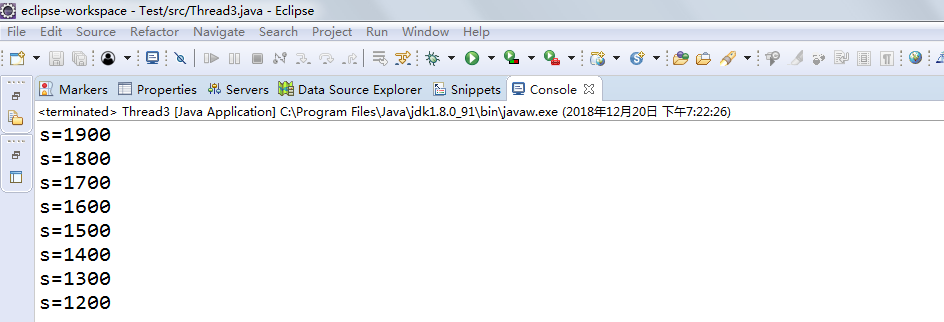
l 在Elipse环境下运行以下程序,结合程序运行结果分析程序存在问题;
l 尝试解决程序中存在问题。
|
class Cbank { private static int s=2000; public static void sub(int m) { int temp=s; temp=temp-m; try { Thread.sleep((int)(1000*Math.random())); } catch (InterruptedException e) { } s=temp; System.out.println("s="+s); } } class Customer extends Thread { public void run() { for( int i=1; i<=4; i++) Cbank.sub(100); } } public class Thread3 { public static void main(String args[]) { Customer customer1 = new Customer(); Customer customer2 = new Customer(); customer1.start(); customer2.start(); } } |
 class Cbank

 {

      private static int s=2000;

      public   static synchronized void sub(int m)

      {

            int temp=s;

            temp=temp-m;

           try {

                  Thread.sleep((int)(1000*Math.random()));

                }

            catch (InterruptedException e)  {              }

               s=temp;

               System.out.println("s="+s);

           }

     }

 class Customer extends Thread

 {

   public void run()

   {

    for( int i=1; i<=4; i++)

      Cbank.sub(100);

     }

  }

 public class Thread3

 {

  public static void main(String args[])

   {

    Customer customer1 = new Customer();

    Customer customer2 = new Customer();

    customer1.start();

    customer2.start();

   }

 }
Cbank
实验2 编程练习
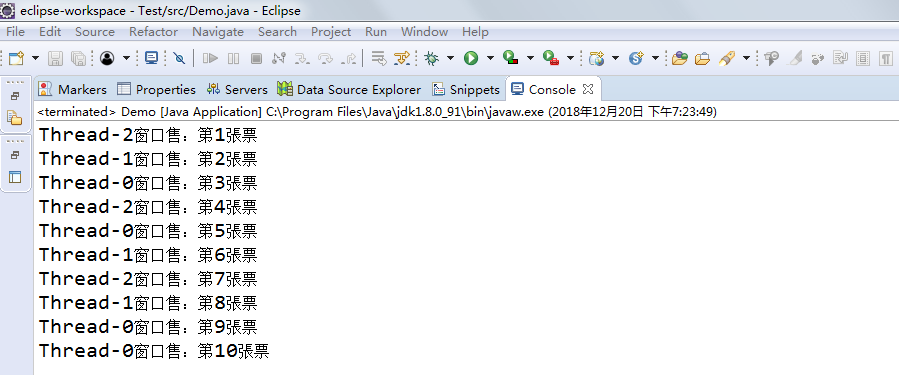
利用多线程及同步方法,编写一个程序模拟火车票售票系统,共3个窗口,卖10张票,程序输出结果类似(程序输出不唯一,可以是其他类似结果)。
Thread-0窗口售:第1张票
Thread-0窗口售:第2张票
Thread-1窗口售:第3张票
Thread-2窗口售:第4张票
Thread-2窗口售:第5张票
Thread-1窗口售:第6张票
Thread-0窗口售:第7张票
Thread-2窗口售:第8张票
Thread-1窗口售:第9张票
Thread-0窗口售:第10张票
 public class Demo {

     public static void main(String[] args) {

         Myrhread myrhread = new Myrhread();

         Thread t1 = new Thread(myrhread);

         Thread t2 = new Thread(myrhread);

         Thread t3 = new Thread(myrhread);

         t1.start();

         t2.start();

         t3.start();

     }

 }

 class Myrhread implements Runnable {

     int t = 1;

     boolean flag = true;

     public void run() {

         while (flag) {

             try {

                 Thread.sleep(500);

             } catch (InterruptedException e) {

                 e.printStackTrace();

             }

             synchronized (this) {

                 if (t <= 10) {

                     System.out.println(Thread.currentThread().getName() + "窗口售:第" + t + "張票");

                     t++;

                 }

                 if (t > 10) {

                     flag = false;

                 }

             }

         }

     }

 }
Demo
3.实验总结:
本周的实验容量很少,实验也相对来说简单,完成的还算顺利。学长也教了我们常用的一些快捷键,本周的收获还是很大的。
201771010113 李婷华 《面向对象程序设计(Java)》第十七周总结的更多相关文章
- 201771010134杨其菊《面向对象程序设计java》第九周学习总结
第九周学习总结 第一部分:理论知识 异常.断言和调试.日志 1.捕获 ...
- 201771010113 李婷华 《面向java对象程序设计(Java)》第四章学习总结
一. 理论知识部分 第四章 对象与类 本章主要讲述面向对象程序设计.如何创建标准Java类库中的类对象.如何编写自己的类. 1.面向对象程序设计的几个主要概念: 抽象数据类型.类和对象.封装.类层次( ...
- 201871010132-张潇潇《面向对象程序设计(java)》第一周学习总结
面向对象程序设计(Java) 博文正文开头 项目 内容 这个作业属于哪个课程 https://www.cnblogs.com/nwnu-daizh/ 这个作业的要求在哪里 https://www.cn ...
- 扎西平措 201571030332《面向对象程序设计 Java 》第一周学习总结
<面向对象程序设计(java)>第一周学习总结 正文开头: 项目 内容 这个作业属于哪个课程 https://www.cnblogs.com/nwnu-daizh/ 这个作业的要求在哪里 ...
- 杨其菊201771010134《面向对象程序设计Java》第二周学习总结
第三章 Java基本程序设计结构 第一部分:(理论知识部分) 本章主要学习:基本内容:数据类型:变量:运算符:类型转换,字符串,输入输出,控制流程,大数值以及数组. 1.基本概念: 1)标识符:由字母 ...
- 201871010124 王生涛《面向对象程序设计JAVA》第一周学习总结
项目 内容 这个作业属于哪个课程 https://www.cnblogs.com/nwnu-daizh/ 这个作业的要求在哪里 https://edu.cnblogs.com/campus/xbsf/ ...
- 201871010115——马北《面向对象程序设计JAVA》第二周学习总结
项目 内容 这个作业属于哪个课程 https://www.cnblogs.com/nwnu-daizh/ 这个作业的要求在哪里 https://www.cnblogs.com/nwnu-daizh/p ...
- 201777010217-金云馨《面向对象程序设计(Java)》第二周学习总结
项目 内容 这个作业属于哪个课程 https://www.cnblogs.com/nwnu-daizh/ 这个作业的要求在哪里 https://www.cnblogs.com/nwnu-daizh/p ...
- 201871010132——张潇潇《面向对象程序设计JAVA》第二周学习总结
项目 内容 这个作业属于哪个课程 https://www.cnblogs.com/nwnu-daizh/ 这个作业的要求在哪里 https://www.cnblogs.com/nwnu-daizh/p ...
- 面向对象程序设计--Java语言第二周编程题:有秒计时的数字时钟
有秒计时的数字时钟 题目内容: 这一周的编程题是需要你在课程所给的时钟程序的基础上修改而成.但是我们并不直接给你时钟程序的代码,请根据视频自己输入时钟程序的Display和Clock类的代码,然后来做 ...
随机推荐
- JUC强大的辅助类讲解--->>>CountDownLatchDemo (减少计数)
原理: CountDownLatch主要有两个方法,当一个或多个线程调用await方法时,这些线程会阻塞.其它线程调用countDown方法会将计数器减1(调用countDown方法的线程不会阻塞), ...
- L17 AlexNet VGG NiN GoogLeNet
深度卷积神经网络(AlexNet) LeNet: 在大的真实数据集上的表现并不尽如⼈意. 1.神经网络计算复杂. 2.还没有⼤量深⼊研究参数初始化和⾮凸优化算法等诸多领域. 机器学习的特征提取:手工定 ...
- L9循环神经网络进阶 ModernRNN
GRU RNN存在的问题:梯度较容易出现衰减或爆炸(BPTT) ⻔控循环神经⽹络:捕捉时间序列中时间步距离较⼤的依赖关系 RNN: Ht=ϕ(XtWxh+Ht−1Whh+bh) H_{t} = ϕ(X ...
- Java前台传值至后台中文乱码
记一次常见问题 今天导入了一个网上下载的项目,运行后发现,前台传值 到Servlet,Servlet保存至数据库,数据库保存的中文数据出现乱码,检查了一下表中的编码是utf8没错. 输出测试了一下 原 ...
- LeetCode466. Count The Repetitions
题目链接 传送门 题意 定义一个特殊的串, 现在给出串S1和S2的参数, 问: S2最多可以多少个连接起来扔是S1的子序列, 求出这个最大值 解题思路 注意s1与S1的区别, 可以去看题目描述, 预处 ...
- 使用STM8S i2c对TPS65987寄存器进行读写
上图是TPS65987的i2c读写协议,和标准i2c协议有点出入,不过也不难理解,在读的时候i2c slave在发送数据过来之前会先发送1byte数据表示后面会有几个字节数据过来,在写的时候i2c h ...
- 还学的动吗? 盘点下Vue.js 3.0.0 那些让人激动的功能
转载请注明出处:葡萄城官网,葡萄城为开发者提供专业的开发工具.解决方案和服务,赋能开发者. 原文出处:https://blog.bitsrc.io/vuejs-3-0-0-beta-features- ...
- PG TO Oracle 增量同步-外部表
背景 最近在负责公司数据Oracle转PG:老平台数据库:Oracle11g:新平台数据库:PostgreSQL12.由于平台统计规则有变动:所以正在推广的游戏数据无法全部迁移过来:只能在老平台上运行 ...
- 数组的forEach和map和for方法的区别
一.定义 foreach(): 从头到尾遍历数组,为每个元素调用指定的函数. map(): 将调用的数组的每个元素传递给指定的函数,并返回一个数组,他包含该函数的返回值. 传递的函数是 forea ...
- DEDE中自定义表单HTML 怎么写
用DEDE嵌套网站时,有时我们需要添加自定义字段,而自定义字段的HTML样式如何设置呢? 功能地图(核心/频道模型/内容模型管理/)——普通文章的修改——字段管理——你的自定义字段的修改——最下面自定 ...