
题解报告:poj 1113 Wall(凸包)
Description
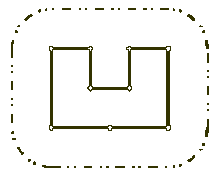 Your task is to help poor Architect to save his head, by writing a program that will find the minimum possible length of the wall that he could build around the castle to satisfy King's requirements.
 The task is somewhat simplified by the fact, that the King's castle has a polygonal shape and is situated on a flat ground. The Architect has already established a Cartesian coordinate system and has precisely measured the coordinates of all castle's vertices in feet.
Input
Next N lines describe coordinates of castle's vertices in a clockwise order. Each line contains two integer numbers Xi and Yi separated by a space (-10000 <= Xi, Yi <= 10000) that represent the coordinates of ith vertex. All vertices are different and the sides of the castle do not intersect anywhere except for vertices.
Output
Sample Input
9 100

200 400

300 400

300 300

400 300

400 400

500 400

500 200

350 200

200 200
Sample Output
1628
Hint
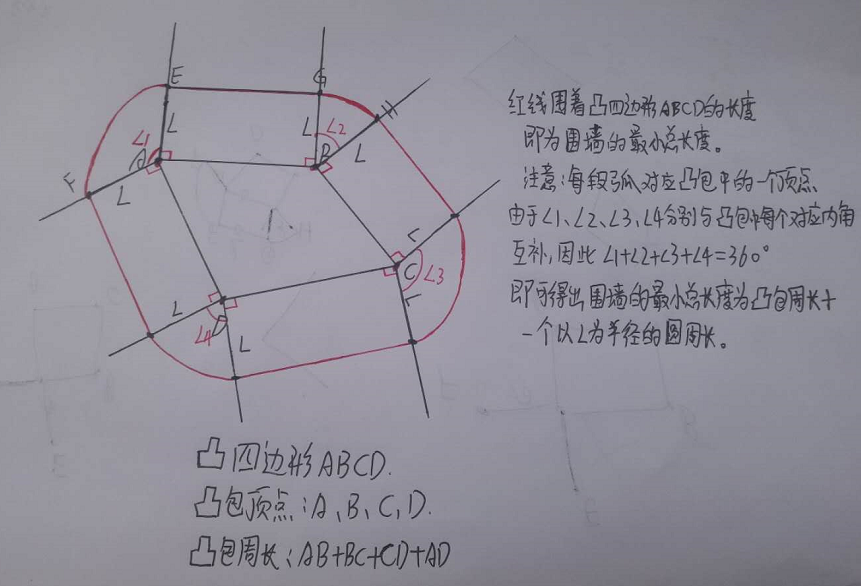
 #include<iostream>

 #include<string.h>

 #include<algorithm>

 #include<cstdio>

 #include<cmath>

 using namespace std;

 const int maxn=;

 const double PI=acos(-1.0);

 struct node{int x,y;};

 node vex[maxn];

 node stackk[maxn];

 bool cmp1(node a,node b){

     if(a.y==b.y)return a.x<b.x;

     else return a.y<b.y;

 }

 bool cmp2(node a,node b){

     double A=atan2(a.y-stackk[].y,a.x-stackk[].x);

     double B=atan2(b.y-stackk[].y,b.x-stackk[].x);

     if(A!=B)return A<B;

     else return a.x<b.x;

 }

 int cross(node p0,node p1,node p2){

     return (p1.x-p0.x)*(p2.y-p0.y)-(p2.x-p0.x)*(p1.y-p0.y);

 }

 double dis(node a,node b){

     return sqrt((a.x-b.x)*(a.x-b.x)*1.0+(a.y-b.y)*(a.y-b.y));

 }

 int main(){

     int n,l;

     while(~scanf("%d%d",&n,&l)){

         for(int i=;i<n;++i)//输入t个点

             scanf("%d%d",&vex[i].x,&vex[i].y);

         memset(stackk,,sizeof(stackk));

         sort(vex,vex+n,cmp1);

         stackk[]=vex[];

         sort(vex+,vex+n,cmp2);

         stackk[]=vex[];

         int top=;

         for(int i=;i<n;++i){

             while(top>&&cross(stackk[top-],stackk[top],vex[i])<=)top--;

             stackk[++top]=vex[i];

         }

         double s=;

         for(int i=;i<=top;++i)

             s+=dis(stackk[i-],stackk[i]);

         s+=dis(stackk[top],vex[]);

         s+=*PI*l;//加上圆的周长

         printf("%d\n",(int)(s+0.5));//四舍五入

     }

     return ;

 }
AC代码二(32ms):Andrew算法:时间复杂度为O(nlogn),但比Graham-scan算法还快!
 #include<iostream>

 #include<string.h>

 #include<algorithm>

 #include<cstdio>

 #include<cmath>

 using namespace std;

 const int maxn=;

 const double PI=acos(-1.0);

 struct node{int x,y;}vex[maxn],stackk[maxn];

 bool cmp(node a,node b){//坐标排序

     return ((a.y<b.y)||(a.y==b.y&&a.x<b.x));

 }

 int cross(node p0,node p1,node p2){

     return (p1.x-p0.x)*(p2.y-p0.y)-(p2.x-p0.x)*(p1.y-p0.y);

 }

 double dis(node a,node b){

     return sqrt((a.x-b.x)*(a.x-b.x)*1.0+(a.y-b.y)*(a.y-b.y));

 }

 int main(){

     int n,l;

     while(~scanf("%d%d",&n,&l)){

         for(int i=;i<n;++i)

             scanf("%d%d",&vex[i].x,&vex[i].y);

         memset(stackk,,sizeof(stackk));

         sort(vex,vex+n,cmp);

         int top=-;

         for(int i=;i<n;++i){//构造凸包下侧

             while(top>&&cross(stackk[top-],stackk[top],vex[i])<=)top--;

             stackk[++top]=vex[i];

         }

         for(int i=n-,k=top;i>=;--i){//构造凸包上侧

             while(top>k&&cross(stackk[top-],stackk[top],vex[i])<=)top--;

             stackk[++top]=vex[i];

         }

         double s=;

         for(int i=;i<=top;++i)//计算凸包周长

             s+=dis(stackk[i-],stackk[i]);

         s+=*PI*l;

         printf("%d\n",(int)(s+0.5));

     }

     return ;

 }
题解报告:poj 1113 Wall(凸包)的更多相关文章
- poj 1113 Wall 凸包的应用
题目链接:poj 1113 单调链凸包小结 题解:本题用到的依然是凸包来求,最短的周长,只是多加了一个圆的长度而已,套用模板,就能搞定: AC代码: #include<iostream> ...
- POJ 1113 Wall 凸包 裸
LINK 题意:给出一个简单几何,问与其边距离长为L的几何图形的周长. 思路:求一个几何图形的最小外接几何,就是求凸包,距离为L相当于再多增加上一个圆的周长(因为只有四个角).看了黑书使用graham ...
- POJ 1113 Wall 凸包求周长
Wall Time Limit: 1000MS Memory Limit: 10000K Total Submissions: 26286 Accepted: 8760 Description ...
- POJ 1113 - Wall 凸包
此题为凸包问题模板题,题目中所给点均为整点,考虑到数据范围问题求norm()时先转换成double了,把norm()那句改成<vector>压栈即可求得凸包. 初次提交被坑得很惨,在GDB ...
- poj 1113 wall(凸包裸题)(记住求线段距离的时候是点积,点积是cos)
Wall Time Limit: 1000MS Memory Limit: 10000K Total Submissions: 43274 Accepted: 14716 Descriptio ...
- POJ 1113 Wall(凸包)
[题目链接] http://poj.org/problem?id=1113 [题目大意] 给出一个城堡,要求求出距城堡距离大于L的地方建围墙将城堡围起来求所要围墙的长度 [题解] 画图易得答案为凸包的 ...
- POJ 1113 Wall【凸包周长】
题目: http://poj.org/problem?id=1113 http://acm.hust.edu.cn/vjudge/contest/view.action?cid=22013#probl ...
- poj 1113:Wall(计算几何,求凸包周长)
Wall Time Limit: 1000MS Memory Limit: 10000K Total Submissions: 28462 Accepted: 9498 Description ...
- POJ 1113 Wall 求凸包
http://poj.org/problem?id=1113 不多说...凸包网上解法很多,这个是用graham的极角排序,也就是算导上的那个解法 其实其他方法随便乱搞都行...我只是测一下模板... ...
随机推荐
- Flume-ng-sdk源码分析
Flume 实战(2)--Flume-ng-sdk源码分析 - mumuxinfei - 博客园 http://www.cnblogs.com/mumuxinfei/p/3823266.html
- [TJOI2017] 不勤劳的图书管理员
题目描述 加里敦大学有个帝国图书馆,小豆是图书馆阅览室的一个书籍管理员.他的任务是把书排成有序的,所以无序的书让他产生厌烦,两本乱序的书会让小豆产生这两本书页数的和的厌烦度.现在有n本被打乱顺序的书, ...
- JVM内存分配策略、各个代区、FullGC/MinorGC
主要讨论默认的Serial/Serial Old内存分配: 一.几种分配方案 1. 对象优先在Eden分配: 一般情况下,对象会在新生代的Eden区分配,Eden区没有足够空间时,虚拟机会 发起一次 ...
- 汉字与区位码互转(天天使用Delphi的String存储的是内码,Windows记事本存储的文件也是内码),几个常见汉字的各种编码,utf8与unicode的编码在线查询,附有读书笔记 good
汉=BABA(内码)=-A0A0=2626(区位码)字=D7D6(内码)=-A0A0=5554(区位码) 各种编码查询表:http://bm.kdd.cc/ 汉(记住它,以后碰到内存里的数值,就会有敏 ...
- hel软工网络16个人作业1
1Task1:注册个人博客账号 1Task2:注册码云账号 1Task3:提出问题 3.1问题一:软件工程是什么? 在第一章中我们可以从P8得到: 1.软件工程就是把系统的.有序的.可量化的方法应用到 ...
- [Selenium] Selenium私房菜(新手入门教程)
http://wenku.baidu.com/link?url=JrHF9o0mKWcpEsE-wijcZaneBWgpmAJPRwGyWXd7RvqzJCLLrsrsv5lf9bPRmgKUa_v- ...
- 【Codeforces 664A】 Complicated GCD
[题目链接] 点击打开链接 [算法] gcd(a,a+1) = 1 所以当a = b时,答案为a,否则为1 [代码] #include<bits/stdc++.h> using names ...
- 开启sqlplus中执行计划
在sqlplus中我们一般用Autotrace来查看执行计划,从而对于一些语句执行过程分析,开展优化工作.这里就演示一下如何将autotrace权限授予给普通的用户,以scott用户为例(set au ...
- 重新安装VMware10提示"The Msi '' Failed"问题解决方案
想把虚拟机软件升级以下,没想到卸载的时候不干净,再安装的时候总提示让我先卸载旧版本但实际上旧版本已经卸载过了,这里又没法再卸载一次,所以就提示”The MSI '' failed“ 显然,安装程序还是 ...
- emacs编辑c文件时,大括号的跳转(转载)
转自:http://forum.ubuntu.org.cn/viewtopic.php?f=68&t=26701 `C-M-n' Move forward over a parenthetic ...