
DataAnnotations - InverseProperty Attribute:
DataAnnotations - InverseProperty Attribute:
We have seen in the Code-First Convention section that Code-First creates {Class Name}_{Primary Key} foreign key column if you have not included foreign key property in a parent class. The InverseProperty attribute is used when you have multiple relationships between classes.
Consider the following example.
public class Student

{

    public Student()

    {

    }

    public int StudentID { get; set; }

    public string StudentName { get; set; }

    public Standard CurrentStandard { get; set; }

    public Standard PreviousStandard { get; set; }

}

public class Standard

{

    public Standard()

    {

    }

    public int StandardId { get; set; }

    public string StandardName { get; set; }

    public ICollection<Student> CurrentStudents { get; set; }

    public ICollection<Student> PreviousStudents { get; set; }

    }
As you can see in the above example, Student class includes two navigation properties to Standard class. The same way Standard class includes two collection navigation properties for Student. Code-First creates four columns for this relationship, as shown below.
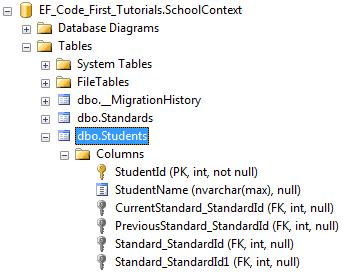
InverseProperty overrides this convention and specifies alignment of the properties. The following example uses InverseProperty in Standard class to fix this problem.
public class Student

{

    public Student()

    {

    }

    public int StudentID { get; set; }

    public string StudentName { get; set; }

    public Standard CurrentStandard { get; set; }

    public Standard PreviousStandard { get; set; }

}

public class Standard

{

    public Standard()

    {

    }

    public int StandardId { get; set; }

    public string StandardName { get; set; }

    [InverseProperty("CurrentStandard")]

    public ICollection<Student> CurrentStudents { get; set; }

    [InverseProperty("PreviousStandard")]

        public ICollection<Student> PreviousStudents { get; set; }

    }
As you can see in the above example, we have applied InverseProperty attribute to CurrentStudents & PreviousStudents property and specify which reference property of Student class it belongs to. Now, Code-First will create only two foreign key column in Student table as shown below.
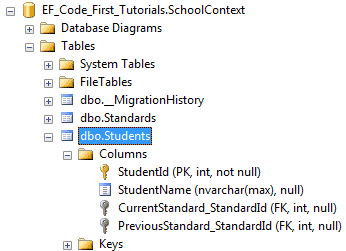
You can also use ForeignKey attribute to include foreign key property with different name as shown below.
public class Student

{

    public Student()

    {

    }

    public int StudentID { get; set; }

    public string StudentName { get; set; }

    public int CurrentStandardId { get; set; }

    public int PreviousStandardId { get; set; }

    [ForeignKey("CurrentStandardId")]

    public Standard CurrentStandard { get; set; }

    [ForeignKey("PreviousStandardId")]

    public Standard PreviousStandard { get; set; }

}

public class Standard

{

    public Standard()

    {

    }

    public int StandardId { get; set; }

    public string StandardName { get; set; }

    [InverseProperty("CurrentStandard")]

    public ICollection<Student> CurrentStudents { get; set; }

    [InverseProperty("PreviousStandard")]

    public ICollection<Student> PreviousStudents { get; set; }

}
The above example will create the following columns.
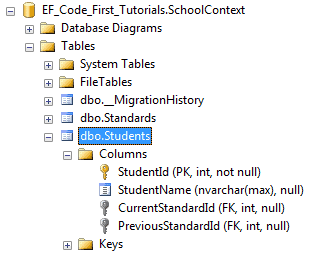
Thus, you can use InverseProperty and ForeignKey attribute for multiple relationships between the same classes.
DataAnnotations - InverseProperty Attribute:的更多相关文章
- Entity Framework Code-First(9.11):DataAnnotations - InverseProperty Attribute
DataAnnotations - InverseProperty Attribute: We have seen in the Code-First Convention section that ...
- Entity Framework Code-First(9.10):DataAnnotations - NotMapped Attribute
DataAnnotations - NotMapped Attribute: NotMapped attribute can be applied to properties of a class. ...
- Entity Framework Code-First(9.9):DataAnnotations - ForeignKey Attribute
DataAnnotations - ForeignKey Attribute: ForeignKey attribute can be applied to properties of a class ...
- Entity Framework Code-First(9.8):DataAnnotations - Column Attribute
DataAnnotations - Column Attribute: Column attribute can be applied to properties of a class. Defaul ...
- Entity Framework Code-First(9.7):DataAnnotations - Table Attribute
DataAnnotations - Table Attribute: Table attribute can be applied to a class. Default Code-First con ...
- Entity Framework Code-First(9.6):DataAnnotations - StringLength Attribute
DataAnnotations - StringLength Attribute: StringLength attribute can be applied to a string type pro ...
- Entity Framework Code-First(9.5):DataAnnotations - MaxLength Attribute
DataAnnotations - MaxLength Attribute: MaxLength attribute can be applied to a string or array type ...
- Entity Framework Code-First(9.2):DataAnnotations - TimeStamp Attribute
DataAnnotations - TimeStamp Attribute: TimeStamp attribute can be applied to only one byte array pro ...
- Entity Framework Code-First(9.1):DataAnnotations - Key Attribute
DataAnnotations - Key Attribute: Key attribute can be applied to properties of a class. Default Code ...
随机推荐
- java多线程系列12 ConcurrentHashMap CopyOnWriteArrayList 简介
我们知道 ,hashmap 和 arraylist 是线程不安全的 在多线程环境下有数据安全问题, 当然 我们可以通过Collections的一些方法把他们变成线程安全的, Collections.s ...
- Zookeeper系列2 原生API 以及核心特性watcher
原生API 增删改查询 public class ZkBaseTest { static final String CONNECT_ADDR = "192.168.0.120"; ...
- QT中报错collect2:ld returned 1 exit status的可能原因。
参考:https://blog.csdn.net/u014546553/article/details/78781547 1.编译成功的例子在后台执行,有时一闪而过,如果再次build ,则会提示上述 ...
- s1 Linux 硬件基础
s1 Linux硬件基础 服务器特点 1.稳定 2.方便拆卸-模块化 运维职责:运行和维护服务器 1.数据不能丢---大片不能没 2.保证网站7*24小时运行--一直要运行 3.用户体验要好----打 ...
- python bittorrent 使用与学习
更新于20171128 关于这个p2p的技术,阿里开源了蜻蜓,大家可以看看,感觉应该比这个要好用,而且文档也全. 前言 最近在学习python的p2p协议,发现网上找不到好的文章,又仔细找了找终于找到 ...
- 读书笔记之Linux系统编程与深入理解Linux内核
前言 本人再看深入理解Linux内核的时候发现比较难懂,看了Linux系统编程一说后,觉得Linux系统编程还是简单易懂些,并且两本书都是讲Linux比较底层的东西,只不过侧重点不同,本文就以Linu ...
- Beta冲刺 (6/7)
Part.1 开篇 队名:彳艮彳亍团队 组长博客:戳我进入 作业博客:班级博客本次作业的链接 Part.2 成员汇报 组员1:(组长)柯奇豪 过去两天完成了哪些任务 部分代码的整合 编辑及标注的提交操 ...
- 从MATLAB到FPGA 视频和图像处理——讲座学习小结(视频地址https://ww2.mathworks.cn/videos/from-matlab-to-fpga-video-and-image-processing-102492.html)
1.HDLcoder产品介绍 图像处理分为两个部分: 这里主要讨论第一部分图像处理部分. 一般产品设计流程如下: 适用人群有以下两类: 这里先用一张slider来进行整体概括: 基于模型的设计的好处— ...
- PHP基础架构
PHP基础架构 一.PHP简介 PHP是一种非常流行的高级脚本语言,尤其适合Web开发,快速.灵活和实用是PHP最重要的特点.PHP自1995年由Lerdorf创建以来,在全球得到了非常广泛的应用. ...
- Maven 常用的远程中央仓库地址
https://repo1.maven.org/maven2/ http://maven.jahia.org/maven2/ http://maven.aliyun.com/nexus/content ...