
论文解读(GGD)《Rethinking and Scaling Up Graph Contrastive Learning: An Extremely Efficient Approach with Group Discrimination》
论文信息
论文标题:Rethinking and Scaling Up Graph Contrastive Learning: An Extremely Efficient Approach with Group Discrimination
论文作者:Yizhen Zheng, Shirui Pan, Vincent Cs Lee, Yu Zheng, Philip S. Yu
论文来源:2022,NeurIPS
论文地址:download
论文代码:download
1 Introduction
GCL 需要大量的 Epoch 在数据集上训练,本文的启发来自 GCL 的代表性工作 DGI 和 MVGRL,因为 Sigmoid 函数存在的缺陷,因此,本文提出 Group Discrimination (GD) ,并基于此提出本文的模型 Graph Group Discrimination (GGD)。
Graph ContrastiveLearning 和 Group Discrimination 的区别:
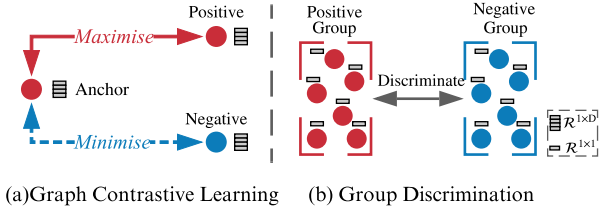
- GD directly discriminates a group of positive nodes from a group of negative nodes.
- GCL maximise the mutual information (MI) between an anchor node and its positive counterparts, sharing similar semantic information while doing the opposite for negative counterparts.
贡献:
- 1) We re-examine existing GCL approaches (e.g., DGI and MVGRL), and we introduce a novel and efficient self-supervised GRL paradigm, namely, Group Discrimination (GD).
- 2) Based on GD, we propose a new self-supervised GRL model, GGD, which is fast in training and convergence, and possess high scalability.
- 3) We conduct extensive experiments on eight datasets, including an extremely large dataset, ogbn-papers100M with billion edges.
2 Rethinking Representative GCL Methods
本节以经典的 DGI 、MVGRL 为例子,说明了互信息最大化并不是对比学习的贡献因素,而是一个新的范式,群体歧视(group discrimination)。
2.1 Rethinking GCL Methods
回顾一下 DGI :
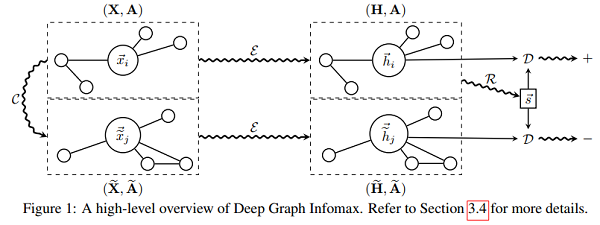
代码:


class DGI(nn.Module):

    def __init__(self, g, in_feats, n_hidden, n_layers, activation, dropout):

        super(DGI, self).__init__()

        self.encoder = Encoder(g, in_feats, n_hidden, n_layers, activation, dropout)

        self.discriminator = Discriminator(n_hidden)

        self.loss = nn.BCEWithLogitsLoss()

    def forward(self, features):

        positive = self.encoder(features, corrupt=False)

        negative = self.encoder(features, corrupt=True)

        summary = torch.sigmoid(positive.mean(dim=0))

        positive = self.discriminator(positive, summary)

        negative = self.discriminator(negative, summary)

        l1 = self.loss(positive, torch.ones_like(positive))

        l2 = self.loss(negative, torch.zeros_like(negative))

        return l1 + l2
本文研究 DGI 结论:一个 Sigmoid 函数不适用于权重被 Xavier 初始化的 GNN 生成的 summary vector,且 summary vector 中的元素非常接近于相同的值。
接着尝试将 Summary vector 中的数值变换成不同的常量 (from 0 to 1):
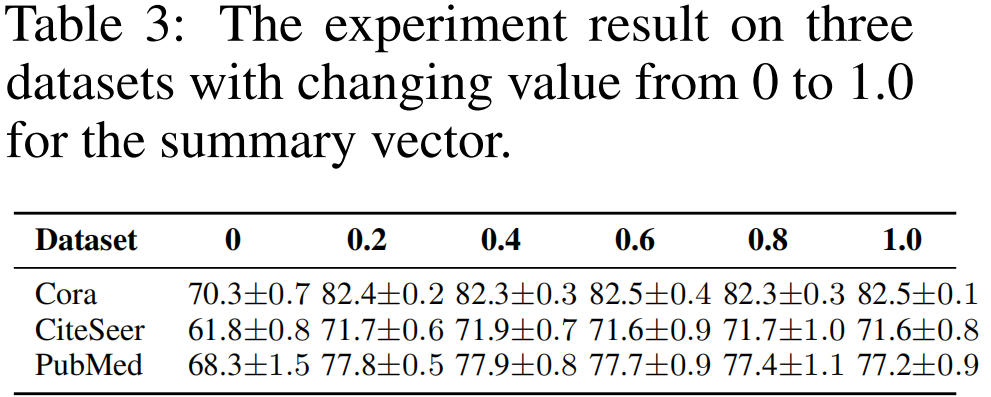
结论:
- 将 summary vector 中的数值变成 0,求解相似度时导致所有的 score 变成 0,也就是 postive 项的损失函数变成 负无穷,无法优化;
- summary vector 设置其他值,导致 数值不稳定;
DGI 的简化:
① 将 summary vector 设置为 单位向量(缩放对损失不影响);
② 去掉 Discriminator (Bilinear :先做线性变换,再求内积相似度)的权重向量;【双线性层的 $W$ 其实就是一个线性变换层】
$\begin{aligned}\mathcal{L}_{D G I} &=\frac{1}{2 N}\left(\sum\limits _{i=1}^{N} \log \mathcal{D}\left(\mathbf{h}_{i}, \mathbf{s}\right)+\log \left(1-\mathcal{D}\left(\tilde{\mathbf{h}}_{i}, \mathbf{s}\right)\right)\right) \\&\left.=\frac{1}{2 N}\left(\sum\limits_{i=1}^{N} \log \left(\mathbf{h}_{i} \cdot \mathbf{s}\right)+\log \left(1-\tilde{\mathbf{h}}_{i} \cdot \mathbf{s}\right)\right)\right) \\&=\frac{1}{2 N}\left(\sum\limits_{i=1}^{N} \log \left(\operatorname{sum}\left(\mathbf{h}_{i}\right)\right)+\log \left(1-\operatorname{sum}\left(\tilde{\mathbf{h}}_{i}\right)\right)\right)\end{aligned} \quad\quad\quad(1)$
Bilinear :
$\mathcal{D}\left(\mathbf{h}_{i}, \mathbf{s}\right)=\sigma_{s i g}\left(\mathbf{h}_{i} \cdot \mathbf{W} \cdot \mathbf{s}\right)\quad\quad\quad(2)$
实验:替换 $\text{Eq.1}$ 中的 aggregation function ,即 sum 函数
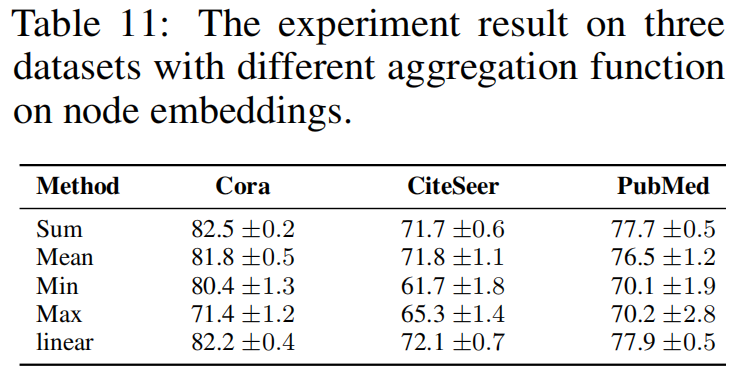
替换形式为:
$\mathcal{L}_{B C E}=-\frac{1}{2 N}\left(\sum\limits _{i=1}^{2 N} y_{i} \log \hat{y}_{i}+\left(1-y_{i}\right) \log \left(1-\hat{y}_{i}\right)\right)\quad\quad\quad(3)$
其中,$\hat{y}_{i}=\operatorname{agg}\left(\mathbf{h}_{i}\right)$ ,$y_{i} \in \mathbb{R}^{1 \times 1}$ ,$\hat{y}_{i} \in \mathbb{R}^{1 \times 1}$。论文中阐述 $y_{i}$ 和 $\hat{y}_{i}$ 分别代表 node $i$ 是否是 postive sample ,及其预测输出。Q :当 aggregation function 采用 $\text{mean}$ 的时候,对于 postive sample $i$ ,$\hat{y}_{i}$ 值会趋于 $1$ 么?
DGI 真正所做的是区分正确拓扑生成的一组节点和损坏拓扑生成的节点,如 Figure 1 所示。可以这么理解,DGI 是使用一个固定的向量 $s$ 去区分两组节点嵌入矩阵(postive and negative)。
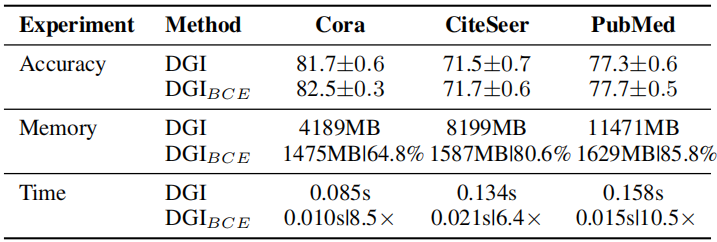
Note:方差大的稍微大一点的 method ,就是容易被诋毁。
3 Methodology
整体框架:
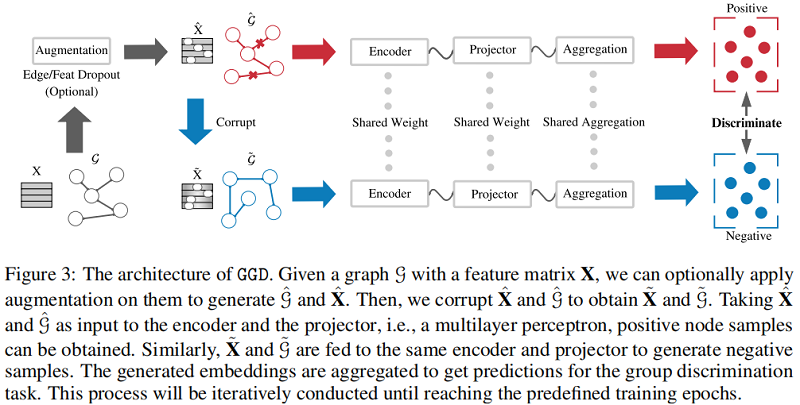
组成部分:
- Siamese Network :模仿 MVGRL 的架构;
- Data Augmentation :提供相似意义信息,带来的是时间成本;【dropout edge、feature mask】
- Loss function : $\text{Eq.3}$;
首先:固定 GNN encoder、MLP predict 的参数,获得初步的节点表示 $\mathbf{H}_{\theta}$;
其次:MVGRL 多视图对比工作给本文深刻的启发,所以考虑引入全局信息 :$ \mathbf{H}_{\theta}^{\text {global }}=\mathbf{A}^{n} \mathbf{H}_{\theta}$;
最后:得到局部表示和全局表示的聚合 $\mathbf{H}=\mathbf{H}_{\theta}^{\text {global }}+\mathbf{H}_{\theta}$ ;
4 Experiments
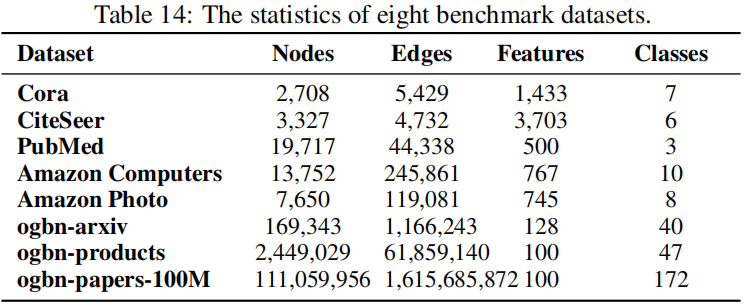
4.1 Datasets
4.2 Result
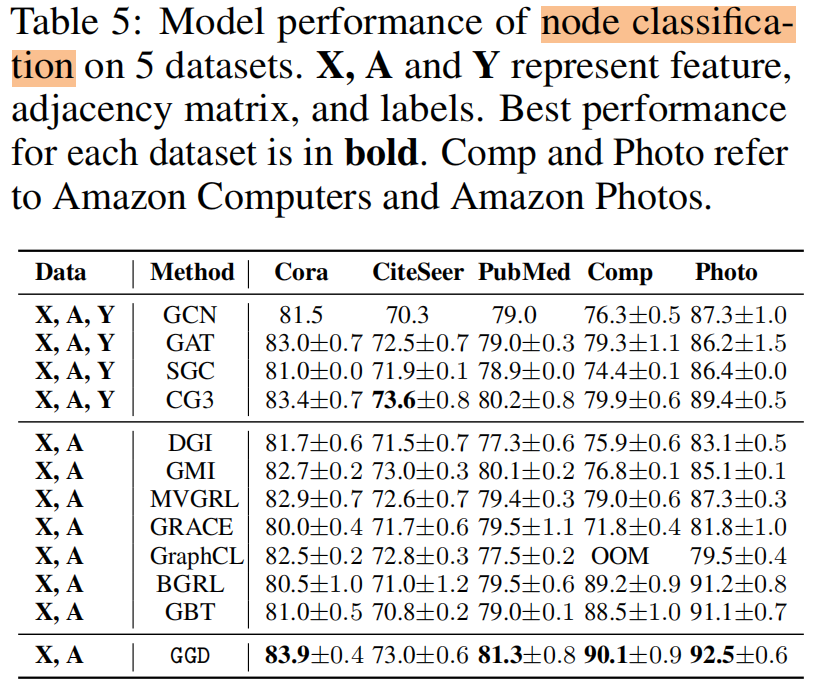
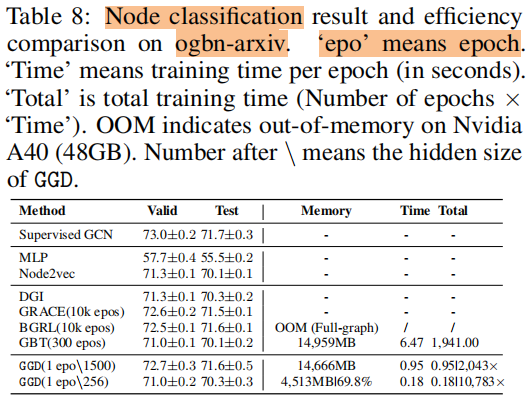
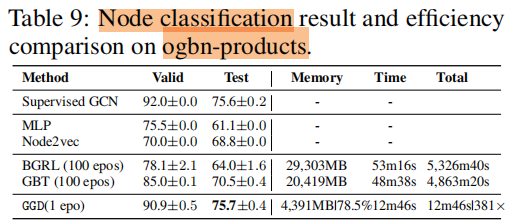
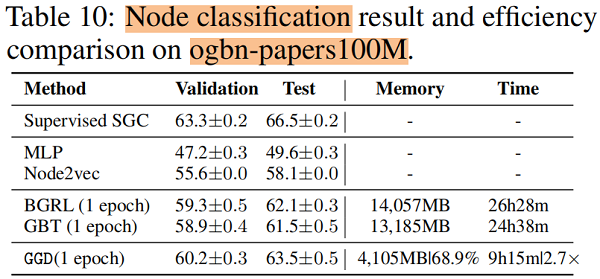
节点分类
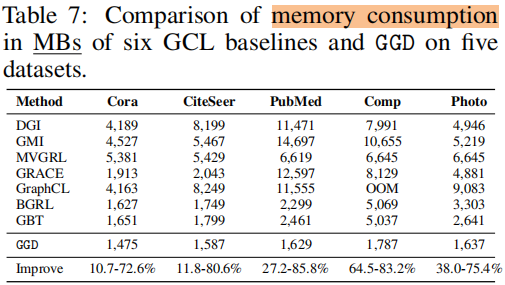
训练时间 和 内存消耗


5 Future Work
For example, can we extend the current binary Group Discrimination scheme (i.e., classifying nodes generated with different topology) to discrimination among multiple groups?
论文解读(GGD)《Rethinking and Scaling Up Graph Contrastive Learning: An Extremely Efficient Approach with Group Discrimination》的更多相关文章
- 论文解读(MLGCL)《Multi-Level Graph Contrastive Learning》
论文信息 论文标题:Structural and Semantic Contrastive Learning for Self-supervised Node Representation Learn ...
- 论文解读(GRACE)《Deep Graph Contrastive Representation Learning》
Paper Information 论文标题:Deep Graph Contrastive Representation Learning论文作者:Yanqiao Zhu, Yichen Xu, Fe ...
- 论文解读(GCC)《GCC: Graph Contrastive Coding for Graph Neural Network Pre-Training》
论文信息 论文标题:GCC: Graph Contrastive Coding for Graph Neural Network Pre-Training论文作者:Jiezhong Qiu, Qibi ...
- 论文解读(GCA)《Graph Contrastive Learning with Adaptive Augmentation》
论文信息 论文标题:Graph Contrastive Learning with Adaptive Augmentation论文作者:Yanqiao Zhu.Yichen Xu3.Feng Yu4. ...
- 论文解读(GROC)《Towards Robust Graph Contrastive Learning》
论文信息 论文标题:Towards Robust Graph Contrastive Learning论文作者:Nikola Jovanović, Zhao Meng, Lukas Faber, Ro ...
- 论文解读(SimGRACE)《SimGRACE: A Simple Framework for Graph Contrastive Learning without Data Augmentation》
论文信息 论文标题:SimGRACE: A Simple Framework for Graph Contrastive Learning without Data Augmentation论文作者: ...
- 论文解读(AGC)《Attributed Graph Clustering via Adaptive Graph Convolution》
论文信息 论文标题:Attributed Graph Clustering via Adaptive Graph Convolution论文作者:Xiaotong Zhang, Han Liu, Qi ...
- 论文解读(SelfGNN)《Self-supervised Graph Neural Networks without explicit negative sampling》
论文信息 论文标题:Self-supervised Graph Neural Networks without explicit negative sampling论文作者:Zekarias T. K ...
- 论文解读《Momentum Contrast for Unsupervised Visual Representation Learning》俗称 MoCo
论文题目:<Momentum Contrast for Unsupervised Visual Representation Learning> 论文作者: Kaiming He.Haoq ...
随机推荐
- odoo14 button 事件调用python方法如何传递参数
1 <field name="user_ids" 2 mode="kanban" 3 nolabel="1" 4 options=&q ...
- GTID主从和lamp架构运行原理
目录 GTID主从 GTID概念介绍 GTID工作原理 GTID主从配置 lamp lamp简介 web服务器工作流程 cgi与fastcgi http协议 是什么? lamp架构运行的原理 Apac ...
- 我说MySQL联合索引遵循最左前缀匹配原则,面试官让我回去等通知
面试官: 我看你的简历上写着精通MySQL,问你个简单的问题,MySQL联合索引有什么特性? 心想,这还不简单,这不是问到我手心里了吗? 听我给你背一遍八股文! 我: MySQL联合索引遵循最左前缀匹 ...
- OC高仿iOS网易云音乐AFNetworking+SDWebImage+MJRefresh+MVC+MVVM
效果 因为OC版本大部分截图和Swift版本一样,所以就不再另外截图了. 列文章目录 因为目录比较多,每次更新这里比较麻烦,所以推荐点击到主页,然后查看iOS云音乐专栏. 目简介 这是一个使用OC语言 ...
- java学习第四天高级数组.day13
正则表达式 冒泡排序 二分法查找 线性查找:从头找到尾,性能比较低. 二分法查找(折半查找):前提数组元素是有序的,性能非常优异. Arrays
- Webstorm设置背景图为Windows桌面背景
桌面背景图会缓存在这个目录中,文件名不确定在改变桌面背景后会不会变. C:\Users\用户名\AppData\Roaming\Microsoft\Windows\Themes\CachedFiles ...
- 分布式id生成器,雪花算法IdWorker
/** * <p>名称:IdWorker.java</p> * <p>描述:分布式自增长ID</p> * <pre> * Twitter的 ...
- Java反射(重要)
全文内容 1: 获取字节码文件对象的三种方式 2: 获取公有,私有方法,并调用构造方法,成员方法 3: 获取并调用私有成员变量 4: 如何为实例对象的成员变量赋值 5: 文末有一些注意 tea1类代码 ...
- 【JDBC】学习路径1-JDBC背景知识
学习完本系列JDBC课程后,你就可以愉快使用Java操作我们的MySQL数据库了. 各种数据分析都不在话下了. 第一章:废话 JDBC编程,就是写Java的时候,调用了数据库. Java Databa ...
- 第九十九篇:JS闭包
好家伙,总是要来的,去面对那些晦涩难懂的原理,它就在那里,等着我去搞定它 首先我要去补充一些最基本的概念, 1.什么是内存? 新华字典永远的神, 但这个解释显然不够 去看看百度百科: 内存: CP ...