
spring再学习之AOP实操
一、spring导包
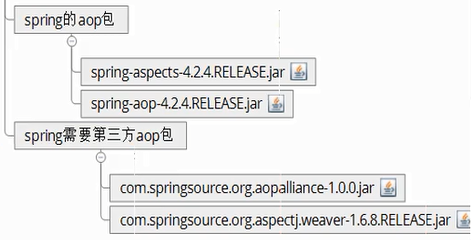
2、目标对象
public class UserServiceImpl implements UserService {

    @Override

    public void save() {

        System.out.println("保存用户!");

        //int i = 1/0;

    }

    @Override

    public void delete() {

        System.out.println("删除用户!");

    }

    @Override

    public void update() {

        System.out.println("更新用户!");

    }

    @Override

    public void find() {

        System.out.println("查找用户!");

    }

}
3、准备通知
//通知类

public class MyAdvice {

    /**

     * 前置通知

     *-目标方法运行前调用

     *后置通知(如果出现异常不会调用)

     *-目标方法运行之后调用

     *环绕通知

     *-在目标方法之前之后调用

     *异常拦截通知

     *-在目标方法运行之后调用

     *后置通知(无论是否出现异常都会调用)

     *目标方法运行后调用

     */

    //前置通知

    public void before() {

        System.out.println("这是前置通知!!!");

    }

    //后置通知通知

    public void afterReturning() {

        System.out.println("这是后置通知(如果出现异常不会调用)!!!");

    }

    //环绕通知

    public Object around(ProceedingJoinPoint pjp) throws Throwable {

        System.out.println("这是环绕通知之前的部分");

        Object proceed = pjp.proceed();//调用目标方法

        System.out.println("这是环绕通知之后的部分");

        return proceed;

    }

    //异常通知

    public void afterException() {

        System.out.println("出事了,出现异常了");

    }

    //后置通知

    public void after() {

        System.out.println("出事了,出现异常了");

    }

}
4、配置进行织入
<?xml version="1.0" encoding="UTF-8"?>

<beans xmlns:xsi="http://www.w3.org/2001/XMLSchema-instance"

       xmlns="http://www.springframework.org/schema/beans"

       xmlns:p="http://www.springframework.org/schema/p"

       xmlns:context="http://www.springframework.org/schema/context"

       xmlns:aop="http://www.springframework.org/schema/aop"

       xsi:schemaLocation="http://www.springframework.org/schema/beans

       http://www.springframework.org/schema/beans/spring-beans-4.2.xsd

       http://www.springframework.org/schema/context

       http://www.springframework.org/schema/context/spring-context-4.2.xsd

       http://www.springframework.org/schema/aop

       http://www.springframework.org/schema/aop/spring-aop-4.2.xsd ">

<!-- 导入安aop(约束)命名空间 -->

<!-- 1.配置目标对象 -->

     <bean name="userServiceTarget" class="cn.itcast.service.UserServiceImpl"></bean>

<!-- 2.配置通知对象 -->

     <bean name="myAdvice" class="cn.itcast.d_springaop.MyAdvice"></bean>

<!-- 3.配置将通知织入目标对象 -->

     <aop:config>

          <!-- 配置切入点
          书写expression="execution(* cn.itcast.service.*ServiceImpl.*(..))"
public void cn.itcast.service.UserServiceImpl.save()

                             一般 public省略掉 ,一般对返回值不做要求用*表示,类下的放大,用*表示全部的方法

          * cn.itcast.service.UserServiceImpl.*()

                             继续演化..表示不对参数有任何要求

          * cn.itcast.service.UserServiceImpl.*(..)

                               继续演化,不对集体的类有要求

          * cn.itcast.service.*ServiceImpl.*(..)

                              继续演化  ,不只找service中的类而且找子包

            * cn.itcast.service..*ServiceImpl.*(..)

          -->


         <aop:pointcut expression="execution(* cn.itcast.service.*ServiceImpl.*(..))" id="pc"/>

         <aop:aspect ref="myAdvice">

              <aop:before method="before" pointcut-ref="pc"/>

              <aop:after-returning method="afterReturning" pointcut-ref="pc"/>

              <aop:around method="around" pointcut-ref="pc"/>

              <aop:after method="after" pointcut-ref="pc"/>

              <aop:after-throwing method="afterException" pointcut-ref="pc"/>

         </aop:aspect>

     </aop:config>

</beans>
测试:
/**

 * @RunWith :帮我们创建容器

 * @ContextConfiguration :指定创建容器时使用哪个配置文件

 * @author zws

 *

 */

@RunWith(SpringJUnit4ClassRunner.class)

@ContextConfiguration("classpath:cn/itcast/e_annotationaop/applicationContext.xml")

public class Demo {

    @Resource(name="userServiceTarget")

    private UserService us;

    @Test

    public void fun1(){

        us.save();

    }

}
结果:
这是环绕通知之前的部分

这是前置通知!!!

保存用户!

这是环绕通知之后的部分

出事了,出现异常了

这是后置通知(如果出现异常不会调用)!!!
注解配置:
//通知类

@Aspect

//表示该类是一个通知类

public class MyAdvice {

    //前置通知

//   -目标方法运行前调用

    //后置通知(如果出现异常不会调用)

//   -目标方法运行之后调用

    //环绕通知

//   -在目标方法之前之后调用

    //异常拦截通知

//  -在目标方法运行之后调用

    //后置通知(无论是否出现异常都会调用)


    //前置通知

    @Before("execution(* cn.itcast.service.*ServiceImpl.*(..))")

    public void before() {

        System.out.println("这是前置通知!!!");

    }

    //后置通知通知

    @AfterReturning("execution(* cn.itcast.service.*ServiceImpl.*(..))")

    public void afterReturning() {

        System.out.println("这是后置通知(如果出现异常不会调用)!!!");

    }

    //环绕通知

    @Around("execution(* cn.itcast.service.*ServiceImpl.*(..))")

    public Object around(ProceedingJoinPoint pjp) throws Throwable {

        System.out.println("这是环绕通知之前的部分");

        Object proceed = pjp.proceed();//调用目标方法

        System.out.println("这是环绕通知之后的部分");

        return proceed;

    }

    //异常通知

    @AfterThrowing("execution(* cn.itcast.service.*ServiceImpl.*(..))")

    public void afterException() {

        System.out.println("出事了,出现异常了");

    }

    //后置通知

    @After("execution(* cn.itcast.service.*ServiceImpl.*(..))")

    public void after() {

        System.out.println("出事了,出现异常了");

    }

}
配置:
<?xml version="1.0" encoding="UTF-8"?>

<beans xmlns:xsi="http://www.w3.org/2001/XMLSchema-instance"
       xmlns="http://www.springframework.org/schema/beans"
       xmlns:p="http://www.springframework.org/schema/p"
       xmlns:context="http://www.springframework.org/schema/context"
       xmlns:aop="http://www.springframework.org/schema/aop"
       xsi:schemaLocation="http://www.springframework.org/schema/beans
       http://www.springframework.org/schema/beans/spring-beans-4.2.xsd
       http://www.springframework.org/schema/context
       http://www.springframework.org/schema/context/spring-context-4.2.xsd
       http://www.springframework.org/schema/aop
       http://www.springframework.org/schema/aop/spring-aop-4.2.xsd ">

<!-- 导入安aop(约束)命名空间 -->

<!-- 1.配置目标对象 -->

     <bean name="userServiceTarget" class="cn.itcast.service.UserServiceImpl"></bean>

<!-- 2.配置通知对象 -->

     <bean name="myAdvice" class="cn.itcast.e_annotationaop.MyAdvice"></bean>

<!-- 3.配置将通知织入目标对象   使用注解完成织如-->

     <aop:aspectj-autoproxy></aop:aspectj-autoproxy>

</beans>
测试:
/**

 * @RunWith :帮我们创建容器

 * @ContextConfiguration :指定创建容器时使用哪个配置文件

 * @author zws

 *

 */

@RunWith(SpringJUnit4ClassRunner.class)

@ContextConfiguration("classpath:cn/itcast/e_annotationaop/applicationContext.xml")

public class Demo {

    @Resource(name="userServiceTarget")

    private UserService us;

    @Test

    public void fun1(){

        us.save();

    }

}
结果;
这是环绕通知之前的部分

这是前置通知!!!

保存用户!

这是环绕通知之后的部分

出事了,出现异常了

这是后置通知(如果出现异常不会调用)!!!
spring再学习之AOP实操的更多相关文章
- spring再学习之AOP事务
spring中的事务 spring怎么操作事务的: 事务的转播行为: 事务代码转账操作如下: 接口: public interface AccountDao { //加钱 void addMoney( ...
- spring再学习之AOP准备
一.aop思想: 横向重复,纵向抽取 1.乱码 2.事务管理 3,action 二.spring能够为容器中管理的对象生成代理对象 1.spring能帮我们生成代理对象 2.spring实现aop的原 ...
- spring再学习之设计模式
今天我们来聊一聊,spring中常用到的设计模式,在spring中常用的设计模式达到九种. 第一种:简单工厂 三种工厂模式:https://blog.csdn.net/xiaoddt/article/ ...
- Spring基础学习(四)—AOP
一.AOP基础 1.基本需求 需求: 日志功能,在程序执行期间记录发生的活动. ArithmeticCalculate.java public interface ArithmeticCal ...
- Spring框架学习06——AOP底层实现原理
在Java中有多种动态代理技术,如JDK.CGLIB.Javassist.ASM,其中最常用的动态代理技术是JDK和CGLIB. 1.JDK的动态代理 JDK动态代理是java.lang.reflec ...
- Spring框架学习05——AOP相关术语详解
1.Spring AOP 的基本概述 AOP(Aspect Oriented Programing)面向切面编程,AOP采取横向抽取机制,取代了传统纵向继承体系重复性代码(性能监视.事务管理.安全检查 ...
- spring框架学习(三)——AOP( 面向切面编程)
AOP 即 Aspect Oriented Program 面向切面编程 首先,在面向切面编程的思想里面,把功能分为核心业务功能,和周边功能. 所谓的核心业务,比如登陆,增加数据,删除数据都叫核心业务 ...
- spring再学习之注解
1.使用注解配置spring <?xml version="1.0" encoding="UTF-8"?> <beans xmlns:xsi= ...
- spring再学习之配置详解
applicationContext.xml文件配置: bean元素: <?xml version="1.0" encoding="UTF-8"?> ...
随机推荐
- k8s集群中遇到etcd集群故障的排查思路
一次在k8s集群中创建实例发现etcd集群状态出现连接失败状况,导致创建实例失败.于是排查了一下原因. 问题来源 下面是etcd集群健康状态: 1 2 3 4 5 6 7 8 9 10 11 [roo ...
- Java中的基本数据类型与引用数据类型
一.基本数据类型 byte.short.int.long(整数类型) float.double(浮点数类型) char(字符型) boolean(布尔类型 ) Java数据大多数存放在堆栈中. 栈区: ...
- Linux TCP漏洞 CVE-2019-11477 CentOS7 修复方法
CVE-2019-11477漏洞简单介绍 https://cert.360.cn/warning/detail?id=27d0c6b825c75d8486c446556b9c9b68 RedHat用户 ...
- [Usaco2008 Mar]Cow Travelling游荡的奶牛
题目描述 奶牛们在被划分成N行M列(2 <= N <= 100; 2 <= M <= 100)的草地上游走,试图找到整块草地中最美味的牧草.Farmer John在某个时刻看见 ...
- 解决maven中某些依赖无法下载,手动安装Maven依赖
<!--先下载jar包,然后在仓库中手动安装,下面是遇到的两个例子--> <!--第一个--> mvn install:install-file -Dfile=D:\kaptc ...
- 本地Mac通过堡垒机代理实现跨堡垒机scp问题
近日,公司在跳板机前架设了堡垒机,以防止ssh攻击,但这带来一个问题,我们平常直接ssh跳板机,可以直接使用scp来上传或下载跳板机数据到本地 架设堡垒之后经常使用的scp工具不好用了 于是本期就来解 ...
- the code has to work especially hard to keep things in the same thread
django/asgiref: ASGI specification and utilities https://github.com/django/asgiref/
- LOJ10078
CQOI 2005 重庆城里有 n 个车站,m 条双向公路连接其中的某些车站.每两个车站最多用一条公路连接,从任何一个车站出发都可以经过一条或者多条公路到达其他车站,但不同的路径需要花费的时间可能不同 ...
- 【DB宝36】使用Docker分分钟搭建漂亮的prometheus+grafana监控
目录 一.部署Prometheus+grafana环境 1.1.下载Prometheus+grafana镜像 1.2.创建镜像 1.3.浏览器访问 二.监控Linux主机 2.1.在被监控主机上部署n ...
- Java调用RestFul接口
使用Java调用RestFul接口,以POST请求为例,以下提供几种方法: 一.通过HttpURLConnection调用 1 public String postRequest(String url ...