
Five Dimensional Points CodeForces - 851C (计算几何+暴力)
2 seconds
256 megabytes
standard input
standard output
You are given set of n points in 5-dimensional space. The points are labeled from 1 to n. No two points coincide.
We will call point a bad if there are different points b and c, not equal to a, from the given set such that angle between vectors  and
and  is acute (i.e. strictly less than
  ). Otherwise, the point is called good.
The angle between vectors  and
and  in 5-dimensional space is defined as
  , where
  is the scalar product and
  is length of .
Given the list of points, print the indices of the good points in ascending order.
The first line of input contains a single integer n (1 ≤ n ≤ 103) — the number of points.
The next n lines of input contain five integers ai, bi, ci, di, ei (|ai|, |bi|, |ci|, |di|, |ei| ≤ 103) — the coordinates of the i-th point. All points are distinct.
First, print a single integer k — the number of good points.
Then, print k integers, each on their own line — the indices of the good points in ascending order.
6
0 0 0 0 0
1 0 0 0 0
0 1 0 0 0
0 0 1 0 0
0 0 0 1 0
0 0 0 0 1
1
1
3
0 0 1 2 0
0 0 9 2 0
0 0 5 9 0
0
In the first sample, the first point forms exactly a angle with all other pairs of points, so it is good.
In the second sample, along the cd plane, we can see the points look as follows:
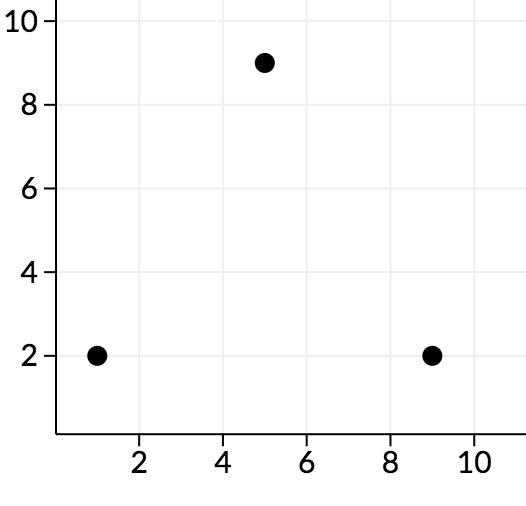
We can see that all angles here are acute, so no points are good.
题意:
给你n个五维空间上的n个点。
让你求出“好”的点的数量。
“好”的点的定义是:
对于一个点i,不存在任何其他两个点,j,k, (三个点互不相同) 使得向量 i->j和向量 i - > k 是锐角。
思路:
判断两个向量的夹角是否是锐角可以通过向量的点积来判断。
五维空间的点积和二维三维的都一样,都是对应坐标相乘再相加。
然后每一次点积后的结果都可以得出这样的结论。

如图,如果点积后的结果小于等于零,那么证明∠J I K不是锐角。
那么就得出结论 j 和k都不是good点,因为对于j,有i和k是的所成的角是锐角。
k同理。
而如果点积结果大于0,那么证明 角jik是锐角,所以i不是good point
需要一个数组vis来维护哪些点是已经被确定不是good点的,以此来降低时间复杂度。
注意到枚举的时候,第三个变量k,设为j+1开始枚举,这样不会让i,j,k每一次重复计算而导致答案错误。
细节见代码:
#include <iostream>

#include <cstdio>

#include <cstring>

#include <algorithm>

#include <cmath>

#include <queue>

#include <stack>

#include <map>

#include <set>

#include <vector>

#include <iomanip>

#define ALL(x) (x).begin(), (x).end()

#define rt return

#define dll(x) scanf("%I64d",&x)

#define xll(x) printf("%I64d\n",x)

#define sz(a) int(a.size())

#define all(a) a.begin(), a.end()

#define rep(i,x,n) for(int i=x;i<n;i++)

#define repd(i,x,n) for(int i=x;i<=n;i++)

#define pii pair<int,int>

#define pll pair<long long ,long long>

#define gbtb ios::sync_with_stdio(false),cin.tie(0),cout.tie(0)

#define MS0(X) memset((X), 0, sizeof((X)))

#define MSC0(X) memset((X), '\0', sizeof((X)))

#define pb push_back

#define mp make_pair

#define fi first

#define se second

#define eps 1e-6

#define gg(x) getInt(&x)

#define db(x) cout<<"== [ "<<x<<" ] =="<<endl;

using namespace std;

typedef long long ll;

ll gcd(ll a,ll b){return b?gcd(b,a%b):a;}

ll lcm(ll a,ll b){return a/gcd(a,b)*b;}

ll powmod(ll a,ll b,ll MOD){ll ans=;while(b){if(b%)ans=ans*a%MOD;a=a*a%MOD;b/=;}return ans;}

inline void getInt(int* p);

const int maxn=;

const int inf=0x3f3f3f3f;

/*** TEMPLATE CODE * * STARTS HERE ***/

int vis[maxn];

struct node

{

    ll a,b,c,d,e;

}arr[maxn];

int n;

ll f(int i,int j,int k)

{

    ll a1=arr[j].a-arr[i].a;

    ll a2=arr[k].a-arr[i].a;

    ll b1=arr[j].b-arr[i].b;

    ll b2=arr[k].b-arr[i].b;

    ll c1=arr[j].c-arr[i].c;

    ll c2=arr[k].c-arr[i].c;

    ll d1=arr[j].d-arr[i].d;

    ll d2=arr[k].d-arr[i].d;

    ll e1=arr[j].e-arr[i].e;

    ll e2=arr[k].e-arr[i].e;

    ll res=a1*a2+b1*b2+c1*c2+d1*d2+e1*e2;

    return res;

}

int main()

{

    //freopen("D:\\common_text\\code_stream\\in.txt","r",stdin);

    //freopen("D:\\common_text\\code_stream\\out.txt","w",stdout);

    gbtb;

    cin>>n;

    repd(i,,n)

    {

        cin>>arr[i].a>>arr[i].b>>arr[i].c>>arr[i].d>>arr[i].e;

    }

    repd(i,,n)

    {

        if(i==)

        {

            i=;

        }

        if(vis[i])

            continue;

        repd(j,,n)

        {

            if(i==j)

            {

                continue;

            }

            repd(k,j+,n)

            {

                if(k==j||k==i)

                {

                    continue;

                }

                if(f(i,j,k)<=)

                {

                    vis[j]=vis[k]=;

                    break;

                }else

                {

                    vis[i]=;

                    break;

                }

            }

            if(vis[i])

                break;

        }

    }

    int ans=;

    repd(i,,n)

    {

        if(!vis[i])

        {

            ans++;

        }

    }

    cout<<ans<<endl;

    repd(i,,n)

    {

        if(!vis[i])

        {

            cout<<i<<" ";

        }

    }cout<<endl;

    return ;

}

inline void getInt(int* p) {

    char ch;

    do {

        ch = getchar();

    } while (ch == ' ' || ch == '\n');

    if (ch == '-') {

        *p = -(getchar() - '');

        while ((ch = getchar()) >= '' && ch <= '') {

            *p = *p *  - ch + '';

        }

    }

    else {

        *p = ch - '';

        while ((ch = getchar()) >= '' && ch <= '') {

            *p = *p *  + ch - '';

        }

    }

}
Five Dimensional Points CodeForces - 851C (计算几何+暴力)的更多相关文章
- codeforces 851C Five Dimensional Points(鸽巢原理)
http://codeforces.com/contest/851/problem/C 题意 - 给出 n 个五维空间的点 - 一个点a为 bad 的定义为 存在两点 b, c, 使的<ab, ...
- Codeforces 850A - Five Dimensional Points(暴力)
原题链接:http://codeforces.com/problemset/problem/850/A 题意:有n个五维空间内的点,如果其中三个点A,B,C,向量AB,AC的夹角不大于90°,则点A是 ...
- 【推导】【暴力】Codeforces Round #432 (Div. 2, based on IndiaHacks Final Round 2017) C. Five Dimensional Points
题意:给你五维空间内n个点,问你有多少个点不是坏点. 坏点定义:如果对于某个点A,存在点B,C,使得角BAC为锐角,那么A是坏点. 结论:如果n维空间内已经存在2*n+1个点,那么再往里面添加任意多个 ...
- 【Codeforces Round #432 (Div. 1) A】 Five Dimensional Points
[链接]点击打开链接 [题意] 给你n个5维的点. 然后让你以其中的某一个点作为起点a. 另选两个点b,c. 组成向量a->b,a->c 如果所有的a->b和a->c的夹角都是 ...
- HDU 6697 Closest Pair of Segments (计算几何 暴力)
2019 杭电多校 10 1007 题目链接:HDU 6697 比赛链接:2019 Multi-University Training Contest 10 Problem Description T ...
- Chladni Figure CodeForces - 1162D (暴力,真香啊~)
Chladni Figure CodeForces - 1162D Inaka has a disc, the circumference of which is nn units. The circ ...
- Karen and Game CodeForces - 816C (暴力+构造)
On the way to school, Karen became fixated on the puzzle game on her phone! The game is played as fo ...
- zoj 1081:Points Within(计算几何,判断点是否在多边形内,经典题)
Points Within Time Limit: 2 Seconds Memory Limit: 65536 KB Statement of the Problem Several dra ...
- BZOJ 1199: [HNOI2005]汤姆的游戏 计算几何暴力
1199: [HNOI2005]汤姆的游戏 Time Limit: 1 Sec Memory Limit: 256 MB 题目连接 http://www.lydsy.com/JudgeOnline/p ...
随机推荐
- 编译.py为.pyc
将test.py编译为.pyc文件,然后直接使用.pyc即可,防止源码外泄 import py_compile py_compile.compile(r'c:/test.py')compileall. ...
- Ecto 总结
ecto 简介 ecto 相当于 elixir 的 ORM,但是得益于 elixir 语言,和传统的 ORM 相比,更加简洁和强大. ecto 主要分为 4 部分: Repo: 这是和真正数据库交互的 ...
- Linux for python教程02
目录 1. Linux用户及权限管理 1.1. who 1.2. 查看当前用户: whoami 1.3. 添加用户账号: useradd 1.4 切换用户 su 2.用户组 3. 修改文件权限: ch ...
- Spring的事务管理1
事务的回顾: 事务:逻辑上的一组操作,组成这组事务的各个单元,要么全部成功,要么全部失败 事务的特性:ACID 原子性(Atomicity):事务不可分割 一致性(Consistency):事务执行前 ...
- 学习Ant Design Pro的一点心得
1.控制反转(Inversion of Control)是一种「思想」,依赖注入(Dependency Injection)则是这一思想的一种具体「实现方式」 2.react 要注意全局 id相同 3 ...
- PHP防盗链的基本思想&&防盗链的设置方法
PHP防盗链的基本思想&&防盗链的设置方法 网站盗链会大量消耗被盗链网站的带宽,而真正的点击率也许会很小,严重损害了被盗链网站的利益.本文主要介绍用PHP实现防盗链的方法以及基本思想, ...
- 16.ajax_case02
# 抓取当当网书评 # http://product.dangdang.com/25340451.html import json import requests from lxml import e ...
- JDK动态代理给Spring事务埋下的坑!
一.场景分析 最近做项目遇到了一个很奇怪的问题,大致的业务场景是这样的:我们首先设定两个事务,事务parent和事务child,在Controller里边同时调用这两个方法,示例代码如下: 1.场景A ...
- Linux 平台下 RMAN 全备 和 增量备份 shell 脚本
转:http://blog.csdn.net/tianlesoftware/article/details/5740630 全备脚本 以 nocatalog 模式为例: Shell 脚本: ##### ...
- ROS 小乌龟测试
教程 1.维基 http://wiki.ros.org/cn/ROS/Tutorials 2. 创客智造 http://www.ncnynl.com/category/ros-junior-tutor ...