
算法:Rate of Growth
Rate of growth describes how an algorithm’s complexity changes as the input size grows. This is commonly represented using Big-O notation. Big-O notation uses a capital O (“order”) and a formula that expresses the complexity of the algorithm. The formula may have a variable, n, which represents the size of the input. The following are some common order functions we will see in this book but this list is by no means complete.
Constant – O(1)
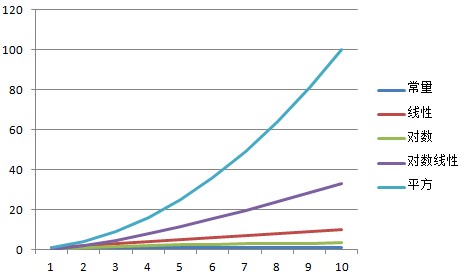
An O(1) algorithm is one whose complexity is constant regardless of how large the input size is. The 1 does not mean that there is only one operation or that the operation takes a small amount of time. It might take 1 microsecond or it might take 1 hour. The point is that the size of the input does not influence the time the operation takes.
         public int GetCount(int[] items)

         {

             return items.Length;

         }
Linear – O(n)
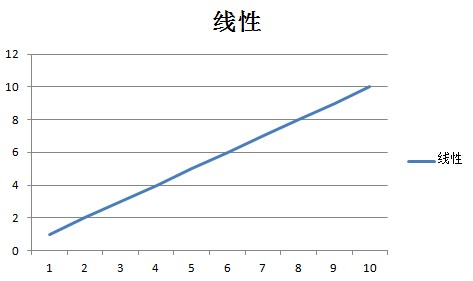
An O(n) algorithm is one whose complexity grows linearly with the size of the input. It is reasonable to expect that if an input size of 1 takes 5 milliseconds, an input with one thousand items will take 5 seconds.You can often recognize an O(n) algorithm by looking for a looping mechanism that accesses each member.
         public long GetSum(int[] items)

         {

             long sum = ;

             foreach (int i in items)

             {

                 sum += i;

             }

             return sum;

         }
Logarithmic – O(log n)
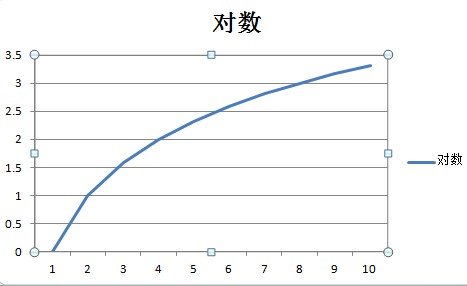
An O(log n) algorithm is one whose complexity is logarithmic to its size. Many divide and conquer algorithms fall into this bucket. The binary search tree Contains method implements an O(log n) algorithm.
Linearithmic – O(n log n)

A linearithmic algorithm, or loglinear, is an algorithm that has a complexity of O(n log n). Some divide and conquer algorithms fall into this bucket. We will see two examples when we look at merge sort and quick sort.
An O(n2)
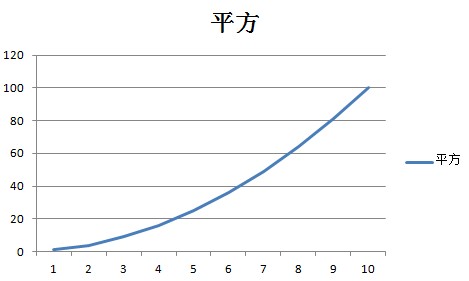
An O(n2) algorithm is one whose complexity is quadratic to its size. While not always avoidable, using a quadratic algorithm is a potential sign that you need to reconsider your algorithm or data structure choice. Quadratic algorithms do not scale well as the input size grows. For example, an array with 1000 integers would require 1,000,000 operations to complete. An input with one million items would take one trillion (1,000,000,000,000) operations. To put this into perspective, if each operation takes one millisecond to complete, an O(n2) algorithm that receives an input of one million items will take nearly 32 years to complete. Making that algorithm 100 times faster would still take 84 days.
We will see an example of a quadratic algorithm when we look at bubble sort.
Best, Average, and Worst Case
When we say an algorithm is O(n), what are we really saying? Are we saying that the algorithm is O(n) on average? Or are we describing the best or worst case scenario?
We typically mean the worst case scenario unless the common case and worst case are vastly different. For example, we will see examples in this book where an algorithm is O(1) on average, but periodically becomes O(n) (see ArrayList.Add). In these cases I will describe the algorithm as O(1) on average and then explain when the complexity changes.
The key point is that saying O(n) does not mean that it is always n operations. It might be less, but it should not be more.
What are we Measuring?
When we are measuring algorithms and data structures, we are usually talking about one of two things: the amount of time the operation takes to complete (operational complexity), or the amount of resources (memory) an algorithm uses (resource complexity).
An algorithm that runs ten times faster but uses ten times as much memory might be perfectly acceptable in a server environment with vast amounts of available memory, but may not be appropriate in an embedded environment where available memory is severely limited.
In this book I will focus primarily on operational complexity, but in the Sorting Algorithms chapter we will see some examples of resource complexity.
Some specific examples of things we might measure include:
- Comparison operations (greater than, less than, equal to).
- Assignments and data swapping.
- Memory allocations.
The context of the operation being performed will typically tell you what type of measurement is being made.
For example, when discussing the complexity of an algorithm that searches for an item within a data structure, we are almost certainly talking about comparison operations. Search is generally a read-only operation so there should not be any need to perform assignments or allocate memory.
However, when we are talking about data sorting it might be logical to assume that we could be talking about comparisons, assignments, or allocations. In cases where there may be ambiguity, I will indicate which type of measurement the complexity is actually referring to.
算法:Rate of Growth的更多相关文章
- 算法中的增长率(Rate of Growth)是什么意思?
一个函数或算法的代码块花费的时间随输入增长的速率称为增长率. 假设你去买一辆小车和一辆自行车.如果你朋友刚好看到,问你在买什么,我们一般都会说:买小车.因为买小车比买自行车花费高多了. [总花费=小车 ...
- 关联规则算法之FP growth算法
FP树构造 FP Growth算法利用了巧妙的数据结构,大大降低了Aproir挖掘算法的代价,他不需要不断得生成候选项目队列和不断得扫描整个数据库进行比对.为了达到这样的效果,它采用了一种简洁的数据结 ...
- 机器学习(十五)— Apriori算法、FP Growth算法
1.Apriori算法 Apriori算法是常用的用于挖掘出数据关联规则的算法,它用来找出数据值中频繁出现的数据集合,找出这些集合的模式有助于我们做一些决策. Apriori算法采用了迭代的方法,先搜 ...
- FBOSS: Building Switch Software at Scale
BOSS: 大规模环境下交换机软件构建 本文为SIGCOMM 2018 论文,由Facebook提供. 本文翻译了论文的关键内容. 摘要: 在网络设备(例如交换机和路由器)上运行的传统软件,通常是由供 ...
- News common vocabulary
英语新闻常用词汇与短语 经济篇 accumulated deficit 累计赤字 active trade balance 贸易顺差 adverse trade balance 贸易逆差 aid 援助 ...
- [IT学习]微软如何做网站内容治理
How Microsoft does SharePoint Governance for their internal platform english sources from:http://www ...
- RFC 2616
Network Working Group R. Fielding Request for Comments: 2616 UC Irvine Obsoletes: 2068 J. Gettys Cat ...
- 自然数e这家伙怎么蹦跶出来的?
自然数e这家伙怎么蹦跶出来的? 之前看过一篇中文介绍自然数e的blog,引起了我的兴趣 原文是阮一峰大牛(我认为必须很有必要尊敬的称,大牛)嚼烂了吐出来的哈哈,只是我认为还是自己去看原文比較好 感觉非 ...
- 美国政府关于Google公司2013年度的财务报表红头文件
请管理员移至新闻版块,谢谢! 来源:http://www.sec.gov/ 财务报表下载↓ 此文仅作参考分析. 10-K 1 goog2013123110-k.htm FORM 10-K UNIT ...
随机推荐
- JavaScript中构造函数
构造函数:函数的另一种执行方法,执行后创建对象,并创建原型对象. 原型链:对象访问构造函数的指针. Function函数:函数对象. Object函数:所有创建对象的祖辈对象,也是由Function对 ...
- java8 - 时间
import java.time.DayOfWeek; import java.time.Duration; import java.time.Instant; import java.time.Lo ...
- 解决Linux中文显示乱码的问题
1.直接执行 export LC_ALL=zh_CN.UTF8 #linux服务器中文显示乱码,但配置文件设置是中文的.解决办法 2.修改文件 修改/etc/sysconfig/i18n文件,确认信息 ...
- [翻译]Gulp.js简介
我们讨论了很多关于怎么减少页面体积,提高重网站性能的方法.有些是操作是一劳永逸的,如开启服务器的gzip压缩,使用适当的图片格式,或删除一些不必要的字符.但有一些任务是每次工作都必须反复执行的.如 新 ...
- jdk与eclipse不匹配的各种问题。。。
- hdoj1232 畅通工程(并查集)
题目链接 http://acm.hdu.edu.cn/showproblem.php?pid=1232 思路 使用并查集求解. 代码 #include <iostream> #includ ...
- 洛谷P2525 Uim的情人节礼物·其之壱 [康托展开]
题目传送门 Uim的情人节礼物·其之壱 题目描述 情人节到了,Uim打算给他的后宫们准备情人节礼物.UIm一共有N(1<=N<=9)个后宫妹子(现充去死 挫骨扬灰!). 为了维护他的后宫的 ...
- 导出Excel超过65535条限制解决方案
使用poi导出excel的时候如果数据过多,超过65535条会报错,因为excel2003一个sheet表最多导出65535条,excel2007是10万4000多条限制. 因此遇到这种excel导出 ...
- Python网络编程之socket应用
1 引言 本篇主要对Python下网络编程中用到的socket模块进行初步总结.首先从网络基础理论出发,介绍了TCP协议和UDP协议:然后总结了socket中的常用函数:最后通过实际代码展示基本函数的 ...
- JAVAEE——宜立方商城10:使用freemarker实现网页静态化、ActiveMq同步生成静态网页、Sso单点登录系统分析
1. 学习计划 1.使用freemarker实现网页静态化 2.ActiveMq同步生成静态网页 2. 网页静态化 可以使用Freemarker实现网页静态化. 2.1. 什么是freemarker ...