
[LeetCode] 723. Candy Crush 糖果粉碎
This question is about implementing a basic elimination algorithm for Candy Crush.
Given a 2D integer array board representing the grid of candy, different positive integers board[i][j] represent different types of candies. A value of board[i][j] = 0 represents that the cell at position (i, j) is empty. The given board represents the state of the game following the player's move. Now, you need to restore the board to a stable state by crushing candies according to the following rules:
- If three or more candies of the same type are adjacent vertically or horizontally, "crush" them all at the same time - these positions become empty.
- After crushing all candies simultaneously, if an empty space on the board has candies on top of itself, then these candies will drop until they hit a candy or bottom at the same time. (No new candies will drop outside the top boundary.)
- After the above steps, there may exist more candies that can be crushed. If so, you need to repeat the above steps.
- If there does not exist more candies that can be crushed (ie. the board is stable), then return the current board.
You need to perform the above rules until the board becomes stable, then return the current board.
Example 1:
Input:

board =

[[110,5,112,113,114],[210,211,5,213,214],[310,311,3,313,314],[410,411,412,5,414],[5,1,512,3,3],[610,4,1,613,614],[710,1,2,713,714],[810,1,2,1,1],[1,1,2,2,2],[4,1,4,4,1014]]

Output:

[[0,0,0,0,0],[0,0,0,0,0],[0,0,0,0,0],[110,0,0,0,114],[210,0,0,0,214],[310,0,0,113,314],[410,0,0,213,414],[610,211,112,313,614],[710,311,412,613,714],[810,411,512,713,1014]]

Explanation:
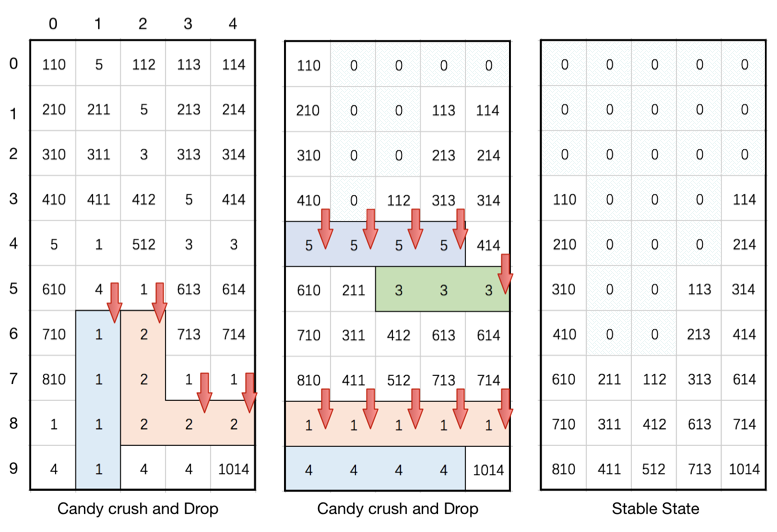
Note:
- The length of
boardwill be in the range [3, 50]. - The length of
board[i]will be in the range [3, 50]. - Each
board[i][j]will initially start as an integer in the range [1, 2000].
一个类似糖果消消乐游戏的题,给一个二维数组board,数组代表糖果,在水平和竖直方向上3个或以上连续相同的数字可以被消除,消除后位于上方的数字会填充空位。注意是所以能消除的糖果消除后然后再落下,进行第二次消除。直到最后没有能消除的了,达到稳定状态。
解法:标记出所有需要被crush的元素,然后去掉这些元素,将上面的数下降,空位变为0。难的地方是如何确定哪些元素需要被crush。
Python:
class Solution(object):

    def candyCrush(self, board):

        """

        :type board: List[List[int]]

        :rtype: List[List[int]]

        """

        R, C = len(board), len(board[0])

        changed = True

        while changed:

            changed = False

            for r in xrange(R):

                for c in xrange(C-2):

                    if abs(board[r][c]) == abs(board[r][c+1]) == abs(board[r][c+2]) != 0:

                        board[r][c] = board[r][c+1] = board[r][c+2] = -abs(board[r][c])

                        changed = True

            for r in xrange(R-2):

                for c in xrange(C):

                    if abs(board[r][c]) == abs(board[r+1][c]) == abs(board[r+2][c]) != 0:

                        board[r][c] = board[r+1][c] = board[r+2][c] = -abs(board[r][c])

                        changed = True

            for c in xrange(C):

                i = R-1

                for r in reversed(xrange(R)):

                    if board[r][c] > 0:

                        board[i][c] = board[r][c]

                        i -= 1

                for r in reversed(xrange(i+1)):

                    board[r][c] = 0

        return board
C++:
// Time:  O((R * C)^2)

// Space: O(1)

class Solution {

public:

    vector<vector<int>> candyCrush(vector<vector<int>>& board) {

        const auto R = board.size(), C = board[0].size();

        bool changed = true;

        while (changed) {

            changed = false;

            for (int r = 0; r < R; ++r) {

                for (int c = 0; c + 2 < C; ++c) {

                    auto v = abs(board[r][c]);

                    if (v != 0 && v == abs(board[r][c + 1]) && v == abs(board[r][c + 2])) {

                        board[r][c] = board[r][c + 1] = board[r][c + 2] = -v;

                        changed = true;

                    }

                }

            }

            for (int r = 0; r + 2 < R; ++r) {

                for (int c = 0; c < C; ++c) {

                    auto v = abs(board[r][c]);

                    if (v != 0 && v == abs(board[r + 1][c]) && v == abs(board[r + 2][c])) {

                        board[r][c] = board[r + 1][c] = board[r + 2][c] = -v;

                        changed = true;

                    }

                }

            }

            for (int c = 0; c < C; ++c) {

                int empty_r = R - 1;

                for (int r = R - 1; r >= 0; --r) {

                    if (board[r][c] > 0) {

                        board[empty_r--][c] = board[r][c];

                    }

                }

                for (int r = empty_r; r >= 0; --r) {

                    board[r][c] = 0;

                }

            }

        }

        return board;

    }

};
C++:
class Solution {

public:

    vector<vector<int>> candyCrush(vector<vector<int>>& board) {

        int m = board.size(), n = board[0].size();

        while (true) {

            vector<pair<int, int>> del;

            for (int i = 0; i < m; ++i) {

                for (int j = 0; j < n; ++j) {

                    if (board[i][j] == 0) continue;

                    int x0 = i, x1 = i, y0 = j, y1 = j;

                    while (x0 >= 0 && x0 > i - 3 && board[x0][j] == board[i][j]) --x0;

                    while (x1 < m && x1 < i + 3 && board[x1][j] == board[i][j]) ++x1;

                    while (y0 >= 0 && y0 > j - 3 && board[i][y0] == board[i][j]) --y0;

                    while (y1 < n && y1 < j + 3 && board[i][y1] == board[i][j]) ++y1;

                    if (x1 - x0 > 3 || y1 - y0 > 3) del.push_back({i, j});

                }

            }

            if (del.empty()) break;

            for (auto a : del) board[a.first][a.second] = 0;

            for (int j = 0; j < n; ++j) {

                int t = m - 1;

                for (int i = m - 1; i >= 0; --i) {

                    if (board[i][j]) swap(board[t--][j], board[i][j]);

                }

            }

        }

        return board;

    }

};
C++:
class Solution {

public:

    vector<vector<int>> candyCrush(vector<vector<int>>& board) {

        int m = board.size(), n = board[0].size();

        bool toBeContinued = false;

        for (int i = 0; i < m; ++i) { // horizontal crushing

            for (int j = 0; j + 2 < n; ++j) {

                int& v1 = board[i][j];

                int& v2 = board[i][j+1];

                int& v3 = board[i][j+2];

                int v0 = std::abs(v1);

                if (v0 && v0 == std::abs(v2) && v0 == std::abs(v3)) {

                    v1 = v2 = v3 = - v0;

                    toBeContinued =  true;

                }

            }

        }

        for (int i = 0; i + 2 < m; ++i) {  // vertical crushing

            for (int j = 0; j < n; ++j) {

                int& v1 = board[i][j];

                int& v2 = board[i+1][j];

                int& v3 = board[i+2][j];

                int v0 = std::abs(v1);

                if (v0 && v0 == std::abs(v2) && v0 == std::abs(v3)) {

                    v1 = v2 = v3 = -v0;

                    toBeContinued = true;

                }

            }

        }

        for (int j = 0; j < n; ++j) { // gravity step

            int dropTo = m - 1;

            for (int i = m - 1; i >= 0; --i) {

                if (board[i][j] >= 0) {

                    board[dropTo--][j] = board[i][j];

                }

            }

            for (int i = dropTo; i >= 0; i--) {

                board[i][j] = 0;

            }

        }

        return toBeContinued ? candyCrush(board) : board;

    }

};
All LeetCode Questions List 题目汇总
[LeetCode] 723. Candy Crush 糖果粉碎的更多相关文章
- [LeetCode] 723. Candy Crush 糖果消消乐
This question is about implementing a basic elimination algorithm for Candy Crush. Given a 2D intege ...
- LeetCode 723. Candy Crush
原题链接在这里:https://leetcode.com/problems/candy-crush/ 题目: This question is about implementing a basic e ...
- [LeetCode] Candy Crush 糖果消消乐
This question is about implementing a basic elimination algorithm for Candy Crush. Given a 2D intege ...
- 【LeetCode】723. Candy Crush 解题报告 (C++)
作者: 负雪明烛 id: fuxuemingzhu 个人博客:http://fuxuemingzhu.cn/ 目录 题目描述 题目大意 解题方法 暴力 日期 题目地址:https://leetcode ...
- [LeetCode] Candy (分糖果),时间复杂度O(n),空间复杂度为O(1),且只需遍历一次的实现
[LeetCode] Candy (分糖果),时间复杂度O(n),空间复杂度为O(1),且只需遍历一次的实现 原题: There are N children standing in a line. ...
- LeetCode:135. 分发糖果
LeetCode:135. 分发糖果 老师想给孩子们分发糖果,有 N 个孩子站成了一条直线,老师会根据每个孩子的表现,预先给他们评分. 你需要按照以下要求,帮助老师给这些孩子分发糖果: 每个孩子至少分 ...
- [LeetCode] Candy 分糖果问题
There are N children standing in a line. Each child is assigned a rating value. You are giving candi ...
- LeetCode OJ:Candy(糖果问题)
There are N children standing in a line. Each child is assigned a rating value. You are giving candi ...
- LeetCode.888-公平的糖果交换(Fair Candy Swap)
这是悦乐书的第339次更新,第363篇原创 01 看题和准备 今天介绍的是LeetCode算法题中Easy级别的第208题(顺位题号是888).Alice和Bob有不同大小的糖果棒:A[i]是Alic ...
随机推荐
- Echo团队Alpha冲刺随笔 - 第九天
项目冲刺情况 进展 已经进入测试阶段,正在消除系统的bug 问题 通过测试,找出了系统中存在的较多bug...... 体会 测试太重要了,很多原本以为没什么bug,一测就能找到好几个,而且改个bug真 ...
- GIL锁是什么鬼?
参考链接: http://cenalulu.github.io/python/gil-in-python/ GIL不是Python特性 GIL是Python解释器(Cpython)时引入的概念,在JP ...
- 学习Spring-Data-Jpa(十二)---投影Projections-对查询结果的扩展
Spring-Data数据查询方法的返回通常的是Repository管理的聚合根的一个或多个实例.但是,有时候我们只需要返回某些特定的属性,不需要全部返回,或者只返回一些复合型的字段.Spring-D ...
- LeetCode 959. Regions Cut By Slashes
原题链接在这里:https://leetcode.com/problems/regions-cut-by-slashes/ 题目: In a N x N grid composed of 1 x 1 ...
- Web API design
Web API design 28 minutes to read Most modern web applications expose APIs that clients can use to i ...
- How to change hostname on debian
How to change hostname on Debian 10 Linux last updated July 13, 2019 in CategoriesDebian / Ubuntu, L ...
- HBase 基本入门篇
无论是 NoSQL,还是大数据领域,HBase 都是非常”炙热”的一门数据库.本文将对 HBase 做一些基础性的介绍,旨在入门. 一.简介 HBase 是一个开源的.面向列的非关系型分布式数据库,目 ...
- fake_useragent 本地运行各种报错解决办法
- 【dp】P1064 金明的预算方案
题目描述 金明今天很开心,家里购置的新房就要领钥匙了,新房里有一间金明自己专用的很宽敞的房间.更让他高兴的是,妈妈昨天对他说:“你的房间需要购买哪些物品,怎么布置,你说了算,只要不超过NN元钱就行”. ...
- 过拟合产生的原因(Root of Overfitting)
之前在<过拟合和欠拟合(Over fitting & Under fitting)>一文中简要地介绍了过拟合现象,现在来详细地分析一下过拟合产生的原因以及相应的解决办法. 过拟合产 ...