
机器学习作业(二)逻辑回归——Matlab实现
题目太长啦!文档下载【传送门】
第1题
简述:实现逻辑回归。
第1步:加载数据文件:
data = load('ex2data1.txt');

X = data(:, [1, 2]); y = data(:, 3);

plotData(X, y);

% Put some labels

hold on;

% Labels and Legend

xlabel('Exam 1 score')

ylabel('Exam 2 score')

% Specified in plot order

legend('Admitted', 'Not admitted')

hold off;
第2步:plotData函数实现训练样本的可视化:
function plotData(X, y)

% Create New Figure

figure;

hold on;

pos = find(y==1);

neg = find(y==0);

plot(X(pos,1),X(pos,2),'k+','LineWidth',2,'MarkerSize',7);

plot(X(neg,1),X(neg,2),'ko','MarkerFaceColor','y','MarkerSize',7);

hold off;

end
第3步:计算代价函数和梯度:
%  Setup the data matrix appropriately, and add ones for the intercept term

[m, n] = size(X);

% Add intercept term to x and X_test

X = [ones(m, 1) X];

% Initialize fitting parameters

initial_theta = zeros(n + 1, 1);

% Compute and display initial cost and gradient

[cost, grad] = costFunction(initial_theta, X, y);
第4步:实现costFunction函数:
function [J, grad] = costFunction(theta, X, y)

m = length(y); % number of training examples

J = 0;

grad = zeros(size(theta));

h = sigmoid(X*theta);

J = 1/m*(-y'*log(h)-(1-y')*log(1-h));

grad = 1/m*(X'*(h-y));

end
第5步:实现sigmoid函数:
function g = sigmoid(z)

g = zeros(size(z));

g = 1./(1+exp(-z));

end
第6步:使用fminunc函数求θ和Cost:
%  Set options for fminunc

options = optimset('GradObj', 'on', 'MaxIter', 400);

%  Run fminunc to obtain the optimal theta

%  This function will return theta and the cost

[theta, cost] = ...

	fminunc(@(t)(costFunction(t, X, y)), initial_theta, options);

% Print theta to screen

fprintf('Cost at theta found by fminunc: %f\n', cost);

fprintf('theta: \n');

fprintf(' %f \n', theta);

% Plot Boundary

plotDecisionBoundary(theta, X, y);

% Put some labels

hold on;

% Labels and Legend

xlabel('Exam 1 score')

ylabel('Exam 2 score')

% Specified in plot order

legend('Admitted', 'Not admitted')

hold off;
第7步:实现plotDecisionBoundary函数:
function plotDecisionBoundary(theta, X, y)

% Plot Data

plotData(X(:,2:3), y);

hold on

if size(X, 2) <= 3

    % Only need 2 points to define a line, so choose two endpoints

    plot_x = [min(X(:,2))-2,  max(X(:,2))+2];

    % Calculate the decision boundary line

    plot_y = (-1./theta(3)).*(theta(2).*plot_x + theta(1));

    % Plot, and adjust axes for better viewing

    plot(plot_x, plot_y)

    % Legend, specific for the exercise

    legend('Admitted', 'Not admitted', 'Decision Boundary')

    axis([30, 100, 30, 100])

else

    % Here is the grid range

    u = linspace(-1, 1.5, 50);

    v = linspace(-1, 1.5, 50);

    z = zeros(length(u), length(v));

    % Evaluate z = theta*x over the grid

    for i = 1:length(u)

        for j = 1:length(v)

            z(i,j) = mapFeature(u(i), v(j))*theta;

        end

    end

    z = z'; % important to transpose z before calling contour

    % Plot z = 0

    % Notice you need to specify the range [0, 0]

    contour(u, v, z, [0, 0], 'LineWidth', 2)

end

hold off

end
运行结果:
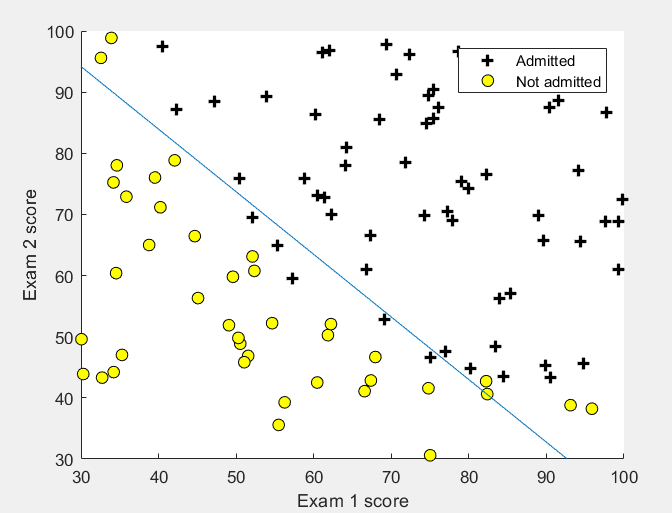
第8步:预测[45 85]成绩的学生,并计算准确率:
prob = sigmoid([1 45 85] * theta);

fprintf(['For a student with scores 45 and 85, we predict an admission ' ...

         'probability of %f\n'], prob);

fprintf('Expected value: 0.775 +/- 0.002\n\n');

% Compute accuracy on our training set

p = predict(theta, X);

fprintf('Train Accuracy: %f\n', mean(double(p == y)) * 100);

fprintf('Expected accuracy (approx): 89.0\n');

fprintf('\n');
第9步:实现predict预测函数:
function p = predict(theta, X)

m = size(X, 1); % Number of training examples

p = zeros(m, 1);

p = round(sigmoid(X*theta));

end
运行结果:

第2题
简述:通过正规化实现逻辑回归。
第1步:加载数据文件:
data = load('ex2data2.txt');

X = data(:, [1, 2]); y = data(:, 3);

plotData(X, y);

% Put some labels

hold on;

% Labels and Legend

xlabel('Microchip Test 1')

ylabel('Microchip Test 2')

% Specified in plot order

legend('y = 1', 'y = 0')

hold off;
第2步:正规化逻辑回归:
% Note that mapFeature also adds a column of ones for us, so the intercept

% term is handled

X = mapFeature(X(:,1), X(:,2));

% Initialize fitting parameters

initial_theta = zeros(size(X, 2), 1);

% Set regularization parameter lambda to 1

lambda = 1;

% Compute and display initial cost and gradient for regularized logistic

% regression

[cost, grad] = costFunctionReg(initial_theta, X, y, lambda);

fprintf('Cost at initial theta (zeros): %f\n', cost);

fprintf('Gradient at initial theta (zeros) - first five values only:\n');

fprintf(' %f \n', grad(1:5));
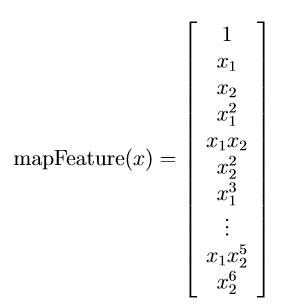
第3步:mapFeature函数实现特征设置:
function out = mapFeature(X1, X2)

degree = 6;

out = ones(size(X1(:,1)));

for i = 1:degree

    for j = 0:i

        out(:, end+1) = (X1.^(i-j)).*(X2.^j);

    end

end

end
其设置的特征值为:
第4步:实现costFunctionReg函数:
function [J, grad] = costFunctionReg(theta, X, y, lambda)

% Initialize some useful values

m = length(y); % number of training examples

% You need to return the following variables correctly

J = 0;

grad = zeros(size(theta));

theta2 = theta(2:end,1);

h = sigmoid(X*theta);

J = 1/m*(-y'*log(h)-(1-y')*log(1-h)) + lambda/(2*m)*sum(theta2.^2);

theta(1,1) = 0;

grad = 1/m*(X'*(h-y)) + lambda/m*theta;

end
第5步:使用fminunc函数求θ和Cost,并预测准确率:
% Initialize fitting parameters

initial_theta = zeros(size(X, 2), 1);

% Set regularization parameter lambda to 1 (you should vary this)

lambda = 1;

% Set Options

options = optimset('GradObj', 'on', 'MaxIter', 400);

% Optimize

[theta, J, exit_flag] = ...

	fminunc(@(t)(costFunctionReg(t, X, y, lambda)), initial_theta, options);

% Plot Boundary

plotDecisionBoundary(theta, X, y);

hold on;

title(sprintf('lambda = %g', lambda))

% Labels and Legend

xlabel('Microchip Test 1')

ylabel('Microchip Test 2')

legend('y = 1', 'y = 0', 'Decision boundary')

hold off;

% Compute accuracy on our training set

p = predict(theta, X);

fprintf('Train Accuracy: %f\n', mean(double(p == y)) * 100);

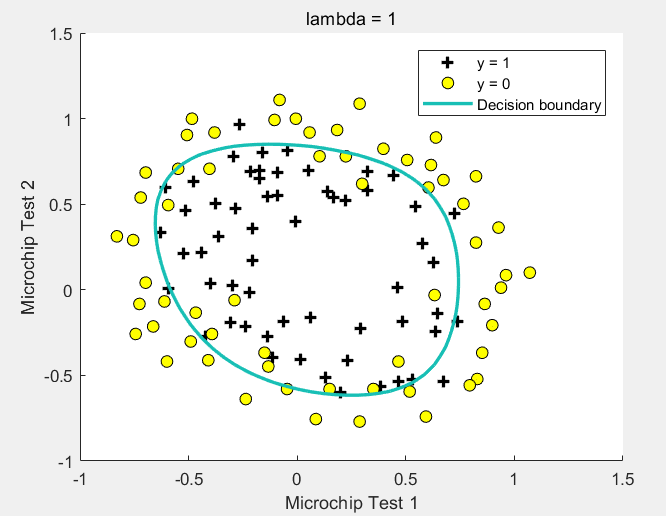
fprintf('Expected accuracy (with lambda = 1): 83.1 (approx)\n');
运行结果:

机器学习作业(二)逻辑回归——Matlab实现的更多相关文章
- 机器学习二 逻辑回归作业、逻辑回归(Logistic Regression)
机器学习二 逻辑回归作业 作业在这,http://speech.ee.ntu.edu.tw/~tlkagk/courses/ML_2016/Lecture/hw2.pdf 是区分spam的. 57 ...
- 机器学习总结之逻辑回归Logistic Regression
机器学习总结之逻辑回归Logistic Regression 逻辑回归logistic regression,虽然名字是回归,但是实际上它是处理分类问题的算法.简单的说回归问题和分类问题如下: 回归问 ...
- Coursera-AndrewNg(吴恩达)机器学习笔记——第三周编程作业(逻辑回归)
一. 逻辑回归 1.背景:使用逻辑回归预测学生是否会被大学录取. 2.首先对数据进行可视化,代码如下: pos = find(y==); %找到通过学生的序号向量 neg = find(y==); % ...
- scikit-learn机器学习(二)逻辑回归进行二分类(垃圾邮件分类),二分类性能指标,画ROC曲线,计算acc,recall,presicion,f1
数据来自UCI机器学习仓库中的垃圾信息数据集 数据可从http://archive.ics.uci.edu/ml/datasets/sms+spam+collection下载 转成csv载入数据 im ...
- Stanford机器学习---第三讲. 逻辑回归和过拟合问题的解决 logistic Regression & Regularization
原文:http://blog.csdn.net/abcjennifer/article/details/7716281 本栏目(Machine learning)包括单参数的线性回归.多参数的线性回归 ...
- 【机器学习基础】逻辑回归——LogisticRegression
LR算法作为一种比较经典的分类算法,在实际应用和面试中经常受到青睐,虽然在理论方面不是特别复杂,但LR所牵涉的知识点还是比较多的,同时与概率生成模型.神经网络都有着一定的联系,本节就针对这一算法及其所 ...
- 机器学习入门11 - 逻辑回归 (Logistic Regression)
原文链接:https://developers.google.com/machine-learning/crash-course/logistic-regression/ 逻辑回归会生成一个介于 0 ...
- Spark机器学习(2):逻辑回归算法
逻辑回归本质上也是一种线性回归,和普通线性回归不同的是,普通线性回归特征到结果输出的是连续值,而逻辑回归增加了一个函数g(z),能够把连续值映射到0或者1. MLLib的逻辑回归类有两个:Logist ...
- Logistic回归二分类Winner or Losser----台大李宏毅机器学习作业二(HW2)
一.作业说明 给定训练集spam_train.csv,要求根据每个ID各种属性值来判断该ID对应角色是Winner还是Losser(0.1分类). 训练集介绍: (1)CSV文件,大小为4000行X5 ...
随机推荐
- [Docker] 使用docker inspect查看宿主机与容器的共享目录
docker inspect 容器名,可以查看到容器的元信息,在返回的j'son信息里面有个Mounts字段可以看到挂载目录 "Mounts": [ { "Type&qu ...
- 封装好通用的reset.css base.css 样式重置css文件
一般是叫reset.css 我这边命名成base.css 哎呀无所谓…… @charset "UTF-8"; /*css reset*/ /*清除内外边距*/ body, h1, ...
- jni和线程
JNI官方规范中文版——在程序中集成JVM需要注意的JNI特征 翻译 我们已经讨论了JNI在写本地代码和向本地应用程序中集成JVM时的特征.本章接下来的部分分介绍其它的JNI特征. 8.1 JNI和线 ...
- .NetCore 3.0迁移遇到的各种问题
错误集合 [错误]当前+.NET+SDK+不支持将+.NET+Core+3.0+设置为目标.请将+.NET+Core+2.2+或更低版 [解决方法]勾选上就可以了 2. [错误] add-migrat ...
- 这 100 道 Python 题,拿去刷!!!
2020年,学 Python 还有价值吗? 根据 2020 年 2 月的 TIOBE 编程语言排行榜显示,Python仍然稳居第三位. 此排行榜排名基于互联网上有经验的程序员. 课程和第三方厂商的数量 ...
- 《自拍教程21》mediainfo_多媒体文件查看工具
mediainfo命令介绍 mediainfo.exe(Linux/iMac下是未带后缀的mediainfo), 是一款音视频图片文件的信息查询工具, 常用于查看多媒体文件的视频流信息,音频流信息,字 ...
- Ajax工作原理及优缺点
1. Ajax是什么? 全称是 asynchronous javascript and xml,是已有技术的组合,主要用来实现客户端与服务器端的异步通信效果(无需重新加载整个网页的情况下),实现页面的 ...
- VUE路径问题
import: html文件中,通过script标签引入js文件. 而vue中,通过import xxx from xxx路径的方式导入文件,不光可以导入js文件. "xxx"指的 ...
- 1级搭建类104-Oracle 12cR2 单实例 FS(阿里云)公开
项目文档引子系列是根据项目原型,制作的测试实验文档,目的是为了提升项目过程中的实际动手能力,打造精品文档AskScuti. 项目文档引子系列目前不对外发布,仅作为博客记录.如学员在实际工作过程中需提前 ...
- 如何使用vscode-代码编辑器工具
vscode-代码编辑器的全称是“visual studio code”,主要是一个运行于 Mac OS X.Windows和 Linux 之上的,针对于编写现代 Web 和云应用的跨平台源代码编辑器 ...