
Nginx - Additional Modules, Website Access and Logging
The following set of modules allows you to configure how visitors access your website and the way your server logs requests.
Index
The Index module provides a simple directive named index, which lets you define the page that Nginx will serve by default if no filename is specified in the client request (in other words, it defines the website index page). You may specify multiple filenames; the first file to be found will be served. If none of the specified files are found, Nginx will either attempt to generate an automatic index of the files, if the autoindex directive is enabled, or return a 403 Forbidden error page.
Optionally, you may insert an absolute filename (such as /page.html) but only as the last argument of the directive.
Syntax: index file1 [file2…] [absolute_file];
Default value: index.html
Eaxmple:
index index.php index.html index.htm;
index index.php index2.php /catchall.php;
This directive is valid in the following contexts: http, server, location.
Autoindex
If Nginx cannot provide an index page for the requested directory, the default behavior is to return a 403 Forbidden HTTP error page. With the following set of directives, you enable an automatic listing of the files that are present in the requested directory:
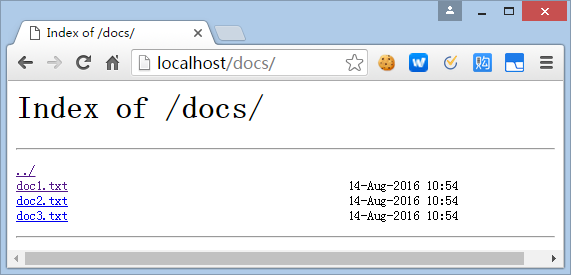
Three columns of information appear for each file—the filename, the file date and time, and the file size in bytes.
autoindex
Context: http, server, location
Enables or disables automatic directory listing for directories missing an index page.
Syntax: on or off
autoindex_exact_size
Context: http, server, location
If set to on, this directive ensures that the listing displays file sizes in bytes. Otherwise, another unit is employed, such as KB, MB, or GB.
Syntax: on or off
Default value: on
autoindex_localtime
Context: http, server, location
By default, this directive is set to off, so the date and time of files in the listing appears as GMT time. Set it to on to make use of the local server time.
Syntax: on or off
Default value: off
Random Index
This module enables a simple directive, random_index, which can be used within a location block in order for Nginx to return an index page selected randomly among the files of the specified directory.
This module is not included in the default Nginx build.
Syntax: on or off
Log
This module controls the behavior of Nginx regarding access logs. It is a key module for system administrators as it allows analyzing the runtime behavior of web applications. It is composed of three essential directives:
access_log
Context: http, server, location
This parameter defines the access log file path, the format of entries in the access log by selecting a template name, or disables access logging.
Syntax: access_log path [format [buffer=size]] | off;
Some remarks concerning the directive syntax:
- Use access_log off to disable access logging at the current level
- The format argument corresponds to a template declared with the log_format directive, described below
- If the format argument is not specified, the default format is employed (combined)
- You may use variables in the file path
log_format
Context: http, server, location
Defines a template to be utilized by the access_log directive, describing the contents that should be included in an entry of
the access log.
Syntax: log_format template_name format_string;
The default template is called combined and matches the following example:
log_format combined '$remote_addr - $remote_user [$time_local] '"$request" $status $body_bytes_sent '"$http_referer" "$http_user_agent"';
# Other example
log_format simple '$remote_addr $request';
open_log_file_cache
Context: http, server, location
Configures the cache for log file descriptors. Please refer to the open_file_cache directive of the HTTP Core Module for additional information.
Syntax: open_log_file_cache max=N [inactive=time] [min_uses=N] [valid=time] | off;
The arguments are similar to the open_file_cache and other related directives; the difference being that this applies to access log files only.
The Log module also enables several new variables, though they are only accessible when writing log entries:
- $connection: The connection number
- $pipe: The variable is set to "p" if the request was pipelined
- $time_local: Local time (at the time of writing the log entry)
- $msec: Local time (at the time of writing the log entry) to the microsecond
- $request_time: Total length of the request processing, in milliseconds
- $status: Response status code
- $bytes_sent: Total number of bytes sent to the client
- $body_bytes_sent: Number of bytes sent to the client for the response body
- $apache_bytes_sent: Similar to $body_bytes, which corresponds to the %B parameter of Apache's mod_log_config
- $request_length: Length of the request body
Nginx - Additional Modules, Website Access and Logging的更多相关文章
- Nginx - Additional Modules, About Your Visitors
The following set of modules provides extra functionality that will help you find out more informati ...
- Nginx - Additional Modules, Limits and Restrictions
The following modules allow you to regulate access to the documents of your websites — require users ...
- Nginx - Additional Modules, Content and Encoding
The following set of modules provides functionalities having an effect on the contents served to the ...
- Nginx - Additional Modules, SSL and Security
Nginx provides secure HTTP functionalities through the SSL module but also offers an extra module ca ...
- 通过Nginx,Tomcat访问日志(access log)记录请求耗时
一.Nginx通过$upstream_response_time $request_time统计请求和后台服务响应时间 nginx.conf使用配置方式: log_format main '$remo ...
- Thinkphp框架网站 nginx环境 访问页面access denied
今日不熟一个tiinkphp框架网站的时候,由于服务器环境是centos6.5+nginx1.8,已经运行php商城项目很正常, 本以为一切比较简单,直接新建了项目文件夹,xftp上传了程序,并配置n ...
- linux+nginx+phpfpm 访问出现Access denied错误解决方案
linux上安装nginx,php-fpm后访问页面一直出现Access denied错误. 网上搜原因大概如下图: 我试了第一个方案,然后就好了.
- Table of Contents - Nginx
Downloading and Installing Nginx Nginx for Windows Basic Nginx Configuration Configuration File Syn ...
- nginx---reference
nginx (pronounced "engine x") is a free open source web server written by Igor Sysoev, a R ...
随机推荐
- Elasticsearch和mysql数据同步(logstash)
1.版本介绍 Elasticsearch: https://www.elastic.co/products/elasticsearch 版本:2.4.0 Logstash: https://www ...
- js奇葩错误 字符串传递问题
第一种方式function hello(){ var name="he"; var content="<input type=button value= ...
- 在Android Eclipse 开发如何 使用 (*.aar)文件
http://www.cnblogs.com/shortboy/p/4424944.html 开场白:其实这篇文章有点白费心机. 详细说明是:http://blog.csdn.net/qiujuer/ ...
- mysql中查询"_"这种特殊字符
http://www.w3school.com.cn/sql/sql_wildcards.asp SQL 通配符 在搜索数据库中的数据时,SQL 通配符可以替代一个或多个字符. SQL 通配符必须与 ...
- IOS Note - Outlet(插座) & Action(动作)
OutletActionViewController.h #import <UIKit/UIKit.h> @interface OutletActionViewController : U ...
- .Net语言 APP开发平台——Smobiler学习日志:开发APP时,如何快速地实现屏幕自适应
最前面的话:Smobiler是一个在VS环境中使用.Net语言来开发APP的开发平台,也许比Xamarin更方便 一.属性介绍 设置控件在客户端屏幕可见并超出客户端屏幕时,是否自动调节高度以适应屏幕高 ...
- 在C# WinForm程序中创建控件数组及相应的事件处理
控件数组是VB提供的一个优秀的设计解决方案,它能很方便快捷的处理大批同类控件的响应和时间处理,但不知为什么在C#中这个优秀特性没有传承下来,甚为可惜,本文将要探讨就是如何在C# WinForm程序实现 ...
- 谷歌插件开发(实现CSDN快速登陆)
谷歌浏览器插件带来了很大的方便,于是就想着是不是也可以开发一个来用用.几经折腾下,开发了个CSDN快速 登陆的插件.下面简述一下开发的步骤. 1.开发工具:谷歌浏览器(我开发时用的是chrome 30 ...
- 苹果Swift语言中文教程资源汇总
苹果swift语言中文教程(零)搭配环境以及代码执行成功http://vjiazhi.com/kaifa/1014.html 苹果Swift语言中文教程(一)基础数据类型 http://vjiazhi ...
- MySQL · 特性分析 · innodb 锁分裂继承与迁移
http://mysql.taobao.org/monthly/2016/06/01/ innodb行锁简介 行锁类型 LOCK_S:共享锁 LOCK_X: 排他锁 GAP类型 LOCK_GAP:只锁 ...