
栈与队列(Stack and Queue)
1.定义
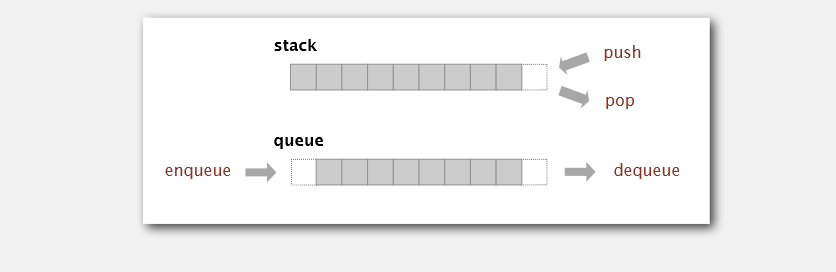
栈:后进先出(LIFO-last in first out):最后插入的元素最先出来。
队列:先进先出(FIFO-first in first out):最先插入的元素最先出来。
2.用数组实现栈和队列
实现栈:
由于数组大小未知,如果每次插入元素都扩展一次数据(每次扩展都意味着构建一个新数组,然后把旧数组复制给新数组),那么性能消耗相当严重。
这里使用贪心算法,数组每次被填满后,加入下一个元素时,把数组拓展成现有数组的两倍大小。
每次移除元素时,检测数组空余空间有多少。当数组里的元素个数只有整个数组大小的四分之一时,数组减半。
为什么不是当数组里的元素个数只有整个数组大小的二分之一时,数组减半?考虑以下情况:数组有4个元素,数组大小为4个元素空间。此时,加一个元素,数组拓展成8个空间;再减一个元素,数组缩小为4个空间;如此循环,性能消耗严重。
具体代码(Java):
public ResizingArrayStackOfStrings()

{

    s=new String[1];
    int N = 0;

}

pubilc void Push(String item)

{

    //如果下一个加入元素超出数组容量,拓展数组

    if(N == s.length) Resize(2 * s.length);

    s[N++] = item;

}

private void Resize(int capacity)

{

   String[] copy = new String[capacity];

   //将旧数组元素复制给新数组

   for(int i=0; i<N; i++) copy[i] = s[i];

   s = copy;

}

public String Pop()

{

  String item = s[--N];

  s[N] = null;

//剩余元素只占数组四分之一空间时,数组减半

  if(N>0 && N=s.length/4) Resize(s.length/2);

  return item;

}
效果如下图:

实现队列
与栈类似:
数组每次被填满后,加入下一个元素时,把数组拓展成现有数组的两倍大小。
每次移除元素时,检测数组空余空间有多少。当数组里的元素个数只有整个数组大小的四分之一时,数组减半。
不同之处在于:
由于是先进先出,移除是从队列的最前端开始的。所以当我们移除数个数据后,队列数据是存储在数组的中间部分的。令队列数据的尾端数据ID为Num,首端数据ID为HeadIndex,则Num - HeadIndex为队列数据元素个数。
当队列数据元素个数为整个数组空间的四分之一时,数组减半,且队列数据左移至数组最左端。即Num-=HeadIndex;HeadIndex=0;

图中,HeadIndex=2;Num=5;
具体代码:
.h:

UCLASS()

class ALGORITHM_API AStackAndQueuesExerciseTwo : public AActor

{

    GENERATED_BODY()

public:

    // Sets default values for this actor's properties

    AStackAndQueuesExerciseTwo();

    // Called every frame

    virtual void Tick(float DeltaTime) override;

    //输入

    void Enqueue(int Input);

    //重构数组(拓展或缩小)

    void Resize(int Capacity);

    //输出且移除

    int Dequeue();

    //队列里没元素了?

    bool IsEmpty();

protected:

    // Called when the game starts or when spawned

    virtual void BeginPlay() override;

public:

private:

    //记录数组中有多少个Int

    int Num;

    //队列数组

    TArray<int> MyIntArray;

    //记录下一个移除的数据ID

    int HeadIndex;

};

.cpp:

AStackAndQueuesExerciseTwo::AStackAndQueuesExerciseTwo()

{

     // Set this actor to call Tick() every frame.  You can turn this off to improve performance if you don't need it.

    PrimaryActorTick.bCanEverTick = true;

    //一开始数组没成员

    Num = ;

    HeadIndex = ;

    //数组中有一个假元素

    MyIntArray.Add();

}

// Called when the game starts or when spawned

void AStackAndQueuesExerciseTwo::BeginPlay()

{

    Super::BeginPlay();

    //测试

    Enqueue();

    Enqueue();

    Enqueue();

    Enqueue();

    Enqueue();

    Dequeue();

    Dequeue();

    Dequeue();

    //队列数组成员

    for (int i = HeadIndex; i < Num; i++)

    {

        UKismetSystemLibrary::PrintString(this, "i: " + FString::FromInt(i) + " End: " + FString::FromInt(MyIntArray[i]));

    }

    //队列数组的容量

    UKismetSystemLibrary::PrintString(this, "MyIntArray.Num(): " + FString::FromInt(MyIntArray.Num()));

}

// Called every frame

void AStackAndQueuesExerciseTwo::Tick(float DeltaTime)

{

    Super::Tick(DeltaTime);

}

void AStackAndQueuesExerciseTwo::Enqueue(int Input)

{

    //如果队列数组已满,拓展数组

    if (Num == MyIntArray.Num())

    {

        Resize( * MyIntArray.Num());

    }

    //拓展或者数组有空位时,添加元素

    if (Num < MyIntArray.Num())

    {

        MyIntArray[Num] = Input;

    }

    Num++;

}

void AStackAndQueuesExerciseTwo::Resize(const int Capacity)

{

    //int a[] = new int[Capacity];

    TArray<int> Copy;

    //添加数个假元素填充数组

    for (int i = ; i < Capacity; i++)

    {

        Copy.Add();

    }

    //将队列数组赋值给Copy数组,如果是缩小数组,则把队列数组左移,节省空间

    for (int i = HeadIndex; i < Num; i++)

    {

        Copy[i - HeadIndex] = MyIntArray[i];

    }

    MyIntArray = Copy;

}

int AStackAndQueuesExerciseTwo::Dequeue()

{

    //判断数组是否为空

    if (IsEmpty())

    {

        UKismetSystemLibrary::PrintString(this, "No Element Exist!!!");

        return ;

    }

    else

    {

        UKismetSystemLibrary::PrintString(this, "Dequeue: " + FString::FromInt(MyIntArray[HeadIndex]));

    }

    HeadIndex++;

    //如果移除元素后,所剩元素为数组空间的四分之一,则数组减半

    if ((Num - HeadIndex) !=  && (Num - HeadIndex) == (MyIntArray.Num() / ))

    {

        Resize(MyIntArray.Num() / );

        //移除空间后,队列数组左移,节省空间

        Num -= HeadIndex;

        HeadIndex = ;

        return MyIntArray[HeadIndex];

    }

    else

    {

        return MyIntArray[HeadIndex - ];

    }

}

//如果下一个要移除的数据不存在,则为空数组

bool AStackAndQueuesExerciseTwo::IsEmpty()

{

    return HeadIndex >= Num;

}
栈与队列(Stack and Queue)的更多相关文章
- Coursera Algorithms week2 栈和队列 练习测验: Queue with two stacks
题目原文: Implement a queue with two stacks so that each queue operations takes a constant amortized num ...
- LeetCode 232题用栈实现队列(Implement Queue using Stacks) Java语言求解
题目链接 https://leetcode-cn.com/problems/implement-queue-using-stacks/ 题目描述 使用栈实现队列的下列操作: push(x) -- 将一 ...
- C#LeetCode刷题之#232-用栈实现队列(Implement Queue using Stacks)
问题 该文章的最新版本已迁移至个人博客[比特飞],单击链接 https://www.byteflying.com/archives/4108 访问. 使用栈实现队列的下列操作: push(x) -- ...
- LeetCode 232. 用栈实现队列(Implement Queue using Stacks) 4
232. 用栈实现队列 232. Implement Queue using Stacks 题目描述 使用栈实现队列的下列操作: push(x) -- 将一个元素放入队列的尾部. pop() -- 从 ...
- Leedcode算法专题训练(栈和队列)
1. 用栈实现队列 232. Implement Queue using Stacks (Easy) Leetcode / 力扣 class MyQueue { Stack<Integer> ...
- lintcode :implement queue by two stacks 用栈实现队列
题目 用栈实现队列 正如标题所述,你需要使用两个栈来实现队列的一些操作. 队列应支持push(element),pop() 和 top(),其中pop是弹出队列中的第一个(最前面的)元素. pop和t ...
- [Swift]LeetCode232. 用栈实现队列 | Implement Queue using Stacks
Implement the following operations of a queue using stacks. push(x) -- Push element x to the back of ...
- LeetCode 232:用栈实现队列 Implement Queue using Stacks
题目: 使用栈实现队列的下列操作: push(x) -- 将一个元素放入队列的尾部. pop() -- 从队列首部移除元素. peek() -- 返回队列首部的元素. empty() -- 返回队列是 ...
- LeetCode#232-Implement Queue using Stacks-用栈实现队列
一.题目 使用栈实现队列的下列操作: push(x) -- 将一个元素放入队列的尾部. pop() -- 从队列首部移除元素. peek() -- 返回队列首部的元素. empty() -- 返回队列 ...
随机推荐
- js中如何通过身份证号计算出生日期和年龄
在html中有如下标签 身份证号:<input type="text" id="Gra_IDCard" onChange="IDCardChan ...
- 强制ubuntu登陆用户退出
#skill -KILL -u user1 杀死并注销user1. #skill -CONT -u user1 恢复user1. 在Windows 2003默认情况下,三个以上就远程不了,必须强制登录 ...
- Win10系列:JavaScript 数据绑定
使用数据绑定可以使页面中元素的属性值与数据源中的数据同步,其中数据源可以来自数据库.文件以及自定义的数据等.在常用的数据绑定方法中,简单对象绑定是将HTML元素与一个仅包含数据的简单对象相绑定,模板绑 ...
- 尚学堂java答案解析 第二章
本答案为本人个人编辑,仅供参考,如果读者发现,请私信本人或在下方评论,提醒本人修改 一.选择题: 1.CD 解析:A public是关键字. B 第一个不能是数字 2.C 解析:j=i++ < ...
- Java工厂方法模式
工厂方法模式: /** * 工厂方法模式:也叫工厂模式,属于创建型模式,父类工厂(接口)负责定义产品对象的公共接口, * 而子类工厂负责创建具体的产品对象. * 目的:是为了把产品的实例化操作延迟到子 ...
- commons-logging 与log4j的关系
参考:http://zachary-guo.iteye.com/blog/361177
- Java实现将数字转为大写汉字
public class Int2Big { static String int2big(int src) { final String num[] = {"零", "壹 ...
- Python返回值不同格式的取值方式
例: { "success": true, "topic_id": "5c89021773798770589936b0"} 转换成text, ...
- xilinx 高速收发器Serdes深入研究-Comma码(转)
一.为什么要用Serdes 传统的源同步传输,时钟和数据分离.在速率比较低时(<1000M),没有问题. 在速率越来越高时,这样会有问题 由于传输线的时延不一致和抖动存在,接收端不能正确的采样数 ...
- Excel日常操作
1.固定表头 视图+冻结窗口+选择 2.下拉列表 数据+数据验证+序列+来源 筛选值也可是函数,函数值区间可以选择,然后隐藏该列数据即可 使用函数: 如果需要函数的值其他列也使用类似函数则拖动同样格式 ...