
Collections.shuffle源码阅读
java.util.Collections
  /**

     * Randomly permutes the specified list using a default source of

     * randomness.  All permutations occur with approximately equal

     * likelihood.<p>

     *

     * The hedge "approximately" is used in the foregoing description because

     * default source of randomness is only approximately an unbiased source

     * of independently chosen bits. If it were a perfect source of randomly

     * chosen bits, then the algorithm would choose permutations with perfect

     * uniformity.<p>

     *

     * This implementation traverses the list backwards, from the last element

     * up to the second, repeatedly swapping a randomly selected element into

     * the "current position".  Elements are randomly selected from the

     * portion of the list that runs from the first element to the current

     * position, inclusive.<p>

     *

     * This method runs in linear time.  If the specified list does not

     * implement the {@link RandomAccess} interface and is large, this

     * implementation dumps the specified list into an array before shuffling

     * it, and dumps the shuffled array back into the list.  This avoids the

     * quadratic behavior that would result from shuffling a "sequential

     * access" list in place.

     *

     * @param  list the list to be shuffled.

     * @throws UnsupportedOperationException if the specified list or

     *         its list-iterator does not support the <tt>set</tt> operation.

     */

    public static void shuffle(List<?> list) {

        if (r == null) {

            r = new Random();

        }

        shuffle(list, r);

    }

    private static Random r;
java.util.Random
  /**

     * Randomly permute the specified list using the specified source of

     * randomness.  All permutations occur with equal likelihood

     * assuming that the source of randomness is fair.<p>

     *

     * This implementation traverses the list backwards, from the last element

     * up to the second, repeatedly swapping a randomly selected element into

     * the "current position".  Elements are randomly selected from the

     * portion of the list that runs from the first element to the current

     * position, inclusive.<p>

     *

     * This method runs in linear time.  If the specified list does not

     * implement the {@link RandomAccess} interface and is large, this

     * implementation dumps the specified list into an array before shuffling

     * it, and dumps the shuffled array back into the list.  This avoids the

     * quadratic behavior that would result from shuffling a "sequential

     * access" list in place.

     *

     * @param  list the list to be shuffled.

     * @param  rnd the source of randomness to use to shuffle the list.

     * @throws UnsupportedOperationException if the specified list or its

     *         list-iterator does not support the <tt>set</tt> operation.

     */

    public static void shuffle(List<?> list, Random rnd) {

        int size = list.size();

        if (size < SHUFFLE_THRESHOLD || list instanceof RandomAccess) {

            for (int i=size; i>1; i--)

                swap(list, i-1, rnd.nextInt(i));

        } else {

            Object arr[] = list.toArray();

            // Shuffle array

            for (int i=size; i>1; i--)

                swap(arr, i-1, rnd.nextInt(i));

            // Dump array back into list

            ListIterator it = list.listIterator();

            for (int i=0; i<arr.length; i++) {

                it.next();

                it.set(arr[i]);

            }

        }

    }
private static final int SHUFFLE_THRESHOLD = 5;
/**
* Swaps the elements at the specified positions in the specified list.
* (If the specified positions are equal, invoking this method leaves
* the list unchanged.)
*
* @param list The list in which to swap elements.
* @param i the index of one element to be swapped.
* @param j the index of the other element to be swapped.
* @throws IndexOutOfBoundsException if either <tt>i</tt> or <tt>j</tt>
* is out of range (i < 0 || i >= list.size()
* || j < 0 || j >= list.size()).
* @since 1.4
*/
public static void swap(List<?> list, int i, int j) {
final List l = list; //这一步有什么用
l.set(i, l.set(j, l.get(i)));
}
java.util.List

@org.intellij.lang.annotations.Flow(sourceIsContainer=true)

public abstract E set(int index,

                      @org.intellij.lang.annotations.Flow(targetIsContainer=true) E element)

Replaces the element at the specified position in this list with the specified element (optional operation).

Parameters:

index - index of the element to replace

element - element to be stored at the specified position

Returns:

the element previously at the specified position
    /**

     * Swaps the two specified elements in the specified array.

     */

    private static void swap(Object[] arr, int i, int j) {

        Object tmp = arr[i];

        arr[i] = arr[j];

        arr[j] = tmp;

    }
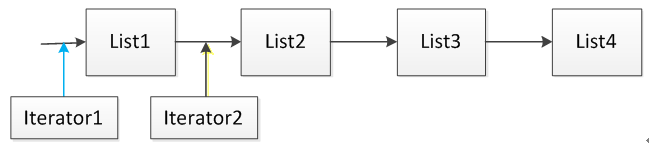
这里假设集合List由四个元素List1、List2、List3和List4组成,当使用语句Iterator it = List.Iterator()时,迭代器it指向的位置是上图中Iterator1指向的位置,当执行语句it.next()之后,迭代器指向的位置后移到上图Iterator2所指向的位置。
首先看一下Iterator和ListIterator迭代器的方法有哪些。
Iterator迭代器包含的方法有:
hasNext():如果迭代器指向位置后面还有元素,则返回 true,否则返回false
next():返回集合中Iterator指向位置后面的元素
remove():删除集合中Iterator指向位置后面的元素
ListIterator迭代器包含的方法有:
add(E e): 将指定的元素插入列表,插入位置为迭代器当前位置之前
hasNext():以正向遍历列表时,如果列表迭代器后面还有元素,则返回 true,否则返回false
hasPrevious():如果以逆向遍历列表,列表迭代器前面还有元素,则返回 true,否则返回false
next():返回列表中ListIterator指向位置后面的元素
nextIndex():返回列表中ListIterator所需位置后面元素的索引
previous():返回列表中ListIterator指向位置前面的元素
previousIndex():返回列表中ListIterator所需位置前面元素的索引
remove():从列表中删除next()或previous()返回的最后一个元素(有点拗口,意思就是对迭代器使用hasNext()方法时,删除ListIterator指向位置后面的元素;当对迭代器使用hasPrevious()方法时,删除ListIterator指向位置前面的元素)
set(E e):从列表中将next()或previous()返回的最后一个元素返回的最后一个元素更改为指定元素e
一.相同点
都是迭代器,当需要对集合中元素进行遍历不需要干涉其遍历过程时,这两种迭代器都可以使用。
二.不同点
1.使用范围不同,Iterator可以应用于所有的集合,Set、List和Map和这些集合的子类型。而ListIterator只能用于List及其子类型。
2.ListIterator有add方法,可以向List中添加对象,而Iterator不能。
3.ListIterator和Iterator都有hasNext()和next()方法,可以实现顺序向后遍历,但是ListIterator有hasPrevious()和previous()方法,可以实现逆向(顺序向前)遍历。Iterator不可以。
4.ListIterator可以定位当前索引的位置,nextIndex()和previousIndex()可以实现。Iterator没有此功能。
5.都可实现删除操作,但是ListIterator可以实现对象的修改,set()方法可以实现。Iterator仅能遍历,不能修改。
三:Iterator和ListIterator用法示例
ListIterator用法:
package com.collection;

import java.util.LinkedList;

import java.util.List;

import java.util.ListIterator;

public class ListIteratorTest {

 public static void main(String[] args) {

  List<String> staff = new LinkedList<>();

  staff.add("zhuwei");

  staff.add("xuezhangbin");

  staff.add("taozhiwei");

  ListIterator<String> iter = staff.listIterator();

  String first = iter.next();

  //删除zhuwei

  iter.remove();

  //把zhuwei改为simei

  //iter.set("simei");

  System.out.println("first:"+first);

  iter.add("xiaobai");

  //遍历List元素

  System.out.println("遍历List中元素,方法一:");

  for(String str : staff)

   System.out.println(str+"  ");

  iter = staff.listIterator();

  System.out.println("遍历List中元素,方法二:");

  while(iter.hasNext())

  {

   System.out.println(iter.next());

  }

 }

}
http://www.linuxidc.com/Linux/2014-11/109950.htm
Collections.shuffle源码阅读的更多相关文章
- Collections.shuffle()源码分析
Java.util.Collections类下有一个静态的shuffle()方法,如下: 1)static void shuffle(List<?> list) 使用默认随机源对列表进行 ...
- System.Collections.Generic 源码阅读总结
ArrayList ,List ArrayList 和 List 都是不限制长度的集合类型 ,List相比ArrayList 就内部实现而言除了泛型本质没有太大区别.不过为避免装箱拆箱问题,尽可能使用 ...
- Spark源码阅读之存储体系--存储体系概述与shuffle服务
一.概述 根据<深入理解Spark:核心思想与源码分析>一书,结合最新的spark源代码master分支进行源码阅读,对新版本的代码加上自己的一些理解,如有错误,希望指出. 1.块管理器B ...
- Flink源码阅读(1.7.2)
目录 Client提交任务 flink的图结构 StreamGraph OptimizedPlan JobGraph ExecutionGraph flink部署与执行模型 Single Job Jo ...
- Bert源码阅读
前言 对Google开源出来的bert代码,来阅读下.不纠结于代码组织形式,而只是梳理下其训练集的生成,训练的self-attention和multi-head的具体实现. 训练集的生成 主要实现在c ...
- ZooKeeper源码阅读——client(二)
原创技术文章,转载请注明:转自http://newliferen.github.io/ 如何连接ZooKeeper集群 要想了解ZooKeeper客户端实现原理,首先需要关注一下客户端的使用方式, ...
- SparkConf加载与SparkContext创建(源码阅读一)
即日起开始spark源码阅读之旅,这个过程是相当痛苦的,也许有大量的看不懂,但是每天一个方法,一点点看,相信总归会有极大地提高的.那么下面开始: 创建sparkConf对象,那么究竟它干了什么了类,从 ...
- java8 ArrayList源码阅读
转载自 java8 ArrayList源码阅读 本文基于jdk1.8 JavaCollection库中有三类:List,Queue,Set 其中List,有三个子实现类:ArrayList,Vecto ...
- JDK1.8源码阅读系列之三:Vector
本篇随笔主要描述的是我阅读 Vector 源码期间的对于 Vector 的一些实现上的个人理解,用于个人备忘,有不对的地方,请指出- 先来看一下 Vector 的继承图: 可以看出,Vector 的直 ...
随机推荐
- implode 多维数组转一维数组并字符串输出
//多维数组返回一维数组,拼接字符串输出 public function r_implode( $glue, $pieces ) { foreach( $pieces as $r_pieces ) { ...
- ssh远程连接不上ubuntu
问题描述: 1.ubuntu安装了openssh-server,启动了ssh 守护进程,使用端口22 2.在本机可以 ssh 127.0.0.1 连接 3.通过ssh远程(比如用putty 或crt) ...
- 如何将HashMap,按照value值排序
这里要用到一个Comparator的接口,里面只有一个方法,compare(),我们实现这个接口就好,很简单 private class ValueComparator implements Comp ...
- JSP导出Excel文件
和普通的查询数据差别是没有分页,response设置一下就是到处功能. window.location.href="${_base}/promoteConsume/exportExcel?& ...
- TinyXml 快速入门(三)
在<TinyXml 快速入门(二)>介绍使用tinyxml库获取xml文件声明,查询指定节点.删除指定节点的做法.在本文中继续介绍修改指定节点和增加节点的做法. 修改节点其实和查询指定节点 ...
- [转] Linux下查看用户列表
原文地址:http://xiaod.in/read.php?77 俺的centos vps上面不知道添加了多少个账户,今天想清理一下,但是以前还未查看过linux用户列表,google了一下,找到方便 ...
- 通过yum升级CentOS/RHEL最小化安装
1.如果你有安装CentOS / RHEL最小服务器安装,您可能有很多麻烦没有安装包 2.有一种方法来安装所有的包,需要一个基本的服务器,使用yum groupinstall命令 3.从最小的安装基本 ...
- C# DBNULL与NULL之间的区别【转】
null是.net中无效的对象引用.DBNull是一个类.DBNull.Value是它唯一的实例.它指数据库中数据为空(<NULL>)时,在.net中的值.null表示一个对象的指向无效, ...
- eclipse - copy类的全名
由于多次操作,感觉eclipse应该提供这个功能,网上搜一下,发现需要安装插件. 下载地址为 http://www.jave.de/eclipse/copyfully/copyfully_1.2.0. ...
- [!] Unable to satisfy the following requirements:
出现这个问题是由于我本地Podfile文件上第三方版本太低. 解决方案就是,更新一下本地Podfile文件上的第三方版本,也就是pod update --verbose一下. 注意一下,这个命令需要很 ...