
leetcode 37. Sudoku Solver 36. Valid Sudoku 数独问题
三星机试也考了类似的题目,只不过是要针对给出的数独修改其中三个错误数字,总过10个测试用例只过了3个与世界500强无缘了
36. Valid Sudoku
Determine if a Sudoku is valid, according to: Sudoku Puzzles - The Rules.
The Sudoku board could be partially filled, where empty cells are filled with the character '.'.
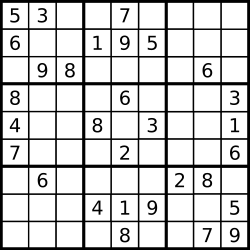
A partially filled sudoku which is valid.
Note:
A valid Sudoku board (partially filled) is not necessarily solvable. Only the filled cells need to be validated.
Subscribe to see which companies asked this question
Idea
Just go through all you see (like "7 in row 3") and check for duplicates.
Solution 1
Using Counter. One logical line, seven physical lines.
def isValidSudoku(self, board):

    return 1 == max(collections.Counter(

        x

        for i, row in enumerate(board)

        for j, c in enumerate(row)

        if c != '.'

        for x in ((c, i), (j, c), (i/3, j/3, c))

    ).values() + [1])
The + [1] is only for the empty board, where max would
get an empty list and complain. It's not necessary to get it accepted here, as the empty board isn't among the test cases, but it's good to have.
Solution 2
Using len(set).
def isValidSudoku(self, board):

    seen = sum(([(c, i), (j, c), (i/3, j/3, c)]

                for i, row in enumerate(board)

                for j, c in enumerate(row)

                if c != '.'), [])

    return len(seen) == len(set(seen))
Solution 3
Using any.
def isValidSudoku(self, board):

    seen = set()

    return not any(x in seen or seen.add(x)

                   for i, row in enumerate(board)

                   for j, c in enumerate(row)

                   if c != '.'

                   for x in ((c, i), (j, c), (i/3, j/3, c)))
Solution 4
Iterating a different way.
def isValidSudoku(self, board):

    seen = sum(([(c, i), (j, c), (i/3, j/3, c)]

                for i in range(9) for j in range(9)

                for c in [board[i][j]] if c != '.'), [])

    return len(seen) == len(set(seen))
Clean and Easy82ms Python
class Solution(object):
def isValidSudoku(self, board):

    """

    :type board: List[List[str]]

    :rtype: bool

    """

    big = set()

    for i in xrange(0,9):

        for j in xrange(0,9):

            if board[i][j]!='.':

                cur = board[i][j]

                if (i,cur) in big or (cur,j) in big or (i/3,j/3,cur) in big:

                    return False

                big.add((i,cur))

                big.add((cur,j))

                big.add((i/3,j/3,cur))
37. Sudoku Solver
Write a program to solve a Sudoku puzzle by filling the empty cells.
Empty cells are indicated by the character '.'.
You may assume that there will be only one unique solution.
A sudoku puzzle...

...and its solution numbers marked in red.
Subscribe to see which companies asked this question
最快的解决方案:
Sharing my 2ms C++ solution with comments and explanations.
3,937 views
Update: there's a follow-up
0ms solution which is even more optimized
This is one of the fastest Sudoku solvers I've ever written. It is compact enough - just 150 lines of C++ code with comments. I thought it'd be interesting to share it, since it combines several techniques like
reactive network update propagation and backtracking with very aggressive pruning.
The algorithm is online - it starts with an empty board and as you add numbers to it, it starts solving the Sudoku.
Unlike in other solutions where you have bitmasks of allowed/disallowed values per row/column/square, this solution track bitmask for every(!) cell, forming a set of constraints for the allowed values for each particular
cell. Once a value is written into a cell, new constraints are immediately propagated to row, column and 3x3 square of the cell. If during this process a value of other cell can be unambiguously deduced - then the value is set, new constraints are propagated,
so on.... You can think about this as an implicit reactive network of cells.
If we're lucky (and we'll be lucky for 19 of 20 of Sudokus published in magazines) then Sudoku is solved at the end (or even before!) processing of the input.
Otherwise, there will be empty cells which have to be resolved. Algorithm uses backtracking for this purpose. To optimize it, algorithm starts with the cell with the smallest ambiguity. This could be improved even
further by using priority queue (but it's not implemented here). Backtracking is more or less standard, however, at each step we guess the number, the reactive update propagation comes back into play and it either quickly proves that the guess is unfeasible
or significantly prunes the remaining search space.
It's interesting to note, that in this case taking and restoring snapshots of the compact representation of the state is faster than doing backtracking rollback by "undoing the moves".
class Solution {

    struct cell // encapsulates a single cell on a Sudoku board

    {

        uint8_t value; // cell value 1..9 or 0 if unset

        // number of possible (unconstrained) values for the cell

        uint8_t numPossibilities;

        // if bitset[v] is 1 then value can't be v

        bitset<10> constraints;

        cell() : value(0), numPossibilities(9),constraints() {};

    };

    array<array<cell,9>,9> cells;

    // sets the value of the cell to [v]

    // the function also propagates constraints to other cells and deduce new values where possible

    bool set(int i, int j, int v)

    {

        // updating state of the cell

        cell& c = cells[i][j];

        if (c.value == v)

            return true;

        if (c.constraints[v])

            return false;

        c.constraints = bitset<10>(0x3FE); // all 1s

        c.constraints.reset(v);

        c.numPossibilities = 1;

        c.value = v;

        // propagating constraints

        for (int k = 0; k<9; k++) {

            // to the row:

            if (i != k && !updateConstraints(k, j, v))

                return false;

            // to the column:

            if (j != k && !updateConstraints(i, k, v))

                return false;

            // to the 3x3 square:

            int ix = (i / 3) * 3 + k / 3;

            int jx = (j / 3) * 3 + k % 3;

            if (ix != i && jx != j && !updateConstraints(ix, jx, v))

                return false;

        }

        return true;

    }

    // update constraints of the cell i,j by excluding possibility of 'excludedValue'

    // once there's one possibility left the function recurses back into set()

    bool updateConstraints(int i, int j, int excludedValue)

    {

        cell& c = cells[i][j];

        if (c.constraints[excludedValue]) {

            return true;

        }

        if (c.value == excludedValue) {

            return false;

        }

        c.constraints.set(excludedValue);

        if (--c.numPossibilities > 1)

            return true;

        for (int v = 1; v <= 9; v++) {

            if (!c.constraints[v]) {

                return set(i, j, v);

            }

        }

        assert(false);

    }

    // backtracking state - list of empty cells

    vector<pair<int, int>> bt;

    // find values for empty cells

    bool findValuesForEmptyCells()

    {

        // collecting all empty cells

        bt.clear();

        for (int i = 0; i < 9; i++) {

            for (int j = 0; j < 9; j++) {

                if (!cells[i][j].value)

                    bt.push_back(make_pair(i, j));

            }

        }

        // making backtracking efficient by pre-sorting empty cells by numPossibilities

        sort(bt.begin(), bt.end(), [this](const pair<int, int>&a, const pair<int, int>&b) {

            return cells[a.first][a.second].numPossibilities < cells[b.first][b.second].numPossibilities; });

        return backtrack(0);

    }

    // Finds value for all empty cells with index >=k

    bool backtrack(int k)

    {

        if (k >= bt.size())

            return true;

        int i = bt[k].first;

        int j = bt[k].second;

        // fast path - only 1 possibility

        if (cells[i][j].value)

            return backtrack(k + 1);

        auto constraints = cells[i][j].constraints;

        // slow path >1 possibility.

        // making snapshot of the state

        array<array<cell,9>,9> snapshot(cells);

        for (int v = 1; v <= 9; v++) {

            if (!constraints[v]) {

                if (set(i, j, v)) {

                    if (backtrack(k + 1))

                        return true;

                }

                // restoring from snapshot,

                // note: computationally this is cheaper

                // than alternative implementation with undoing the changes

                cells = snapshot;

            }

        }

        return false;

    }

public:

    void solveSudoku(vector<vector<char>> &board) {

        cells = array<array<cell,9>,9>(); // clear array

        // Decoding input board into the internal cell matrix.

        // As we do it - constraints are propagated and even additional values are set as we go

        // (in the case if it is possible to unambiguously deduce them).

        for (int i = 0; i < 9; i++)

        {

            for (int j = 0; j < 9; j++) {

                if (board[i][j] != '.' && !set(i, j, board[i][j] - '0'))

                    return; // sudoku is either incorrect or unsolvable

            }

        }

        // if we're lucky we've already got a solution,

        // however, if we have empty cells we need to use backtracking to fill them

        if (!findValuesForEmptyCells())

            return; // sudoku is unsolvable

        // copying the solution back to the board

        for (int i = 0; i < 9; i++)

        {

            for (int j = 0; j < 9; j++) {

                if (cells[i][j].value)

                    board[i][j] = cells[i][j].value + '0';

            }

        }

    }

};
Simple and Clean Solution / C++
871 views
bool check(vector<vector<char>> &board, int i, int j, char val)

{

    int row = i - i%3, column = j - j%3;

    for(int x=0; x<9; x++) if(board[x][j] == val) return false;

    for(int y=0; y<9; y++) if(board[i][y] == val) return false;

    for(int x=0; x<3; x++)

    for(int y=0; y<3; y++)

        if(board[row+x][column+y] == val) return false;

    return true;

}

bool solveSudoku(vector<vector<char>> &board, int i, int j)

{

    if(i==9) return true;

    if(j==9) return solveSudoku(board, i+1, 0);

    if(board[i][j] != '.') return solveSudoku(board, i, j+1);

    for(char c='1'; c<='9'; c++)

    {

        if(check(board, i, j, c))

        {

            board[i][j] = c;

            if(solveSudoku(board, i, j+1)) return true;

            board[i][j] = '.';

        }

    }

    return false;

}
public: void solveSudoku(vector<vector>& board) { solveSudoku(board, 0, 0); }
c++ clear solution using dfs, beating 90% c++ coder.
690 views
class Solution {

public:

    bool col[10][10],row[10][10],f[10][10];

    bool flag = false;

    void solveSudoku(vector<vector<char>>& board) {

         memset(col,false,sizeof(col));

         memset(row,false,sizeof(row));

         memset(f,false,sizeof(f));

         for(int i = 0; i < 9;i++){

             for(int j = 0; j < 9;j++){

                 if(board[i][j] == '.')   continue;

                 int temp = 3*(i/3)+j/3;

                 int num = board[i][j]-'0';

                 col[j][num] = row[i][num] = f[temp][num] = true;

             }

         }

         dfs(board,0,0);

    }

    void dfs(vector<vector<char>>& board,int i,int j){

        if(flag == true)  return ;

        if(i >= 9){

            flag = true;

            return ;

        }

        if(board[i][j] != '.'){

             if(j < 8)  dfs(board,i,j+1);

             else dfs(board,i+1,0);

             if(flag)  return;

        }

        else{

            int temp = 3*(i/3)+j/3;

            for(int n = 1; n <= 9; n++){

                if(!col[j][n] && !row[i][n] && !f[temp][n]){

                    board[i][j] = n + '0';

                    col[j][n] = row[i][n] = f[temp][n] = true;

                    if(j < 8)  dfs(board,i,j+1);

                    else dfs(board,i+1,0);

                    col[j][n] = row[i][n] = f[temp][n] = false;

                    if(flag)  return;

                }

            }

            board[i][j] = '.';

        }

    }

};
13-line Python solution, dfs, beats 47.79%
77 views
def solveSudoku(self, board):

  def dfs():

    for i, row in enumerate(board):

      for j, char in enumerate(row):

        if char == '.':

          for x in s9 - {row[k] for k in r9} - {board[k][j] for k in r9} - \

              {board[i / 3 * 3 + m][j / 3 * 3 + n] for m in r3 for n in r3}:

            board[i][j] = x

            if dfs(): return True

            board[i][j] = '.'

          return False

    return True

  r3, r9, s9 = range(3), range(9), {'1', '2', '3', '4', '5', '6', '7', '8', '9'}

  dfs()
参考文献:
http://www.cnblogs.com/felixfang/p/3705754.html
leetcode 37. Sudoku Solver 36. Valid Sudoku 数独问题的更多相关文章
- LeetCode:36. Valid Sudoku,数独是否有效
LeetCode:36. Valid Sudoku,数独是否有效 : 题目: LeetCode:36. Valid Sudoku 描述: Determine if a Sudoku is valid, ...
- 【LeetCode】36. Valid Sudoku 解题报告(Python)
[LeetCode]36. Valid Sudoku 解题报告(Python) 作者: 负雪明烛 id: fuxuemingzhu 个人博客: http://fuxuemingzhu.cn/ 题目地址 ...
- [Leetcode][Python]36: Valid Sudoku
# -*- coding: utf8 -*-'''__author__ = 'dabay.wang@gmail.com' 36: Valid Sudokuhttps://oj.leetcode.com ...
- [LeetCode] 36. Valid Sudoku 验证数独
Determine if a 9x9 Sudoku board is valid. Only the filled cells need to be validated according to th ...
- [leetcode]36. Valid Sudoku验证数独
Determine if a 9x9 Sudoku board is valid. Only the filled cells need to be validated according to th ...
- leetCode 36.Valid Sudoku(有效的数独) 解题思路和方法
Valid Sudoku Determine if a Sudoku is valid, according to: Sudoku Puzzles - The Rules. The Sudoku bo ...
- 【leetcode】36. Valid Sudoku(判断能否是合法的数独puzzle)
Share Determine if a 9 x 9 Sudoku board is valid. Only the filled cells need to be validated accordi ...
- 【一天一道LeetCode】#36. Valid Sudoku
一天一道LeetCode 本系列文章已全部上传至我的github,地址:https://github.com/Zeecoders/LeetCode 欢迎转载,转载请注明出处 (一)题目 Determi ...
- LeetCode 36 Valid Sudoku
Problem: Determine if a Sudoku is valid, according to: Sudoku Puzzles - The Rules. The Sudoku board ...
随机推荐
- ●BZOJ 2002 [Hnoi2010]Bounce 弹飞绵羊
题链: http://www.lydsy.com/JudgeOnline/problem.php?id=2002 题解: LCT 如果把弹跳的起点和终点连一条边,弹出去的与n+1号点连边, 则不难发现 ...
- ●codeforces 528D Fuzzy Search
题链: http://codeforces.com/problemset/problem/528/D 题解: FFT 先解释一下题意: 给出两个字符串(只含'A','T','C','G'四种字符),一 ...
- ●BZOJ 2560 串珠子
题链: http://www.lydsy.com/JudgeOnline/problem.php?id=2560 题解: 容斥,状压计数dp 首先求出一个数组 g[s] 表示集合内的点的连边方案数(两 ...
- 【Codeforces Round 438 A B C D 四个题】
题目所在比赛的地址在这里呀 A. Bark to Unlock ·述大意: 输入一个目标串.然后输入n(1<=n<=100)个串,询问是否可以通过这些串收尾相接或者它本身拼出目 ...
- java 之 MyBatis(sql 可以执行,在eclipse执行报错问题)
前段时间写 mybatis Sql 查询语句的时候,发现一个很奇怪的现象,我写的SQL 语句在 pl/Sql 中明明可以执行,但是放到 eclipse 中执行却报错,因为时间比较久,依稀记得是文字与字 ...
- sharepoint环境安装
SharePoint 2013 测试环境安装配置指南 软件版本 Windows Server 2012 标准版 SQL Server 2012 标准版 SharePoint Server 2013 企 ...
- Linux之软链接与硬链接
什么是链接? 链接简单说实际上是一种文件共享的方式,是 POSIX 中的概念,主流文件系统都支持链接文件. 它是用来干什么的? 你可以将链接简单地理解为 Windows 中常见的快捷方式(或是 OS ...
- IOS和OSX事件传递机制
本文ios部分转载自: http://zhoon.github.io/ios/2015/04/12/ios-event.html iOS的事件有好几种:Touch Events(触摸事件).Motio ...
- Weblogic Exception in AppMerge flows' progression
原因:经过分析是web.xml配置的问题,有些servlet上面配置了'display-name',这个weblogic是不支持的. 解决:在web.xml中把'display-name'删除掉,工程 ...
- 70. Climbing Stairs(easy, 号称 Dynamic Programming 天下第一题)
You are climbing a stair case. It takes n steps to reach to the top. Each time you can either climb ...