
python3二元Logistics Regression 回归分析(LogisticRegression)
纲要
boss说增加项目平台分析方法:
T检验(独立样本T检验)、线性回归、二元Logistics回归、因子分析、可靠性分析
根本不懂,一脸懵逼状态,分析部确实有人才,反正我是一脸懵
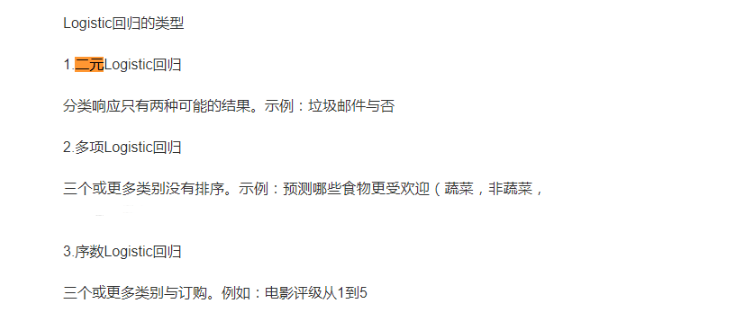
首先解释什么是二元Logistic回归分析吧
官方简介:
链接:https://pythonfordatascience.org/logistic-regression-python/

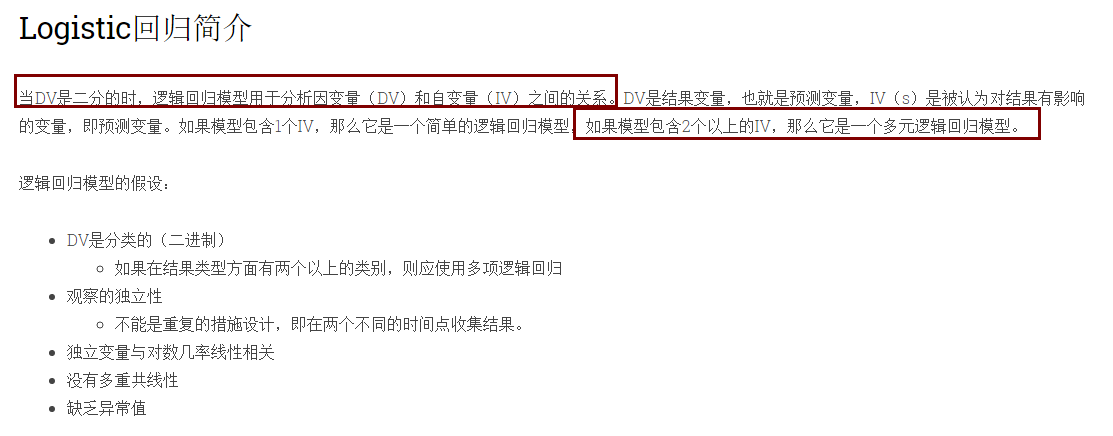
Logistic regression models are used to analyze the relationship between a dependent variable (DV) and independent variable(s) (IV) when the DV is dichotomous. The DV is the outcome variable, a.k.a. the predicted variable, and the IV(s) are the variables that are believed to have an influence on the outcome, a.k.a. predictor variables. If the model contains  IV, then it is a simple logistic regression model, and if the model contains + IVs, then it is a multiple logistic regression model.

Assumptions for logistic regression models:

The DV is categorical (binary)

If there are more than  categories in terms of types of outcome, a multinomial logistic regression should be used

Independence of observations

Cannot be a repeated measures design, i.e. collecting outcomes at two different time points.

Independent variables are linearly related to the log odds

Absence of multicollinearity

Lack of outliers
原文
理解了什么是二元以后,开始找库
需要用的包
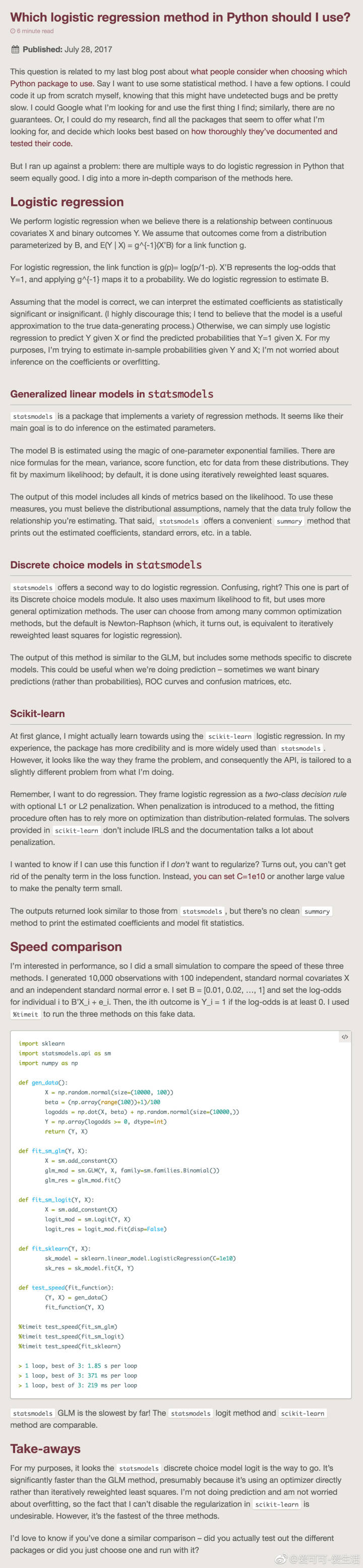
这里需要特别说一下,第一天晚上我就用的logit,但结果不对,然后用机器学习搞,发现结果还不对,用spss比对的值
奇怪,最后没办法,只能抱大腿了,因为他们纠结Logit和Logistic的区别,然后有在群里问了下,有大佬给解惑了
而且也有下面文章给解惑
1. 是 statsmodels 的logit模块
2. 是 sklearn.linear_model 的 LogisticRegression模块
先说第一种方法
首先借鉴文章链接:https://blog.csdn.net/zj360202/article/details/78688070?utm_source=blogxgwz0
解释的比较清楚,但是一定要注意一点就是,截距项,我就是在这个地方出的问题,因为我觉得不重要,就没加
#!/usr/bin/env

# -*- coding:utf-8 -*-

import pandas as pd

import statsmodels.api as sm

import pylab as pl

import numpy as np

from pandas import DataFrame, Series

from sklearn.cross_validation import train_test_split

from sklearn.linear_model import LogisticRegression

from sklearn import metrics

from collections import OrderedDict

data = {

    'y': [0, 0, 0, 0, 0, 0, 0, 0, 1, 0, 0, 1, 0, 0, 1, 0, 1, 1, 1, 1],

    'x': [i for i in range(1, 21)],

}

df = DataFrame(OrderedDict(data))

df["intercept"] = 1.0  # 截距项,很重要的呦,我就错在这里了

print(df)

print("==================")

print(len(df))

print(df.columns.values)

print(df[df.columns[1:]])

logit = sm.Logit(df['y'],  df[df.columns[1:]])

#

result = logit.fit()

#

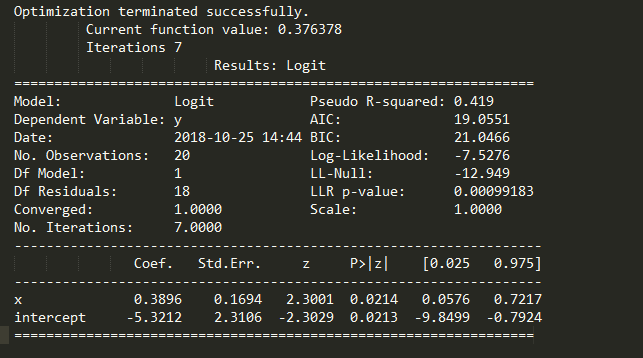
res = result.summary2()

print(res)
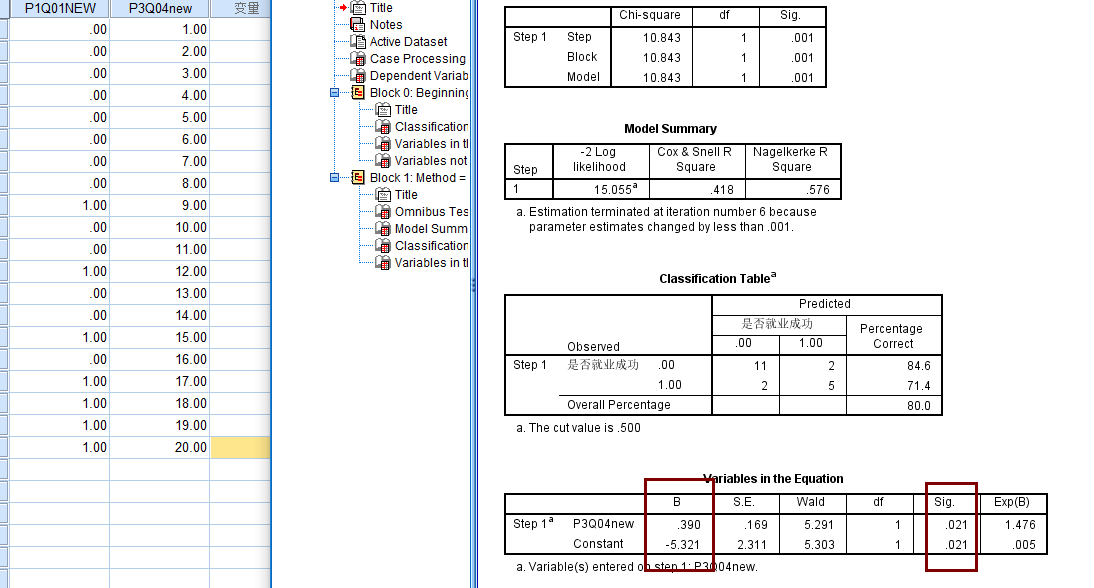
这么写我觉得更好,因为上面那么写执行第二遍的时候总是报错:
statsmodels.tools.sm_exceptions.PerfectSeparationError: Perfect separation detected, results not available
我改成x, y变量自己是自己的,就莫名其妙的好了
    obj = TwoDimensionalLogisticRegressionModel()

    data_x = obj.SelectVariableSql( UserID, ProjID, QuesID, xVariable, DatabaseName, TableName, CasesCondition)

    data_y = obj.SelectVariableSql( UserID, ProjID, QuesID, yVariable, DatabaseName, TableName, CasesCondition)

    if len(data_x) != len(data_y):

        raise MyCustomError(retcode=4011)

    obj.close()

    df_X = DataFrame(OrderedDict(data_x))

    df_Y = DataFrame(OrderedDict(data_y))

    df_X["intercept"] = 1.0  # 截距项,很重要的呦,我就错在这里了

    logit = sm.Logit(df_Y, df_X)

    result = logit.fit()

    res = result.summary()

    data = [j for j in [i for i in str(res).split('\n')][-3].split(' ') if j != ''][1:]

    return data
允许二分数值虚拟变量的使用,修改后
obj = TwoDimensionalLogisticRegressionModel()

data_x = obj.SelectVariableSql( UserID, ProjID, QuesID, xVariable, DatabaseName, TableName, CasesCondition)

data_y = obj.SelectVariableSql( UserID, ProjID, QuesID, yVariable, DatabaseName, TableName, CasesCondition)

if len(data_x) != len(data_y):

    raise MyCustomError(retcode=)

obj.close()

df_X = DataFrame(data_x)

df_Y = DataFrame(data_y) # 因变量,,

df_X["intercept"] = 1.0  # 截距项,很重要的呦,我就错在这里了

YColumnList = list(df_Y[yVariable].values)

setYColumnList = list(set(YColumnList))

if len(setYColumnList) >  or len(setYColumnList) < :

    raise MyCustomError(retcode=)

else:

    if len(setYColumnList) ==  and [,] != [int(i) for i in setYColumnList]:

        newYcolumnsList = []

        for i in YColumnList:

            if i == setYColumnList[]:

                newYcolumnsList.append()

            else:

                newYcolumnsList.append()

        df_Y = DataFrame({yVariable:newYcolumnsList})

logit = sm.Logit(df_Y, df_X)

result = logit.fit()

res = result.summary()

data = [j for j in [i for i in str(res).split('\n')][-].split(' ') if j != '']

return data[:]
再次更新后
def TwoDimensionalLogisticRegressionDetail(UserID, ProjID, QuesID, xVariableID, yVariableID, CasesCondition):

    two_obj = TwoDimensionalLogisticModel()

    sql_data, xVarName, yVarName = two_obj.showdatas(UserID, ProjID, QuesID, xVariableID, yVariableID, CasesCondition)

    two_obj.close()

    df_dropna = DataFrame(sql_data).dropna()

    df_X = DataFrame()

    df_Y = DataFrame()  # 因变量,0, 1

    df_X[xVarName] = df_dropna[xVarName]

    df_Y[yVarName] = df_dropna[yVarName]

    df_X["intercept"] = 1.0  # 截距项,很重要的呦,我就错在这里了

    YColumnList = list(df_Y[yVarName].values)

    setYColumnList = list(set(YColumnList))

    # print(setYColumnList)

    if len(setYColumnList) > 2 or len(setYColumnList) < 2:

        raise MyCustomError(retcode=4015)

    # else:

    if len(setYColumnList) == 2 and [0, 1] != [int(i) for i in setYColumnList]:

        newYcolumnsList = []

        for i in YColumnList:

            if i == setYColumnList[0]:

                newYcolumnsList.append(0)

            else:

                newYcolumnsList.append(1)

        df_Y = DataFrame({yVarName: newYcolumnsList})

    logit = sm.Logit(df_Y, df_X)

    res = logit.fit()

    res_all = res.summary()

    LogLikelihood = [i.strip() for i in str(res_all).split("\n")[6].split("   ") if i][3]

    # 没找到具体参数, 只能这么分割

    index_var = [i.strip() for i in str(res_all).split("\n")[12].split("   ") if i]

    intercept = [i.strip() for i in str(res_all).split("\n")[13].split("   ") if i]

    std_err = [index_var[2], intercept[2]]

    z = [index_var[3], intercept[3]]

    P_z = [index_var[4], intercept[4]] # 显著性

    interval_25 = [index_var[5], intercept[5]]

    interval_975 = [index_var[6], intercept[6]]

    Odds_Ratio = [math.e ** i for i in list(res.params)]

    return {

        "No_Observations": res.nobs,#No. Observations

        "Pseudo_R": res.prsquared,# Pseudo R^2

        "Log_Likelihood": LogLikelihood, # LogLikelihood

        "LLNull": res.llnull,

        "llr_pvalue": res.llr_pvalue, #llr显著性

        "coef": list(res.params), # 系数

        "std_err": std_err,

        "Odds_Ratio": Odds_Ratio,

        "z": z,

        "P": P_z, #显著性

        "interval_25": interval_25, # 区间0.025

        "interval_975": interval_975

    }
第二种方法,机器学习
参考链接:https://zhuanlan.zhihu.com/p/34217858
#!/usr/bin/env python

# -*- coding:utf-8 -*-

from collections import OrderedDict

import pandas as pd

examDict = {

    '学习时间': [i for i in range(1, 20)],

    '通过考试': [0, 0, 0, 0, 0, 0, 0, 0, 1, 0, 0, 1, 0, 0, 1, 0, 1, 1, 1]

}

examOrderDict = OrderedDict(examDict)

examDF = pd.DataFrame(examOrderDict)

# print(examDF.head())

exam_X = examDF.loc[:, "学习时间"]

exam_Y = examDF.loc[:, "通过考试"]

print(exam_X)

# print(exam_Y)

from sklearn.cross_validation import train_test_split

X_train,X_test,y_train, y_test = train_test_split(exam_X,exam_Y, train_size=0.8)

# print(X_train.values)

print(len(X_train.values))

X_train = X_train.values.reshape(-1, 1)

print(len(X_train))

print(X_train)

X_test = X_test.values.reshape(-1, 1)

from sklearn.linear_model import LogisticRegression

module_1 = LogisticRegression()

module_1.fit(X_train, y_train)

print("coef:", module_1.coef_)

front = module_1.score(X_test,y_test)

print(front)

print("coef:", module_1.coef_)

print("intercept_:", module_1.intercept_)

# 预测

pred1 = module_1.predict_proba(3)

print("预测概率[N/Y]", pred1)

pred2 = module_1.predict(5)

print(pred2)
但是,机器学习的这个有问题,就是只抽取了15个值
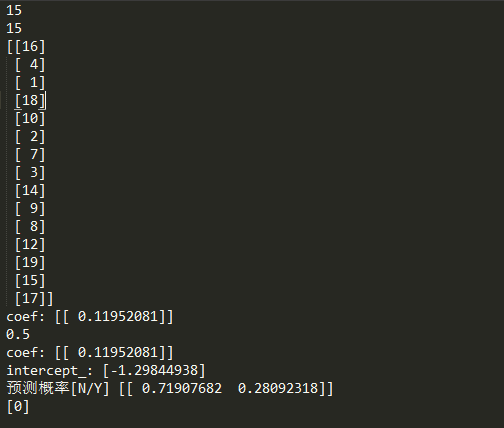
statsmodels的库链接
Statsmodels:http://www.statsmodels.org/stable/index.html
python3二元Logistics Regression 回归分析(LogisticRegression)的更多相关文章
- 1.2、Logistics Regression算法实践
1.1.Logistics Regression算法实践 有了上篇博客的理论准备后,接下来,我们用以及完成的函数,构建Logistics Regression分类器.我们利用线性可分的数据作为训练样 ...
- 1.1、Logistics Regression模型
1.线性可分VS线性不可分 对于一个分类问题,通常可以分为线性可分与线性不可分两种 .如果一个分类问题可以使用线性判别函数正确的分类,则称该问题为线性可分.如图所示为线性可分,否则为线性不可分: 下图 ...
- logistics regression
logistics regression用于解决一些二分类问题.比如(纯假设)网上购物时,网站会判断一个人退货的可能性有多大,如果该用户退货的可能性很大,那么网站就不会推荐改用户购买退费险.反之,如果 ...
- Popular generalized linear models|GLMM| Zero-truncated Models|Zero-Inflated Models|matched case–control studies|多重logistics回归|ordered logistics regression
============================================================== Popular generalized linear models 将不同 ...
- python进行数据分析
1. python进行数据分析----线性回归 2. python进行数据分析------相关分析 3. python进行数据分析---python3卡方 4. 多重响应分析,多选题二分法思路 5. ...
- Logistic Regression Vs Decision Trees Vs SVM: Part I
Classification is one of the major problems that we solve while working on standard business problem ...
- logistics回归简单应用(二)
警告:本文为小白入门学习笔记 网上下载的数据集链接:https://pan.baidu.com/s/1NwSXJOCzgihPFZfw3NfnfA 密码: jmwz 不知道这个数据集干什么用的,根据直 ...
- 2.1、Softmax Regression模型
Softmax Regression模型 由于Logistics Regression算法复杂度低,容易实现等特点,在工业中的到广泛的使用,但是Logistics Regression算法主要用于处理 ...
- 【R语言进行数据挖掘】回归分析
1.线性回归 线性回归就是使用下面的预测函数预测未来观测量: 其中,x1,x2,...,xk都是预测变量(影响预测的因素),y是需要预测的目标变量(被预测变量). 线性回归模型的数据来源于澳大利亚的C ...
随机推荐
- grpc使用客户端技巧
grpc 使用技巧,最近在做的项目是服务端是go语言提供服务使用的是grpc框架. java在实现客户端的时候,参数的生成大部分采用创建者模式.java在接受go服务端 返回数据的时候,更多的是通过p ...
- POJ.1752.Advertisement(差分约束 最长路SPFA)
题目链接 \(Description\) 有\(n\)个人在一条直线上跑步,每个人的起点 \(Si\).终点 \(Ei\) 已知:每个点可以放一个广告牌,一个人\(i\)能看到的广告牌数量为 \(Ei ...
- 洛谷.4234.最小差值生成树(LCT)
题目链接 先将边排序,这样就可以按从小到大的顺序维护生成树,枚举到一条未连通的边就连上,已连通则(用当前更大的)替换掉路径上最小的边,这样一定不会更差. 每次构成树时更新答案.答案就是当前边减去生成树 ...
- 搜索+剪枝——POJ 1011 Sticks
搜索+剪枝--POJ 1011 Sticks 博客分类: 算法 非常经典的搜索题目,第一次做还是暑假集训的时候,前天又把它翻了出来 本来是想找点手感的,不想在原先思路的基础上,竟把它做出来了而且还是0 ...
- PHP抓取网页内容经验总结
用php 抓取页面的内容在实际的开发当中是非常有用的,如作一个简单的内容采集器,提取网页中的部分内容等等,抓取到的内容在通过正则表达式做一下过滤就得到了你想要的内容,至于如何用正则表达式过滤,在这里就 ...
- Eclipse 重构
使用重构工具可以快捷地将代码变成整洁而高度模块化的代码. Rename Rename 是 Eclipse 中最常用的重构.利用这个重构,可以对变量.类.方法.包.文件夹及几乎任何的 Java 标识符进 ...
- Structured Streaming教程(1) —— 基本概念与使用
近年来,大数据的计算引擎越来越受到关注,spark作为最受欢迎的大数据计算框架,也在不断的学习和完善中.在Spark2.x中,新开放了一个基于DataFrame的无下限的流式处理组件--Structu ...
- Facebook's React vs AngularJS: A Closer Look
When we launched React | A JavaScript library for building user interfaces two weeks ago there were ...
- WHY数学表达式的3D可视化
WHY数学表达式的3D可视化 很早之前我就有这种想法,将数学表达式的图形显示出来.最近终于实现了这套较为完善的版本,将其代码公布,也为开源做点贡献.首先系统中定义一套脚本语言格式,用于描述数学表达式. ...
- 推荐一款在线编辑JSON的网站
推荐一款在线编辑JSON的网站 https://github.com/DavidDurman/FlexiJsonEditor 开源地址:https://github.com/DavidDurman/F ...