
『Sklearn』数据划分方法
原理介绍
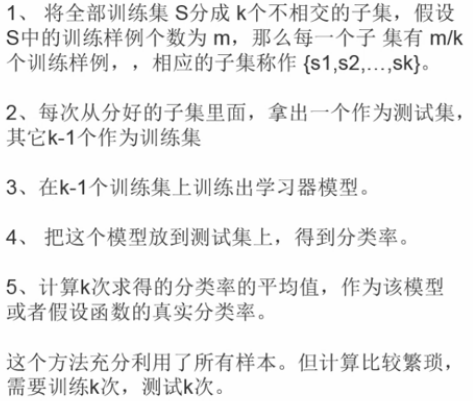
K折交叉验证:
KFold,GroupKFold,StratifiedKFold,
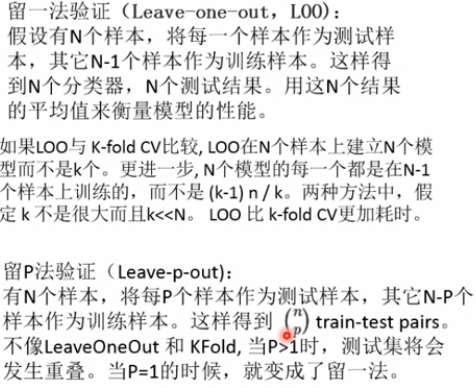
留一法:
LeaveOneGroupOut,LeavePGroupsOut,LeaveOneOut,LeavePOut,
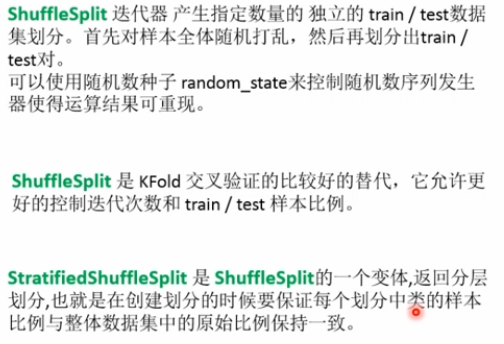
随机划分法:
ShuffleSplit,GroupShuffleSplit,StratifiedShuffleSplit,
代码实现
流程:
实例化分类器 -> 迭代器迭代组[.split()]
KFold(n_splits=2)
#KFold

import numpy as np

from sklearn.model_selection import KFold

X=np.array([[1,2],[3,4],[5,6],[7,8],[9,10],[11,12]])

y=np.array([1,2,3,4,5,6])

kf=KFold(n_splits=2)    # 定义分成几个组

# kf.get_n_splits(X)    # 查询分成几个组

print(kf)

for train_index,test_index in kf.split(X):

    print("Train Index:",train_index,",Test Index:",test_index)

    X_train,X_test=X[train_index],X[test_index]

    y_train,y_test=y[train_index],y[test_index]

    #print(X_train,X_test,y_train,y_test)
GroupKFold(n_splits=2)
# GroupKFold,不是很懂这个划分方法

import numpy as np

from sklearn.model_selection import GroupKFold

X=np.array([[1,2],[3,4],[5,6],[7,8],[9,10],[11,12]])

y=np.array([1,2,3,4,5,6])

groups=np.array([1,2,3,4,5,6])

group_kfold=GroupKFold(n_splits=2)

group_kfold.get_n_splits(X,y,groups)

print(group_kfold)

for train_index,test_index in group_kfold.split(X,y,groups):

    print("Train Index:",train_index,",Test Index:",test_index)

    X_train,X_test=X[train_index],X[test_index]

    y_train,y_test=y[train_index],y[test_index]

    #print(X_train,X_test,y_train,y_test)

#GroupKFold(n_splits=2)

#Train Index: [0 2 4] ,Test Index: [1 3 5]

#Train Index: [1 3 5] ,Test Index: [0 2 4]
StratifiedKFold(n_splits=3)
# stratifiedKFold:保证训练集中每一类的比例是相同的(尽量)

import numpy as np

from sklearn.model_selection import StratifiedKFold

X=np.array([[1,2],[3,4],[5,6],[7,8],[9,10],[11,12]])

y=np.array([1,1,1,2,2,2])

skf=StratifiedKFold(n_splits=3)

skf.get_n_splits(X,y)

print(skf)

for train_index,test_index in skf.split(X,y):

    print("Train Index:",train_index,",Test Index:",test_index)

    X_train,X_test=X[train_index],X[test_index]

    y_train,y_test=y[train_index],y[test_index]

    #print(X_train,X_test,y_train,y_test)

#StratifiedKFold(n_splits=3, random_state=None, shuffle=False)

#Train Index: [1 2 4 5] ,Test Index: [0 3]

#Train Index: [0 2 3 5] ,Test Index: [1 4]
LeaveOneOut()
# leaveOneOut:测试集就留下一个

import numpy as np

from sklearn.model_selection import LeaveOneOut

X=np.array([[1,2],[3,4],[5,6],[7,8],[9,10],[11,12]])

y=np.array([1,2,3,4,5,6])

loo=LeaveOneOut()

loo.get_n_splits(X)

print(loo)

for train_index,test_index in loo.split(X,y):

    print("Train Index:",train_index,",Test Index:",test_index)

    X_train,X_test=X[train_index],X[test_index]

    y_train,y_test=y[train_index],y[test_index]

    #print(X_train,X_test,y_train,y_test)

#LeaveOneOut()

#Train Index: [1 2 3 4 5] ,Test Index: [0]

#Train Index: [0 2 3 4 5] ,Test Index: [1]

#Train Index: [0 1 3 4 5] ,Test Index: [2]

#Train Index: [0 1 2 4 5] ,Test Index: [3]

#Train Index: [0 1 2 3 5] ,Test Index: [4]

#Train Index: [0 1 2 3 4] ,Test Index: [5]
LeavePOut(p=3)
LeavePOut:测试集留下P个

import numpy as np

from sklearn.model_selection import LeavePOut

X=np.array([[1,2],[3,4],[5,6],[7,8],[9,10],[11,12]])

y=np.array([1,2,3,4,5,6])

lpo=LeavePOut(p=3)

lpo.get_n_splits(X)

print(lpo)

for train_index,test_index in lpo.split(X,y):

    print("Train Index:",train_index,",Test Index:",test_index)

    X_train,X_test=X[train_index],X[test_index]

    y_train,y_test=y[train_index],y[test_index]

    #print(X_train,X_test,y_train,y_test)

#LeavePOut(p=3)

#Train Index: [3 4 5] ,Test Index: [0 1 2]

#Train Index: [2 4 5] ,Test Index: [0 1 3]

#Train Index: [2 3 5] ,Test Index: [0 1 4]

#Train Index: [2 3 4] ,Test Index: [0 1 5]

#Train Index: [1 4 5] ,Test Index: [0 2 3]

#Train Index: [1 3 5] ,Test Index: [0 2 4]

#Train Index: [1 3 4] ,Test Index: [0 2 5]

#Train Index: [1 2 5] ,Test Index: [0 3 4]

#Train Index: [1 2 4] ,Test Index: [0 3 5]

#Train Index: [1 2 3] ,Test Index: [0 4 5]

#Train Index: [0 4 5] ,Test Index: [1 2 3]

#Train Index: [0 3 5] ,Test Index: [1 2 4]

#Train Index: [0 3 4] ,Test Index: [1 2 5]

#Train Index: [0 2 5] ,Test Index: [1 3 4]

#Train Index: [0 2 4] ,Test Index: [1 3 5]

#Train Index: [0 2 3] ,Test Index: [1 4 5]

#Train Index: [0 1 5] ,Test Index: [2 3 4]

#Train Index: [0 1 4] ,Test Index: [2 3 5]

#Train Index: [0 1 3] ,Test Index: [2 4 5]

#Train Index: [0 1 2] ,Test Index: [3 4 5]
ShuffleSplit(n_splits=3,test_size=.25,random_state=0)
# ShuffleSplit 把数据集打乱顺序,然后划分测试集和训练集,训练集额和测试集的比例随机选定,

# 训练集和测试集的比例的和可以小于1

import numpy as np

from sklearn.model_selection import ShuffleSplit

X=np.array([[1,2],[3,4],[5,6],[7,8],[9,10],[11,12]])

y=np.array([1,2,3,4,5,6])

rs=ShuffleSplit(n_splits=3,test_size=.25,random_state=0)

rs.get_n_splits(X)

print(rs)

for train_index,test_index in rs.split(X,y):

    print("Train Index:",train_index,",Test Index:",test_index)

    X_train,X_test=X[train_index],X[test_index]

    y_train,y_test=y[train_index],y[test_index]

    #print(X_train,X_test,y_train,y_test)

print("==============================")

rs=ShuffleSplit(n_splits=3,train_size=.5,test_size=.25,random_state=0)

rs.get_n_splits(X)

print(rs)

for train_index,test_index in rs.split(X,y):

    print("Train Index:",train_index,",Test Index:",test_index)

#ShuffleSplit(n_splits=3, random_state=0, test_size=0.25, train_size=None)

#Train Index: [1 3 0 4] ,Test Index: [5 2]

#Train Index: [4 0 2 5] ,Test Index: [1 3]

#Train Index: [1 2 4 0] ,Test Index: [3 5]

#==============================

#ShuffleSplit(n_splits=3, random_state=0, test_size=0.25, train_size=0.5)

#Train Index: [1 3 0] ,Test Index: [5 2]

#Train Index: [4 0 2] ,Test Index: [1 3]

#Train Index: [1 2 4] ,Test Index: [3 5]
StratifiedShuffleSplit(n_splits=3,test_size=.5,random_state=0)
# StratifiedShuffleSplitShuffleSplit 把数据集打乱顺序,然后划分测试集和训练集,

# 训练集额和测试集的比例随机选定,训练集和测试集的比例的和可以小于1,但是还要保证训练集中各类所占的比例是一样的

import numpy as np

from sklearn.model_selection import StratifiedShuffleSplit

X=np.array([[1,2],[3,4],[5,6],[7,8],[9,10],[11,12]])

y=np.array([1,2,1,2,1,2])

sss=StratifiedShuffleSplit(n_splits=3,test_size=.5,random_state=0)

sss.get_n_splits(X,y)

print(sss)

for train_index,test_index in sss.split(X,y):

    print("Train Index:",train_index,",Test Index:",test_index)

    X_train,X_test=X[train_index],X[test_index]

    y_train,y_test=y[train_index],y[test_index]

    #print(X_train,X_test,y_train,y_test)

#StratifiedShuffleSplit(n_splits=3, random_state=0, test_size=0.5,train_size=None)

#Train Index: [5 4 1] ,Test Index: [3 2 0]

#Train Index: [5 2 3] ,Test Index: [0 4 1]

#Train Index: [5 0 4] ,Test Index: [3 1 2]
『Sklearn』数据划分方法的更多相关文章
- 『Sklearn』特征向量化处理
『Kaggle』分类任务_决策树&集成模型&DataFrame向量化操作 1 2 3 4 5 6 7 8 9 '''特征提取器''' from sklearn.feature_extr ...
- 『Sklearn』框架自带数据集接口
自带数据集类型如下: # 自带小型数据集# sklearn.datasets.load_<name># 在线下载数据集# sklearn.datasets.fetch_<name&g ...
- JS 中通过对象关联实现『继承』
JS 中继承其实是种委托,而不是传统面向对象中的复制父类到子类,只是通过原型链将要做的事委托给父类. 下面介绍通过对象关联来实现『继承』的方法: Foo = { // 需要提供一个 init 方法来初 ...
- 『Python』__getattr__()特殊方法
self的认识 & __getattr__()特殊方法 将字典调用方式改为通过属性查询的一个小class, class Dict(dict): def __init__(self, **kw) ...
- 『TensorFlow』模型保存和载入方法汇总
『TensorFlow』第七弹_保存&载入会话_霸王回马 一.TensorFlow常规模型加载方法 保存模型 tf.train.Saver()类,.save(sess, ckpt文件目录)方法 ...
- 『转载』hadoop2.x常用端口、定义方法及默认端口
『转载』hadoop2.x常用端口.定义方法及默认端口 1.问题导读 DataNode的http服务的端口.ipc服务的端口分别是哪个? NameNode的http服务的端口.ipc服务的端口分别是哪 ...
- 『计算机视觉』Mask-RCNN_推断网络终篇:使用detect方法进行推断
一.detect和build 前面多节中我们花了大量笔墨介绍build方法的inference分支,这节我们看看它是如何被调用的. 在dimo.ipynb中,涉及model的操作我们简单进行一下汇总, ...
- 『TensorFlow』读书笔记_降噪自编码器
『TensorFlow』降噪自编码器设计 之前学习过的代码,又敲了一遍,新的收获也还是有的,因为这次注释写的比较详尽,所以再次记录一下,具体的相关知识查阅之前写的文章即可(见上面链接). # Aut ...
- 『AngularJS』$location 服务
项目中关于 $location的用法 简介 $location服务解析在浏览器地址栏中的URL(基于window.location)并且让URL在你的应用中可用.改变在地址栏中的URL会作用到$loc ...
随机推荐
- centos7.3上安装oracle xe 11g
oracle -11g-xe是数据库是免费版本,支持标准版的大部分功能.oracle XE版本也称快捷版本.是个个人学习,熟悉oracle的简化版. oracle XE做为免费的Oracle数据库版本 ...
- 联合体union的详解
1.概述 联合体union的定义方式与结构体一样,但是二者有根本区别. 在结构中各成员有各自的内存空间,一个结构变量的总长度是各成员长度之和.而在“联合”中,各成员共享一段内存空间,一个联合变量的长度 ...
- Python入门之logging模块
本章目录: 一.logging模块简介 二.logging模块的使用 三.通过JSON或者YMAL文件配置logging模块 ===================================== ...
- phpstorm常用快捷键(自备不全)
CTRL+N 查找类 CTRL+SHIFT+N 全局搜索文件 ,优先文件名匹配的文件 CTRL+SHIFT+ALT+N 查找php类名/变量名 ,js方法名/变量名, css 选择器 CTRL+G 定 ...
- python的os模块和sys模块
os模块 os.getcwd() 获取当前的工作目录 os.chdir('绝对路径/相对于当前工作目录的路径') 改变工作目录,相当于shell的cd命令,例如Windows平台下os.chdir ...
- bzoj1634 / P2878 [USACO07JAN]保护花朵Protecting the Flowers
P2878 [USACO07JAN]保护花朵Protecting the Flowers 难得的信息课......来一题水题吧. 经典贪心题 我们发现,交换两头奶牛的解决顺序,对其他奶牛所产生的贡献并 ...
- MS08_067漏洞测试——20145301
MS08_067漏洞测试 实验步骤 search MS08_067查看相关信息 show payloads命令查找需要的攻击载荷 选择generic/shell_reverse_tcp来获取漏洞主机的 ...
- Python3基础 print \n换行
Python : 3.7.0 OS : Ubuntu 18.04.1 LTS IDE : PyCharm 2018.2.4 Conda ...
- hdu4719 Oh My Holy FFF 线段树优化dp
思路 好久之前的了,忘记什么题目了 可以到我这里做luogu 反正就是hdu数据太水,导致自己造的数据都过不去,而hdu却A了 好像是维护了最大值和次大值,然后出错的几率就小了很多也许是自己写错了,忘 ...
- Springboot2.x 拦截器
一,单个拦截器,实现接口 HandlerInterceptor @Component public class MyInterceptor1 implements HandlerIntercepto ...