
olivettifaces数据集实现人脸识别代码
数据集: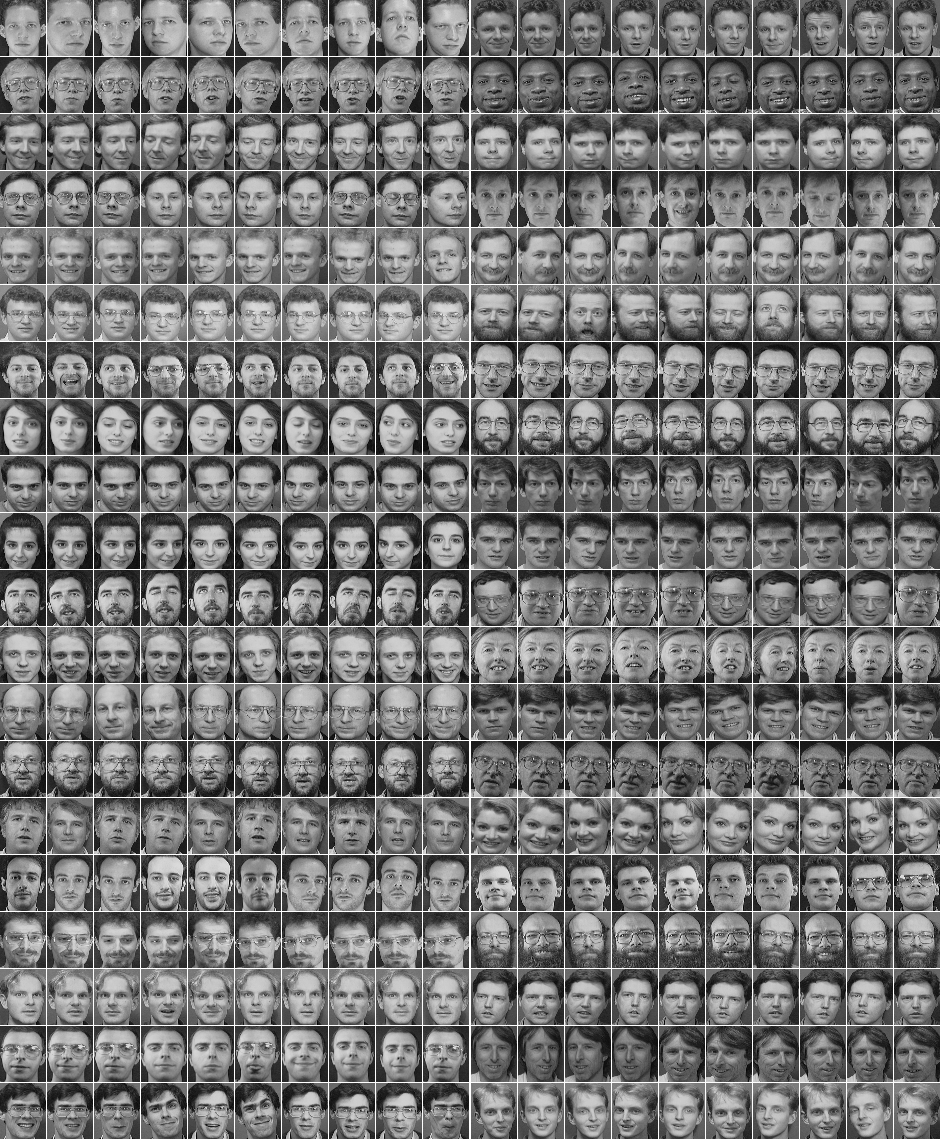
# -*- coding: utf-8 -*-

"""

Created on Wed Apr 24 18:21:21 2019

@author: 92958

"""

import os

import numpy as np

import tensorflow as tf

import matplotlib.pyplot as plt

import matplotlib.image as mpimg

import matplotlib.patches as patches

import numpy

from PIL import Image

dataset_path='./olivettifaces.gifa'

#获取dataset

def load_data(dataset_path):

    img = Image.open(dataset_path)

    # 定义一个20 × 20的训练样本,一共有40个人,每个人都10张样本照片

    img_ndarray = np.asarray(img, dtype='float64') / 256

    #img_ndarray = np.asarray(img, dtype='float32') / 32

    # 记录脸数据矩阵,57 * 47为每张脸的像素矩阵

    faces = np.empty((400, 57 * 47))

    for row in range(20):

        for column in range(20):

            faces[20 * row + column] = np.ndarray.flatten(

                img_ndarray[row * 57: (row + 1) * 57, column * 47 : (column + 1) * 47]

            )

    label = np.zeros((400, 40))

    for i in range(40):

        label[i * 10: (i + 1) * 10, i] = 1

    # 将数据分成训练集,验证集,测试集

    train_data = np.empty((320, 57 * 47))

    train_label = np.zeros((320, 40))

    vaild_data = np.empty((40, 57 * 47))

    vaild_label = np.zeros((40, 40))

    test_data = np.empty((40, 57 * 47))

    test_label = np.zeros((40, 40))

    for i in range(40):

        train_data[i * 8: i * 8 + 8] = faces[i * 10: i * 10 + 8]

        train_label[i * 8: i * 8 + 8] = label[i * 10: i * 10 + 8]

        vaild_data[i] = faces[i * 10 + 8]

        vaild_label[i] = label[i * 10 + 8]

        test_data[i] = faces[i * 10 + 9]

        test_label[i] = label[i * 10 + 9]

    train_data = train_data.astype('float32')

    vaild_data = vaild_data.astype('float32')

    test_data = test_data.astype('float32')

    return [

        (train_data, train_label),

        (vaild_data, vaild_label),

        (test_data, test_label)

    ]

def convolutional_layer(data, kernel_size, bias_size, pooling_size):

    kernel = tf.get_variable("conv", kernel_size, initializer=tf.random_normal_initializer())

    bias = tf.get_variable('bias', bias_size, initializer=tf.random_normal_initializer())

    conv = tf.nn.conv2d(data, kernel, strides=[1, 1, 1, 1], padding='SAME')

    linear_output = tf.nn.relu(tf.add(conv, bias))

    pooling = tf.nn.max_pool(linear_output, ksize=pooling_size, strides=pooling_size, padding="SAME")

    return pooling

def linear_layer(data, weights_size, biases_size):

    weights = tf.get_variable("weigths", weights_size, initializer=tf.random_normal_initializer())

    biases = tf.get_variable("biases", biases_size, initializer=tf.random_normal_initializer())

    return tf.add(tf.matmul(data, weights), biases)

def convolutional_neural_network(data):

    # 根据类别个数定义最后输出层的神经元

    n_ouput_layer = 40

    kernel_shape1=[5, 5, 1, 32]

    kernel_shape2=[5, 5, 32, 64]

    full_conn_w_shape = [15 * 12 * 64, 1024]

    out_w_shape = [1024, n_ouput_layer]

    bias_shape1=[32]

    bias_shape2=[64]

    full_conn_b_shape = [1024]

    out_b_shape = [n_ouput_layer]

    data = tf.reshape(data, [-1, 57, 47, 1])

    # 经过第一层卷积神经网络后,得到的张量shape为:[batch, 29, 24, 32]

    with tf.variable_scope("conv_layer1") as layer1:

        layer1_output = convolutional_layer(

            data=data,

            kernel_size=kernel_shape1,

            bias_size=bias_shape1,

            pooling_size=[1, 2, 2, 1]

        )

    # 经过第二层卷积神经网络后,得到的张量shape为:[batch, 15, 12, 64]

    with tf.variable_scope("conv_layer2") as layer2:

        layer2_output = convolutional_layer(

            data=layer1_output,

            kernel_size=kernel_shape2,

            bias_size=bias_shape2,

            pooling_size=[1, 2, 2, 1]

        )

    with tf.variable_scope("full_connection") as full_layer3:

        # 讲卷积层张量数据拉成2-D张量只有有一列的列向量

        layer2_output_flatten = tf.contrib.layers.flatten(layer2_output)

        layer3_output = tf.nn.relu(

            linear_layer(

                data=layer2_output_flatten,

                weights_size=full_conn_w_shape,

                biases_size=full_conn_b_shape

            )

        )

        # layer3_output = tf.nn.dropout(layer3_output, 0.8)

    with tf.variable_scope("output") as output_layer4:

        output = linear_layer(

            data=layer3_output,

            weights_size=out_w_shape,

            biases_size=out_b_shape

        )

    return output;

def train_facedata(dataset, model_dir,model_path):

    # train_set_x = data[0][0]

    # train_set_y = data[0][1]

    # valid_set_x = data[1][0]

    # valid_set_y = data[1][1]

    # test_set_x = data[2][0]

    # test_set_y = data[2][1]

    # X = tf.placeholder(tf.float32, shape=(None, None), name="x-input")  # 输入数据

    # Y = tf.placeholder(tf.float32, shape=(None, None), name='y-input')  # 输入标签

    batch_size = 40

    # train_set_x, train_set_y = dataset[0]

    # valid_set_x, valid_set_y = dataset[1]

    # test_set_x, test_set_y = dataset[2]

    train_set_x = dataset[0][0]

    train_set_y = dataset[0][1]

    valid_set_x = dataset[1][0]

    valid_set_y = dataset[1][1]

    test_set_x = dataset[2][0]

    test_set_y = dataset[2][1]

    X = tf.placeholder(tf.float32, [batch_size, 57 * 47])

    Y = tf.placeholder(tf.float32, [batch_size, 40])

    predict = convolutional_neural_network(X)

    cost_func = tf.reduce_mean(tf.nn.softmax_cross_entropy_with_logits(logits=predict, labels=Y))

    optimizer = tf.train.AdamOptimizer(1e-2).minimize(cost_func)

    # 用于保存训练的最佳模型

    saver = tf.train.Saver()

    #model_dir = './model'

    #model_path = model_dir + '/best.ckpt'

    with tf.Session() as session:

        # 若不存在模型数据,需要训练模型参数

        if not os.path.exists(model_path + ".index"):

            session.run(tf.global_variables_initializer())

            best_loss = float('Inf')

            for epoch in range(20):

                epoch_loss = 0

                for i in range((int)(np.shape(train_set_x)[0] / batch_size)):

                    x = train_set_x[i * batch_size: (i + 1) * batch_size]

                    y = train_set_y[i * batch_size: (i + 1) * batch_size]

                    _, cost = session.run([optimizer, cost_func], feed_dict={X: x, Y: y})

                    epoch_loss += cost

                print(epoch, ' : ', epoch_loss)

                if best_loss > epoch_loss:

                    best_loss = epoch_loss

                    if not os.path.exists(model_dir):

                        os.mkdir(model_dir)

                        print("create the directory: %s" % model_dir)

                    save_path = saver.save(session, model_path)

                    print("Model saved in file: %s" % save_path)

        # 恢复数据并校验和测试

        saver.restore(session, model_path)

        correct = tf.equal(tf.argmax(predict,1), tf.argmax(Y,1))

        valid_accuracy = tf.reduce_mean(tf.cast(correct,'float'))

        print('valid set accuracy: ', valid_accuracy.eval({X: valid_set_x, Y: valid_set_y}))

        test_pred = tf.argmax(predict, 1).eval({X: test_set_x})

        test_true = np.argmax(test_set_y, 1)

        test_correct = correct.eval({X: test_set_x, Y: test_set_y})

        incorrect_index = [i for i in range(np.shape(test_correct)[0]) if not test_correct[i]]

        for i in incorrect_index:

            print('picture person is %i, but mis-predicted as person %i'

                %(test_true[i], test_pred[i]))

        plot_errordata(incorrect_index, "olivettifaces.gif")

#画出在测试集中错误的数据

def plot_errordata(error_index, dataset_path):

    img = mpimg.imread(dataset_path)

    plt.imshow(img)

    currentAxis = plt.gca()

    for index in error_index:

        row = index // 2

        column = index % 2

        currentAxis.add_patch(

            patches.Rectangle(

                xy=(

                     47 * 9 if column == 0 else 47 * 19,

                     row * 57

                    ),

                width=47,

                height=57,

                linewidth=1,

                edgecolor='r',

                facecolor='none'

            )

    )

    plt.savefig("result.png")

    plt.show()

def main():

    dataset_path = "olivettifaces.gif"

    data = load_data(dataset_path)

    model_dir = './model'

    model_path = model_dir + '/best.ckpt'

    train_facedata(data, model_dir, model_path)

if __name__ == "__main__" :

    main()
控制台信息:
runfile('F:/python/TensorFlow/人脸识别/olive1.py', wdir='F:/python/TensorFlow/人脸识别')
WARNING:tensorflow:From C:\Users\92958\Anaconda3\lib\site-packages\tensorflow\python\framework\op_def_library.py:263: colocate_with (from tensorflow.python.framework.ops) is deprecated and will be removed in a future version.
Instructions for updating:
Colocations handled automatically by placer.
WARNING: The TensorFlow contrib module will not be included in TensorFlow 2.0.
For more information, please see:
- https://github.com/tensorflow/community/blob/master/rfcs/20180907-contrib-sunset.md
- https://github.com/tensorflow/addons
If you depend on functionality not listed there, please file an issue.
WARNING:tensorflow:From C:\Users\92958\Anaconda3\lib\site-packages\tensorflow\contrib\layers\python\layers\layers.py:1624: flatten (from tensorflow.python.layers.core) is deprecated and will be removed in a future version.
Instructions for updating:
Use keras.layers.flatten instead.
WARNING:tensorflow:From F:/python/TensorFlow/人脸识别/olive1.py:158: softmax_cross_entropy_with_logits (from tensorflow.python.ops.nn_ops) is deprecated and will be removed in a future version.
Instructions for updating:
Future major versions of TensorFlow will allow gradients to flow
into the labels input on backprop by default.
See tf.nn.softmax_cross_entropy_with_logits_v2.
0 : 2671140.984375
create the directory: ./model
Model saved in file: ./model/best.ckpt
1 : 610905.9375
Model saved in file: ./model/best.ckpt
2 : 181258.35693359375
Model saved in file: ./model/best.ckpt
3 : 54391.228271484375
Model saved in file: ./model/best.ckpt
4 : 24234.38525390625
Model saved in file: ./model/best.ckpt
5 : 9868.018524169922
Model saved in file: ./model/best.ckpt
6 : 3433.5851974487305
Model saved in file: ./model/best.ckpt
7 : 826.4495697021484
Model saved in file: ./model/best.ckpt
8 : 200.12329292297363
Model saved in file: ./model/best.ckpt
9 : 194.84842109680176
Model saved in file: ./model/best.ckpt
10 : 63.74338483810425
Model saved in file: ./model/best.ckpt
11 : 10.006996154785156
Model saved in file: ./model/best.ckpt
12 : 7.118054211139679
Model saved in file: ./model/best.ckpt
13 : 0.0
Model saved in file: ./model/best.ckpt
14 : 0.0
15 : 0.0
16 : 0.0
17 : 0.0
18 : 0.0
19 : 0.0
WARNING:tensorflow:From C:\Users\92958\Anaconda3\lib\site-packages\tensorflow\python\training\saver.py:1266: checkpoint_exists (from tensorflow.python.training.checkpoint_management) is deprecated and will be removed in a future version.
Instructions for updating:
Use standard file APIs to check for files with this prefix.
INFO:tensorflow:Restoring parameters from ./model/best.ckpt
valid set accuracy: 0.8
picture person is 4, but mis-predicted as person 8
picture person is 18, but mis-predicted as person 14
picture person is 21, but mis-predicted as person 27
picture person is 35, but mis-predicted as person 17

原文:https://blog.csdn.net/hanghangaidoudou/article/details/79347080
olivettifaces数据集实现人脸识别代码的更多相关文章
- opencv人脸识别代码
opencv人脸识别C++代码 /* * Copyright (c) 2011,2012. Philipp Wagner <bytefish[at]gmx[dot]de>. * Relea ...
- 百度Aip人脸识别之python代码
用python来做人脸识别代码量少 思路清晰, 在使用之前我们需要在我们的配置的编译器中通过pip install baidu-aip 即可 from aip import AipFace 就可以开 ...
- CNN卷积神经网络人脸识别
图片总共40个人,每人10张图片,每张图片高57,宽47.共400张图片. 读取图片的py文件 import numpyimport pandasfrom PIL import Imagefrom k ...
- 人脸识别FaceNet+TensorFlow
一.本文目标 利用facenet源码实现从摄像头读取视频,实时检测并识别视频中的人脸.换句话说:把facenet源码中contributed目录下的real_time_face_recognition ...
- [译]Kubernetes 分布式应用部署和人脸识别 app 实例
原文地址:KUBERNETES DISTRIBUTED APPLICATION DEPLOYMENT WITH SAMPLE FACE RECOGNITION APP 原文作者:skarlso 译文出 ...
- Python3利用Dlib19.7实现摄像头人脸识别的方法
0.引言 利用python开发,借助Dlib库捕获摄像头中的人脸,提取人脸特征,通过计算欧氏距离来和预存的人脸特征进行对比,达到人脸识别的目的: 可以自动从摄像头中抠取人脸图片存储到本地,然后提取构建 ...
- 「Python」人脸识别应用
人脸识别主要步骤: face_recognition 库的安装 安装此库,首先需要安装编译dlib,此处我们偷个懒,安装软件Anaconda(大牛绕过),此软件预装了dlib. 安装好后,我们直接通过 ...
- 百度人脸识别AI实践.doc
0, 前言 百度开放了很多AI能力,其中人脸识别就是其中之一. 本文对百度人脸识别AI进行实践检验,看看其使用效果如何. 鉴于是最为基础的实践,基本都是在其接口范例代码修改而来. 百度人脸识别AI网站 ...
- python 与 百度人脸识别api
用python来做人脸识别代码量少 思路清晰, 在使用之前我们需要在我们的配置的编译器中通过pip install baidu-aip 即可 from aip import AipFac ...
随机推荐
- 项目复审——Alpha阶段
Deadline: 2018-5-19 10:00PM,以提交至班级博客时间为准. 5.10实验课上,以(1.2班级,3.4班级为单位)进行项目复审.根据以下要求,完成本团队对其他团队的复审排序. 参 ...
- C++中的 CONST 含义(从#define 到 CONST 的转变)
const 与define 两者都可以用来定义常量,但是const定义时,定义了常量的类型,所以更精确一些.#define只是简单的文本替换,除了可以定义常量外,还可以用来定义一些简单的函数,有点类似 ...
- angularjs学习第二天笔记---过滤器
您好,我是一名后端开发工程师,由于工作需要,现在系统的从0开始学习前端js框架之angular,每天把学习的一些心得分享出来,如果有什么说的不对的地方,请多多指正,多多包涵我这个前端菜鸟,欢迎大家的点 ...
- [PHP] 排序和查找算法
知乎:冒泡排序(bubble sort)的原理是什么? 潘屹峰: 冒泡排序的原理可以顾名思义:把每个数据看成一个气泡,按初始顺序自底向上依次对两两气泡进行比较,对上重下轻的气泡交换顺序(这里用气泡轻. ...
- linux_shell_入门
shell编程入门: 程序员标配:第一个shell脚本 输出 ---- " Hello World !!" 1.先创建一个hello.sh脚本文件 vi hello.sh 然后在输 ...
- Ubuntu下自定义调整CPU工作频率(用于省电或提高性能都好用)
昨天高铁上拿T480切win10系统看电影,为了节电给细调了个省电策略(设置CPU性能30%),不知是不是因为这个原因,今天切回Ubuntu1604工作导致CPU工作频率非常低. 查阅了一下相关方法, ...
- BZOJ1802: [Ahoi2009]checker(性质分析 dp)
题意 题目链接 Sol 一个不太容易发现但是又很显然的性质: 如果有两个相邻的红格子,那么第一问答案为0, 第二问可以推 否则第一问答案为偶数格子上的白格子数,第二问答案为偶数格子上的红格子数 #in ...
- 【代码笔记】iOS-自定义switch
一,效果图. 二,工程图. 三,代码. ViewController.h #import <UIKit/UIKit.h> #import "CustomSwitch.h" ...
- Spring AOP 中@Pointcut的用法
Spring Aop中@pointCut的用法,格式:execution(modifiers-pattern? ret-type-pattern declaring-type-pattern? nam ...
- kvm 创建新虚拟机命virt-install 使用说明
virt-install 命令说明 1.命令作用 建立(provision)新虚拟机 2.语法 virt-install [选项]... 3.说明(DESCRIPTION) vi ...