
Entity Framework Code-First(13):Configure Many-to-Many
Configure Many-to-Many relationship:
Here, we will learn how to configure Many-to-Many relationship between the Student and Course entity classes. Student can join multiple courses and multiple students can join one course.
Visit Entity Relationship section to understand how EF manages one-to-one, one-to-many and many-to-many relationships between the entities.
Configure Many-to-Many relationship using DataAnnotation:
Student class should have a collection navigation property for Course, and Course should have a collection navigation property for student, which will create a Many-to-Many relationship between student and course as shown below:
public class Student

{

    public Student() { }

    public int StudentId { get; set; }

    [Required]

    public string StudentName { get; set; }

    public int StdandardId { get; set; }

    public virtual ICollection<Course> Courses { get; set; }

}

public class Course

{

    public Course()

    {

        this.Students = new HashSet<Student>();

    }

    public int CourseId { get; set; }

    public string CourseName { get; set; }

    public virtual ICollection<Student> Students { get; set; }

}
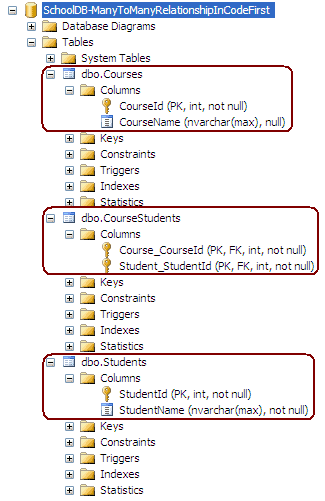
The code shown above will create the following database, where Code-First will create a third joining table, CourseStudent, which will consist of the PK of both the tables, i.e. StudentId & CourseId:
Configure Many-to-Many relationship using Fluent API:
You can use the Fluent API to configure a Many-to-Many relationship between Student and Course, as shown below:
protected override void OnModelCreating(DbModelBuilder modelBuilder)

{

    modelBuilder.Entity<Student>()

                .HasMany<Course>(s => s.Courses)

                .WithMany(c => c.Students)

                .Map(cs =>

                        {

                            cs.MapLeftKey("StudentRefId");

                            cs.MapRightKey("CourseRefId");

                            cs.ToTable("StudentCourse");

                        });

}
As you can see in the above example, .HasMany<Course>(s => s.Courses).WithMany(c => c.Students)says that Student and Course has many-to-many relationship with Students navigation property in Course class and Courses navigation property in Student class.
Map method takes Action type delegate, hence, we can pass lambda expression wherein we will specify FK property name of Student (we start with Student entity, so it will be left table) and FK of Course table. ToTable will create StudentCourse table.
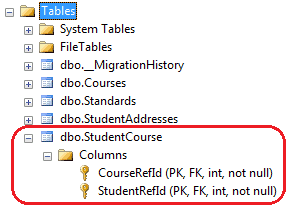
This will create a new joining table StudentCourse with two Primary Keys which will also be Foreign Keys, as shown below:
Entity Framework Code-First(13):Configure Many-to-Many的更多相关文章
- Entity Framework Tutorial Basics(13):Database First
Database First development with Entity Framework: We have seen this approach in Create Entity Data M ...
- Entity Framework Code first(转载)
一.Entity Framework Code first(代码优先)使用过程 1.1Entity Framework 代码优先简介 不得不提Entity Framework Code First这个 ...
- Entity Framework Code First (三)Data Annotations
Entity Framework Code First 利用一种被称为约定(Conventions)优于配置(Configuration)的编程模式允许你使用自己的 domain classes 来表 ...
- Entity Framework Code First (二)Custom Conventions
---------------------------------------------------------------------------------------------------- ...
- Entity Framework Code First (一)Conventions
Entity Framework 简言之就是一个ORM(Object-Relational Mapper)框架. Code First 使得你能够通过C#的类来描述一个模型,模型如何被发现/检测就是通 ...
- Entity Framework Tutorial Basics(11):Code First
Code First development with Entity Framework: Entity Framework supports three different development ...
- Entity Framework Code First (七)空间数据类型 Spatial Data Types
声明:本文针对 EF5+, Visual Studio 2012+ 空间数据类型(Spatial Data Types)是在 EF5 中引入的,空间数据类型表现有两种: Geography (地理学上 ...
- Entity Framework Code First (四)Fluent API - 配置属性/类型
上篇博文说过当我们定义的类不能遵循约定(Conventions)的时候,Code First 提供了两种方式来配置你的类:DataAnnotations 和 Fluent API, 本文将关注 Flu ...
- Entity Framework Code First (八)迁移 Migrations
创建初始模型和数据库 在开始使用迁移(Migrations)之前,我们需要一个 Project 和一个 Code First Model, 对于本文将使用典型的 Blog 和 Post 模型 创建一个 ...
- Entity Framework Code First (六)存储过程
声明:本文只针对 EF6+ 默认情况下,Code First 对实体进行插入.更新.删除操作是直接在表上进行的,从 EF6 开始你可以选择使用存储过程(Stored Procedures) 简单实体映 ...
随机推荐
- 第一天 格式化操作符 条件、for、while、break、continue语句
python2和3的区别: 2中的print 不必加括号 3中的print变为函数 要加括号 2中的input不能输入字母(输入的字母被认为是变量,而之前又没定义,所以报错),默认只能计算数字,要 ...
- 适用grunt的注意点
0.使用grunt可以为前端开发省去很多工作量,与git版本控制器配合起来不要太完美,一般也都是这么用的: 1.先安装node.js,下载软件安装就行了,一般自带npm管理器; 2.通过npm安装gr ...
- linux 压缩和归档
在linux下有几种压缩方式:gzip.bzip2.xz.zip gzip 压缩文件以.gz结尾, 只能压缩文件,不能压缩目录 用法: gzip:/path/to/somefile 用来压缩,完成 ...
- linux 新建分区 、格式化 并挂载的命令
一.新建分区命令为 fdisk /dev/diskname fdisk命令为交互式命令 p:显示当前硬盘上的分区,包括没保存的改动 n:创建新分区 e:表示扩扩展分区 p:表示主分区 d:删除一个分区 ...
- node.js+express验证码的实现
安装ccap库 npm install ccap var ccap = require(); var captcha = ccap({ width:190, height:50, offset:30, ...
- 图解Skip List——本质是空间换时间的数据结构,在lucene的倒排列表,bigtable,hbase,cassandra的memtable,redis中sorted set中均用到
Skip List的提出已有二十多年[Pugh, W. (1990)],却依旧应用广泛(Redis.LevelDB等).作为平衡树(AVL.红黑树.伸展树.树堆)的替代方案,虽然它性能不如平衡树稳定, ...
- 10 Python 数据类型—集合
在Python set是基本数据类型的一种集合类型,它有可变集合(set())和不可变集合(frozenset)两种.创建集合set.集合set添加.集合删除.交集.并集.差集的操作都是非常实用的方法 ...
- 数据库ACID和mvcc
一.数据库的ACID性: 原子性(atomicity).一致性(consistency).隔离性(isolation).持久性(durability). 二.原子性 1.原子性:一个事务要么全部完成, ...
- 数据库连接池(connection pool)
1.JDBC数据库连接池的必要性 在使用开发基于数据库的web程序时,传统的模式基本是按以下步骤: – 在主程序(如servlet.beans)中建立数据库连接. – 进行sql ...
- FEC之我见二
前面简单说了一下FEC,以及它的配合使用的方法.下面我想详细说一下FEC算法: 曾经有位大神在帖子里这么写着:采用改进型的vandermonde矩阵RS算法.其优点算法运算复杂度更低且解决了利用矩阵构 ...