
Python基础之内置函数(二)
先上一张图,python中内置函数:
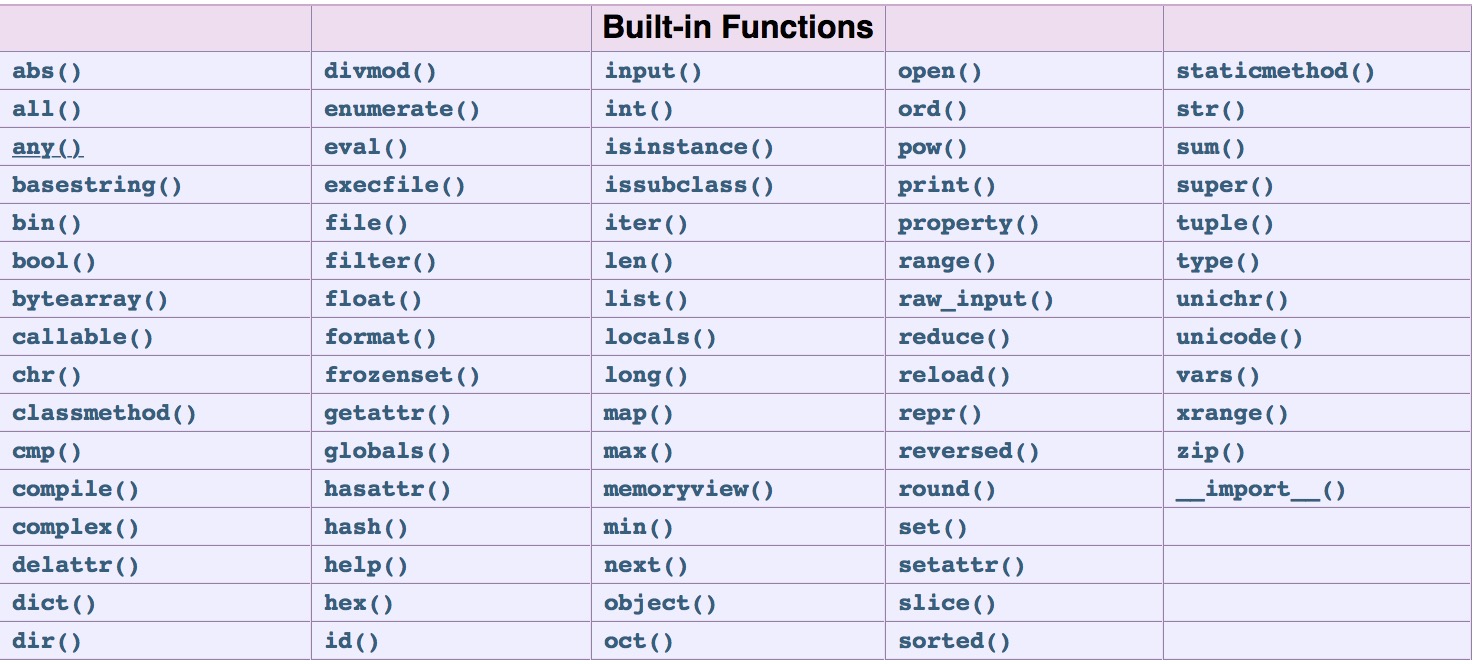
python官方解释在这:点我点我
继续聊内置函数:
callable(object):检查对象是否可被调用,或是否可执行,结果为bool值
def f1():

    pass

f2 = 123

print(callable(f1))

print(callable(f2))

out:

True

False
char():
ord():
这两个一起讲,都是对应ASCii表的,char(obect)将十进制数字转化为ascii中对应的字母,ord(object)将字母转化为ascii中对应的十进制数字。
顺便上一张ascii表吧,以便以后查询:

用处呢,可以用来搞随机验证码等等,随机验证码在这:点我点我
>>> chr(89)

'Y'

>>> chr(64)

'@'

>>> ord('x')

120

>>>
compile():将字符串编译成python代码,格式:compile( str, file, type )
compile语句是从type类型(包括’eval’: 配合eval使用,’single’: 配合单一语句的exec使用,’exec’: 配合多语句的exec使用)中将str里面的语句创建成代码对象
exam:
>>> s = "print(123)"

>>> r = compile(s, "<string>", "exec")

>>> exec(r)

123

>>>
执行:
eval() exec()
eval():格式:eval( obj[, globals=globals(), locals=locals()] ), 运算符,表达式:只能执行运算符,表达式, 并且eval() 有返回值
exec(): 格式:exec(obj),执行代码或者字符串,没有返回值,执行代码时,接收代码或者字符串
exam:
>>> s='8*8'

>>> eval(s)

64    #有返回值

>>>

>>> exec('8+7*8')    #无返回

>>> eval('8+7*8')

64

>>>
dir():快速查看对象提供了哪些功能
help():查看对象使用帮助,显示功能详情
exam:
>>> dir(list)

['__add__', '__class__', '__contains__', '__delattr__', '__delitem__', '__dir__', '__doc__', '__eq__', '__format__', '__ge__', '__getattribute__', '__getitem__', '__gt__', '__hash__', '__iadd__', '__imul__', '__init__', '__iter__', '__le__', '__len__', '__lt__', '__mul__', '__ne__', '__new__', '__reduce__', '__reduce_ex__', '__repr__', '__reversed__', '__rmul__', '__setattr__', '__setitem__', '__sizeof__', '__str__', '__subclasshook__', 'append', 'clear', 'copy', 'count', 'extend', 'index', 'insert', 'pop', 'remove', 'reverse', 'sort']

>>> help(list)

Help on class list in module builtins:

class list(object)

 |  list() -> new empty list

 |  list(iterable) -> new list initialized from iterable's items

 |

 |  Methods defined here:
divmod() :求商和余数,返回数据类型是元组,常用于页面分页计算
>>> r = divmod(100, 10)

>>> print(r[0])

10

>>> print(r[1])

0

>>> print(r)

(10, 0)

#也可这么用

>>> n1,n2=divmod(100,9)

>>> print(n1,n2)

11 1

>>>
isinstance():判断对象是否为某类的实例
>>> s='alex'

>>> isinstance(s,str)

True

>>> li=[1,2,3,4]

>>> isinstance(li,dict)

False

>>>
filter(func,obj):过滤,其中obj为可迭代的对象, 循环第二个参数,将每一个循环元素,去执行第一个参数(函数),如果函数的返回值为True,即合法
filter()用来筛选,函数返回True,将元素添加到结果中。
需要注意的是,filter如果直接打印的话,是一个内存地址,需要将其转化为有序元素,比如list等。
exam:
def f1(args):

    result = []

    for item in args:

        if item > 22:

            result.append(item)

    return result

li = [11, 22, 33, 44, 55]

ret = f1(li)

print(ret)

out:

[33, 44, 55]

===================

li=[11,22,33,45,67,23,14,52,]

def f1(a):

    if a > 22:

        return 1

res=filter(f1,li)

print(type(res))

print(list(res))

out:

<class 'filter'>

[33, 45, 67, 23, 52]

=================

li = [11, 22, 33, 44, 55]

res=filter(lambda a:a>27,li)

print(list(res))

out:

[33, 44, 55]
可以看出来,使用lambda表达式可使代码更简洁,因为lambda表达式是自动return,不用像函数那样特意定义返回值
li=[11,22,33,45,67,23,14,52,]

res=map(lambda a:a+100,li)

print(list(res))

out:

[111, 122, 133, 145, 167, 123, 114, 152]
filter与map的区别:
filter()是使用函数对可迭代对象进行筛选,如果函数返回为True,将对象添加到结果中
map()是使用函数对可迭代对象进行处理,批量操作,将函数返回值添加到结果中
frozenset() :不可变集合,与set()相对
set()是可变的,有add(),remove()等方法。既然是可变的,所以它不存在哈希值
NAME = "ALEX"

def show():

    a = 123

    c = 123

    print(locals())

    print(globals())

show()

out:

{'c': 123, 'a': 123}

{'__package__': None, '__spec__': None, '__cached__': None, '__loader__': <_frozen_importlib_external.SourceFileLoader object at 0x1007a5c50>, 'show': <function show at 0x10137b620>, '__builtins__': <module 'builtins' (built-in)>, '__name__': '__main__', '__file__': '/Users/shane/PycharmProjects/Py_study/Base/S4/test.py', '__doc__': None, 'NAME': 'ALEX'}
hash():生成hash值,生成的值不是固定的
exam:
s = "hhhasdfasdfasdfasdfasdfasdfasdfasdfa" \

    "sdfasdfasdfhhhasdfasdfasdfasdfasdfasdfasdfasdfasdfasdfasdf"

print(hash(s))

out:

1352149349547718846
len() 计算元素的长度的,但需要注意的一点是汉字:
在2.7中,len('汉字')是按字节算的,值为6
在3.5中,len('汉字')是按字符算的,值为2
exam:
s='李杰'

print(len(s))

b=bytes(s,encoding='utf8')

print(len(b))

out:

2

6
>>> li=[1,2,56,7,8,90]

>>> min(li)

1

>>> max(li)

90

>>> sum(li)

164

>>>
pow() 求幂,等同于**
exam:
>>> pow(10,3)

1000

>>> 10**3

1000

>>>
reversed() 反转
exam:
li = [11,22,1,1]

#与 li.reverse() 相同

reversed(li)

print(li)

out:

[11, 22, 1, 1]
round() 四舍五入
exam:
>>> round(1.4)

1

>>> round(5.8)

6

>>>
sorted() 排序
exam:
li = [11,2,1,1]

li.sort()

等同:

sorted(li)
zip() 接受任意多个(包括0个和1个)序列作为参数,返回一个tuple列表,不是很好描述
exam:
l1 = ["alex", 11, 22, 33]

l2 = ["is", 11, 22, 33]

l3 = ["sb", 11, 22, 33]

r = zip(l1, l2, l3)

print(r)

print(list(r))

out:

<zip object at 0x10137cfc8>    #注意结果,print的话也是内存地址

[('alex', 'is', 'sb'), (11, 11, 11), (22, 22, 22), (33, 33, 33)]
注意长度计算方式:
x = [1, 2, 3]

y = [4, 5, 6, 7]

xy = zip(x, y)

print(list(xy))

out:

[(1, 4), (2, 5), (3, 6)]
一个列表:
x = [1, 2, 3]

zx=zip(x)

print(list(zx))

y=[1,]

zy=zip(y)

print(list(zy))

out:

[(1,), (2,), (3,)]

[(1,)]
slice() 切片
格式:slice(start,stop,step) 也可 slice(none,stop,none)
exam:
l=list(range(10))

print(l)

print(l[slice(1,6,2)])

print(l[1:8:2])

print(l[slice(5)])

out:

[0, 1, 2, 3, 4, 5, 6, 7, 8, 9]

[1, 3, 5]

[1, 3, 5, 7]

[0, 1, 2, 3, 4]
字符串也可以这么搞
s='abddfdfdf'

print(s[0:8:2])

print(s[slice(0,8,2)])

out:

adff

adff
Python基础之内置函数(二)的更多相关文章
- python基础之内置函数
该博客内容参考http://www.cnblogs.com/wupeiqi/articles/4943406.html 内置函数 一 详细见python文档,猛击这里 文件操作 操作文件时,一般需要经 ...
- Python基础之内置函数和递归
一.内置函数 下面简单介绍几个: 1.abs() 求绝对值 2.all() 如果 iterable 的所有元素都为真(或者如果可迭代为空),则返回 True 3.any() 如果 iterable 的 ...
- python基础之内置函数补充、匿名函数、递归函数
内置函数补充 python divmod()函数:把除数和余数运算结果结合起来,返回一个包含商和余数的元组(a // b, a % b) 语法: 1 divmod(a, b) #a.b为数字,a为除数 ...
- python基础之内置函数和匿名函数
内置函数 学习函数以后多了很多概念,例如函数的命名空间,函数的作用域,函数的调用等等,函数的作用就是为了实现某些功能而方便以后可以调用,内置函数就是这样的一些公共的函数,被称为内置函数. 我们就一 ...
- python基础之内置函数(一)
内建函数都在 _builtins_ 里面 (1)abs() 取绝对值 adb(-10) 10 (2)bool()将参数转换成布尔型,返回值是True或False 参数是数字时,0返回False,其他任 ...
- python基础——内置函数
python基础--内置函数 一.内置函数(python3.x) 内置参数详解官方文档: https://docs.python.org/3/library/functions.html?highl ...
- python之内置函数(二)与匿名函数、递归函数初识
一.内置函数(二)1.和数据结构相关(24)列表和元祖(2)list:将一个可迭代对象转化成列表(如果是字典,默认将key作为列表的元素).tuple:将一个可迭代对象转化成元组(如果是字典,默认将k ...
- python基础-内置函数详解
一.内置函数(python3.x) 内置参数详解官方文档: https://docs.python.org/3/library/functions.html?highlight=built#ascii ...
- python基础-内置函数 isinstance() 与 issubclass()
面向对象编程之内置函数 isinstance() 与 issubclass() isinstance():判断一个对象是否是另一个类的实例.返回bool值,True表示是,False表示不是. 语法: ...
随机推荐
- cookie、session与用户认证组件
1.cookie def login(request): if request.method == "GET": return render(request,"login ...
- sbt 配置个屁的国内源
~/.sbt/repositories [repositories] #本地源 local #兼容 Ivy 路径布局 apache-ivy: https://repo1.maven.apache.or ...
- Mybatis-Plus select不列出全部字段
https://www.jianshu.com/p/e97b8236db67 只显示某两个字段 @Test public void selectByWrapper10() { QueryWrapper ...
- iptables 相关命令
1. 清除已有iptables规则 iptables -F iptables -X iptables -Z 2. 开放指定的端口(添加规则) iptables -A INPUT -s 127.0.0. ...
- 011_GoldWave软件安装及使用
(一)软件安装包: 链接:https://pan.baidu.com/s/15c5veooyA8bAYIAgLFOLjg提取码:jiis 复制这段内容后打开百度网盘手机App,操作更方便哦 (二)降低 ...
- icpc 银川 I. Base62 任意进制的转换 短除法
Problem Description As we already know, base64 is a common binary-to-text encoding scheme. Here we d ...
- 35 | join语句怎么优化?
在上一篇文章中,我和你介绍了 join 语句的两种算法,分别是 Index Nested-Loop Join(NLJ) 和 Block Nested-Loop Join(BNL). 我们发现在使用 N ...
- Greenplum 表空间和filespace的用法
转载:https://yq.aliyun.com/articles/190 Greenplum支持表空间,创建表空间时,需要指定filespace.postgres=# \h create table ...
- [AGC028B]Removing Blocks 概率与期望
考虑算每一个位置在所有情况的期望值乘以全排列似乎就是答案. 那么对于 $i$,如果要由 $j$ 来贡献的话就要满足 $j$ 在 $i....j-1$ 之前先拿. 而在拿 $j$ 时,先于 $i...j ...
- 洛谷P1016 旅行家的预算 题解
主要就是注意一下各个变量的类型别弄混了 https://www.luogu.org/problem/P1016 #include<cstdio> using namespace std; ...