
Notes: Principles of fMRI 1 (Coursera)
course link: https://class.coursera.org/fmri1-001
Part 1
❤ Three fundmental goals in fMRI:
localization (brain mapping approach: task comparison, brain-behavior correlation, information-based mapping);
connectivity (functional connectivity (seed-based), effectivity connectivity (DCM), multivariate connectivity (ICA, PCA, graph theory));
prediction (use the brain activities to predict something such as behavior)
❤ fMRI data structure:
TR: temporal resolution
Sturctural images:T1, WM<GM<CSF (longitudinal relaxation)
Functional images: T2* images
T2: teanscerse reliaxation
❤ fmri data structure
Field of view (FOV): to what extent of view in each direction we can see the brain
Slice thickness
eg. If the FOC is 192 mm, matrix size is 64 mm (the area of each slice), the slice thickness is 3 mm, then voxel size: 192mm (FOV)/64 (matrix size)*3 (slice thickness) = 3*3*3 mm voxel size (the last 3 means slice thickness)
hierarchy: Experiment-subjects-session-run-volume-slice-voxel
❤ Statistical map: the colors indicate reliable, non-zero effects
❤ Reverse inference: observed brain actives -> the feeling
One fallacy: if P->Q, Q, therefore P (true only if P is the only factor leads to Q)
❤ For regional brain activation to have high positive predictive value:
- It must respond consistently to the task/state (high sentivitivity);
- It must respond only to the task/state (high specificity).
Part 2
course link: https://class.coursera.org/fmri1-001
❤ T1 time
WM = 600;
GM = 1000;
CSF = 3000.
❤ Terms relating to time
TR: how often we excite the nuclei;
TE: how soon after exciation we begin data collection.
❤ K-space
K-space is frequency space.
Doing inverse Fourier transformation on points in k-space could reconstruct brain image we need.
Each individual point in image space depends on all points in k-space (in other words, the value of the points in k-space tells us its relative contribution in reconstruct the brain image).
"Low spatial frequencies represent parts of the object that change in a spatially slow manner (Contrast); high spatial frequencies represent small structures whose size is on the same order as the voxel size (Tissue boundaries)." -- the center points in the k-space contribute most of the brain image, while the outskirt part mostly contribute to the sketch of the brain.
Part 3
❤ BOLD signal
- Oxyhemoglobin is diamagnetic; while deoxyhemoglobin is paramagnetic (distort the magetic fields, and suppress the MR signal - when deoxyhemoglobin decrease, then the T2*-weighted signal increase).
- Bold signal often corresponds relatively closely to the local field potential (LFP - often reflect the integrated post-synaptic activiy across a group of neurons) - the electrical field potentional surrounding a group of cells.
- Bold signal does not always reflect changes in neuron activity.
❤ Basic quality control
- SNR (signal-to-noise ratio): a basic measure of effect size.
- CNR (contrast-to-noise ratio)
The two measurements can be calculated at both spatial and temporal level. Note that for temporally detrended data, the temporal SNR (or functional SNR) is also called Signal-to-Fluctuation-Noise Ratio (SFNR). Temporal CNR is also signal sentivity.
- Bold response is non-linear, which may cause nonlinear 'saturation'. This effect can be reduced by increasing the intervals between two stimuli.
❤ fMRI artefacts and non-signal-related noise
- Drift (low frequency noise)
Slow changes in voxel intersity over time - scanner instabilities and aliased physiological noise. Should be taken care about when pre-process images and conduct statistical analysis.
To aviod drift the experiment design should be fast.
-Motion
Should be taken care about when pre-process images and conduct statistical analysis. Only motion correction in pre-processing steps is not enough.
- Respiration and heart rate
TR that is too low may give rise to aliasing.
Part 6 - GLM
- Statistical analysis under certain circumstances:

- Pay attention that the first colume of design matrix should be 1, in correspondance to β0;
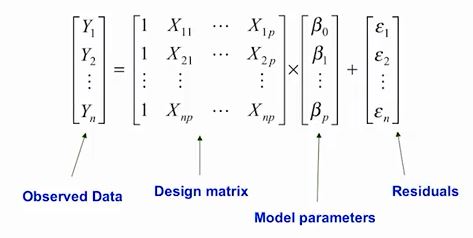
- Build a certian GLM model: assume a LTI (linear time invariant) system (because HRF is fixed and will not change with time), and the predictors (Xs) should be the neural response function convolved with HRF;
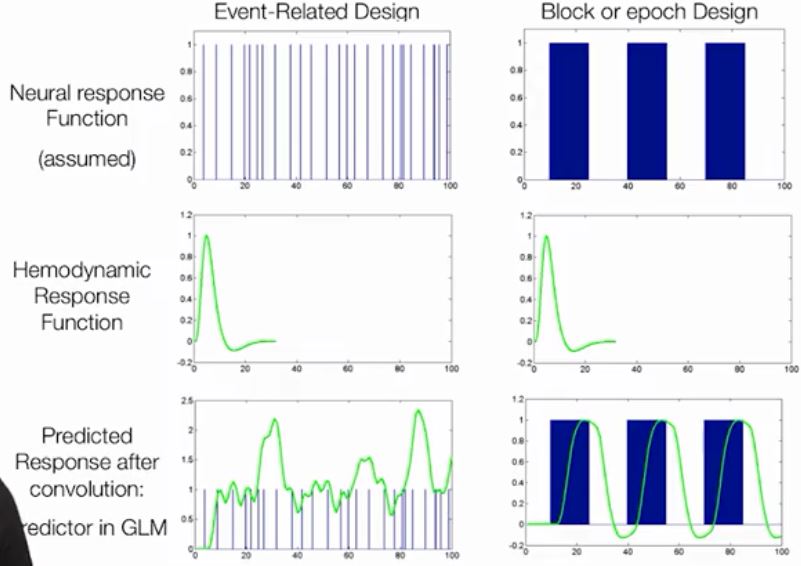
- Mass univariate analysis: assume each voxel in the brain responding independently, and build a GLM for them each for analysis;
- Contrast: vector of weights, used to perform statistical analysis (c'*β = a, a is h in statistical analysis). Usually sum(c) should equal to 0 for the convenience to conduct statistical analysis of H0 = 0.
- Using one sigle shaped curve to fit the HRF has imperfictions: actually HRF varies across brain regions and experiment paradigm. Three ways to model HRF:
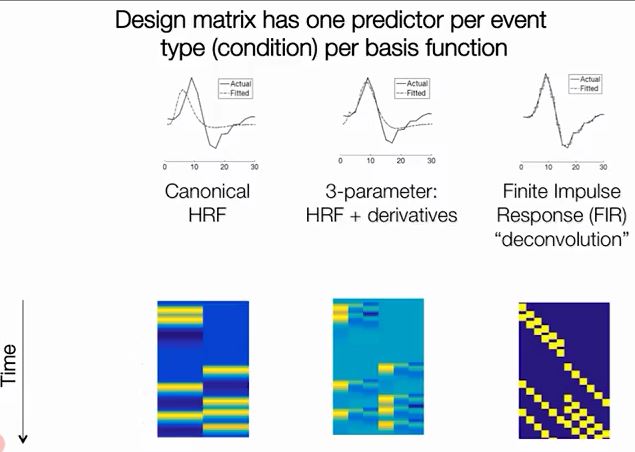
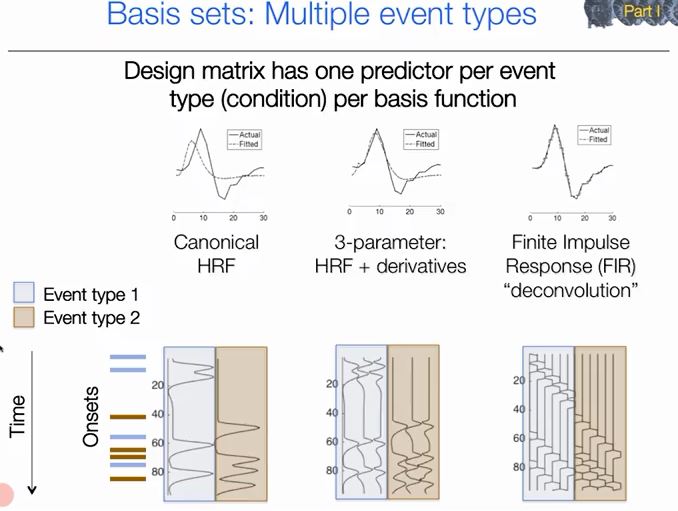
❤ Parameters estimation (actually we don't have to care about these the details)
- Based on the assumption below:
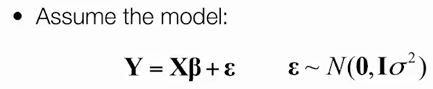
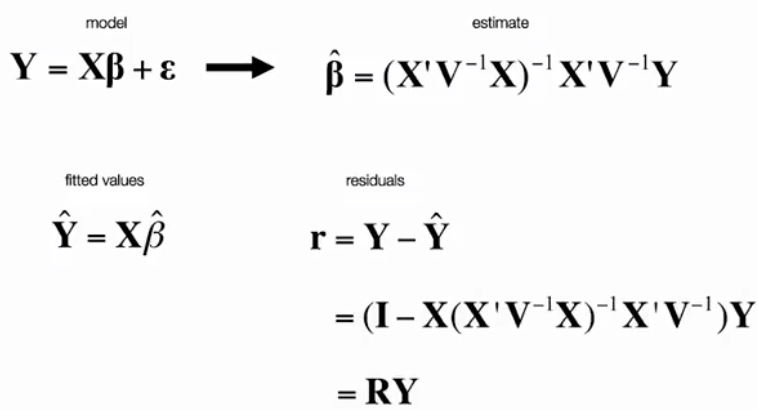
The following computation is based on two kind of hypothesis: ε is normally distributed at the mean zero and is IID (Independent and identically distributed) (then the variance-covariance matrix V can be considered as I(σ^2)) or not.
Then we have:


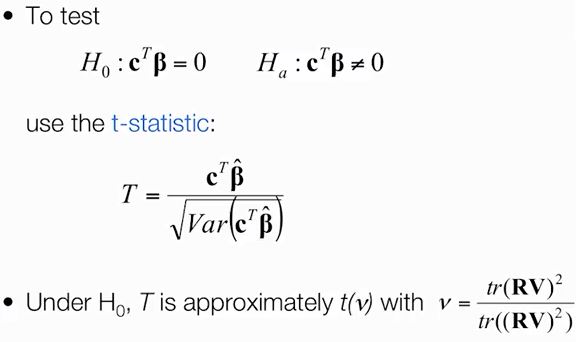
- Specific computation equations for T and F-test in SPM:

- Interesting angles about GLM
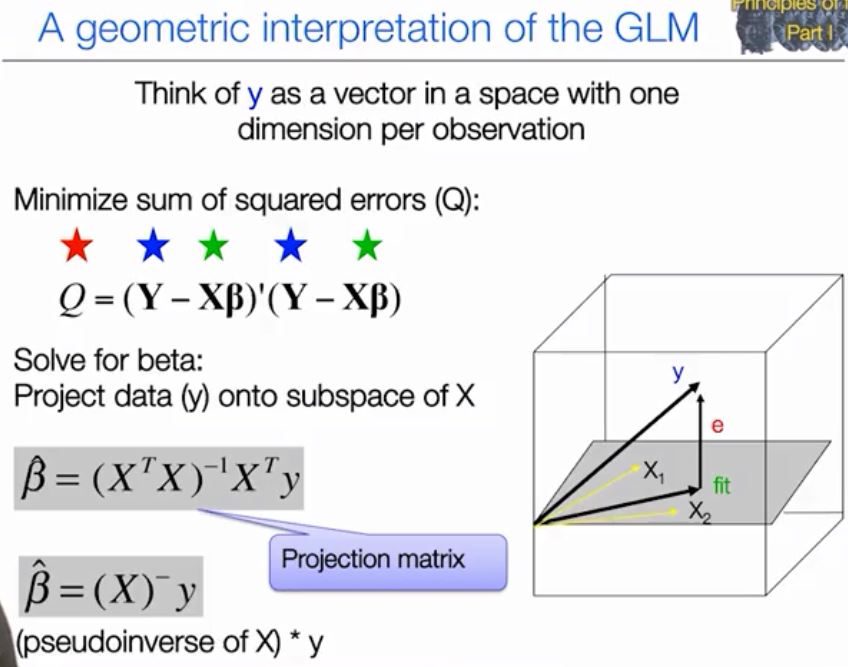
.. When fitting the GLM model, we are actually calculating in a p-dimention hyperplane space (p is the number of independent variables, namely the columns of the design matrix (-1? for the baseline));
.. As the figure shows below, the fitting of the dependent variable y' is actually the projection of y onto the plane that independent variable matrix (design matrix) X defines.
Part 7 - Multiple comparison correction
- voxel-based correction:
FWE (Bonferroni correction & Random Field Theory (usually gaussian random field) & Permutation) - too stringent;
FDR;
- cluster-level inference (correction): sensitivity but bad spacial specifity;
- threshold-free cluster enhancement (TFCE).
Notes: Principles of fMRI 1 (Coursera)的更多相关文章
- fMRI在认知心理学上的研究
参考:Principles of fMRI 1 问题: 1. fMRI能做什么不能做什么? 第一周:fMRI简介,data acquisition and reconstruction 大致分为两类: ...
- Notes of Principles of Parallel Programming - TODO
0.1 TopicNotes of Lin C., Snyder L.. Principles of Parallel Programming. Beijing: China Machine Pres ...
- Coursera公开课Functional Programming Principles in Scala习题解答:Week 2
引言 OK.时间非常快又过去了一周.第一周有五一假期所以感觉时间绰绰有余,这周中间没有假期仅仅能靠晚上加周末的时间来消化,事实上还是有点紧张呢! 后来发现每堂课的视频还有相应的课件(Slide).字幕 ...
- Coursera 机器学习Course Wiki Lecture Notes
https://share.coursera.org/wiki/index.php/ML:Main 包含了每周的Lecture Notes,以便复习回顾的时候使用.
- Coursera, Machine Learning, notes
Basic theory (i) Supervised learning (parametric/non-parametric algorithms, support vector machine ...
- Coursera台大机器学习课程笔记15 -- Three Learning Principles
这节课是最后一节,讲的是做机器学习的三个原则. 第一个是Occan's razor,即越简单越好.接着解释了什么是简单的hypothesis,什么是简单的model.关于为什么越简单越好,林老师从大致 ...
- Notes of Principles of Parallel Programming: Peril-L Notation - TODO
Content 1 syntax and semantic 2 example set 1 syntax and semantic 1.1 extending C Peril-L notation s ...
- C++基本要点复习--------coursera程序设计实习(PKU)的lecture notes
因为一些特性复杂,很多时候也用不到一些特性,所以忘记了,算是随笔,也当作一个临时查找的手册.没有什么顺序,很杂. 1.构造函数通过函数重载的机制可以有多个(不同的构造函数,参数个数,或者参数类型不同. ...
- Laterality issue on fMRI image
The laterality issue: different software will interpret fMRI images in different way (mainly refer t ...
随机推荐
- GCD同步异步 串行并行大解析
/** 核心概念 任务:block里需要执行的操作 队列:把任务添加进入队列中,按照先进先出的原则来执行任务 串行队列:一个一个的执行 并行队列:可以让多个任务并发(同时)执行(自动开启多个线程同时 ...
- iOS开发中如何使自定义方法具有XCode插件使用提示
iOS开发中难免要安装一些好用的插件,然而插件在使用时往往只对系统的方法有提示作用,而自己写的方法不能用上插件的便利. 其实还是有办法使插件对自定义的方法有效: 1. 首先知道Xcode的插件安装路径 ...
- 巧用Xode中的代码块(转)
在我们编码的过程中,总会发现有一些重复的编码工作,可能你会不厌其烦的去copy and paste,但是你有去考虑过怎样解决这样的问题吗?其实现在很多的编程IDE都能帮助我们减少一些编码的任务,提高编 ...
- C++语言-08-命名空间
概述 命名空间通常作为附加信息来区分不同库中相同名称的函数.类.变量.命名空间的本质是定义一个范围,该范围即为一个上下文,一个上下文中通常不允许出现相同名称的函数.类.变量. 定义 定义格式 普通的命 ...
- v0lt CTF安全工具包
0×00 v0lt v0lt是一个我尝试重组每一个我使用过的/现在在使用的/将来要用的用python开发的安全领域CTF工具.实践任务可能会采用bash脚本来解决,但我认为Python更具有灵活性,这 ...
- Linux 折腾汇集,实时更新
一.Linux教程 入门教程:http://www.92csz.com/study/linux/ 命令大全:http://man.linuxde.net/ 一.界面: 在Ubuntu.Linux Mi ...
- Zero to One读后感
Zero to One是一本不错的书,无论你是在职场还是在创业都应该看看先.书中没有告诉你任何的职业技巧,但是很明确的告诉了你应该有的思考方式,告诉你人与机器的关系,告诉成功企业固有的模式以及你为什么 ...
- JavaScript(五)——插入地图
代码: <!DOCTYPE html PUBLIC "-//W3C//DTD XHTML 1.0 Transitional//EN" "http://www.w3. ...
- Mongodb源代码阅读笔记:Journal机制
Mongodb源代码阅读笔记:Journal机制 Mongodb源代码阅读笔记:Journal机制 涉及的文件 一些说明 PREPLOGBUFFER WRITETOJOURNAL WRITETODAT ...
- 《java JDK7学习笔记》之跨平台与路径设置
Platforms表示Solaris.Linux.Windows各种操作系统平台,在这些平台上架构了java Virtaul Machine,简称JVM,Java虚拟机. Java虚拟机可以让java ...