
POJ-2528 Mayor's posters(线段树区间更新+离散化)
http://poj.org/problem?id=2528
https://www.luogu.org/problem/UVA10587
Description
- Every candidate can place exactly one poster on the wall.
- All posters are of the same height equal to the height of the wall; the width of a poster can be any integer number of bytes (byte is the unit of length in Bytetown).
- The wall is divided into segments and the width of each segment is one byte.
- Each poster must completely cover a contiguous number of wall segments.
They have built a wall 10000000 bytes long (such that there is enough place for all candidates). When the electoral campaign was restarted, the candidates were placing their posters on the wall and their posters differed widely in width. Moreover, the candidates started placing their posters on wall segments already occupied by other posters. Everyone in Bytetown was curious whose posters will be visible (entirely or in part) on the last day before elections.
Your task is to find the number of visible posters when all the posters are placed given the information about posters' size, their place and order of placement on the electoral wall.
Input
Output
The picture below illustrates the case of the sample input. 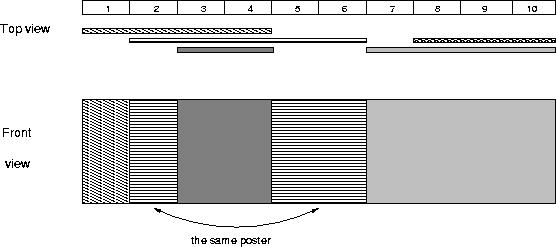
Sample Input
Sample Output
题目大意:
给你一个无限长的板子,n(n<=10000)个人依次贴n张等高的海报,给出每张海报所贴的范围li,ri(1<=li<=ri<=10000000),求出最后还能看见多少张海报。
题解:
一看线段树没跑了对吧? 就像染色一样,贴一张海报就把那一段染上新颜色, 这就是个很明显的区间修改嘛, 最后统计线段上有多少种不同颜色输出答案就OK了。
但是要注意线段树区间更新问题,给的长度的可能非常大,有1e9,不加处理直接维护一个线段树肯定会MLE,TLE,
但是我们注意到一共最多只有2e4个点,因此我们可以用离散化的思想先对区间进行预处理,所谓的离散化,
在我理解看来就是将一个很大的区间映射为一个很小的区间,而不改变原有的大小覆盖关系,但是注意简单的离散化可能
会出现错误,给出下面两个简单的例子应该能体现普通离散化的缺陷:
例子一:1-10 1-4 5-10
例子二:1-10 1-4 6-10
普通离散化后都变成了[1,4][1,2][3,4]
线段2覆盖了[1,2],线段3覆盖了[3,4],那么线段1是否被完全覆盖掉了呢?
例子一是完全被覆盖掉了,而例子二没有被覆盖
解决的办法则是对于距离大于1的两相邻点,中间再插入一个点。
下面的离散化方法摘自别处(分不清哪位大佬是原创。。。反正不是本蒟蒻):
解法:离散化,如下面的例子(题目的样例),因为单位1是一个单位长度,将下面的
1 2 3 4 6 7 8 10
— — — — — — — —
1 2 3 4 5 6 7 8
离散化 X[1] = 1; X[2] = 2; X[3] = 3; X[4] = 4; X[5] = 6; X[7] = 8; X[8] = 10
于是将一个很大的区间映射到一个较小的区间之中了,然后再对每一张海报依次更新在宽度为1~8的墙上(用线段树),最后统计不同颜色的段数。
但是只是这样简单的离散化是错误的,
如三张海报为:1~10 1~4 6~10
离散化时 X[ 1 ] = 1, X[ 2 ] = 4, X[ 3 ] = 6, X[ 4 ] = 10
第一张海报时:墙的1~4被染为1;
第二张海报时:墙的1~2被染为2,3~4仍为1;
第三张海报时:墙的3~4被染为3,1~2仍为2。
最终,第一张海报就显示被完全覆盖了,于是输出2,但实际上明显不是这样,正确输出为3。
新的离散方法为:在相差大于1的数间加一个数,例如在上面1 4 6 10中间加5(算法中实际上1,4之间,6,10之间都新增了数的)
X[ 1 ] = 1, X[ 2 ] = 4, X[ 3 ] = 5, X[ 4 ] = 6, X[ 5 ] = 10
这样之后,第一次是1~5被染成1;第二次1~2被染成2;第三次4~5被染成3
最终,1~2为2,3为1,4~5为3,于是输出正确结果3。
解这题特意去看了下STL中的unique函数(from:https://www.cnblogs.com/wangkundentisy/p/9033782.html)
unique函数属于STL中比较常用函数,它的功能是元素去重。即”删除”序列中所有相邻的重复元素(只保留一个)。
此处的删除,并不是真的删除,而是指重复元素的位置被不重复的元素给占领了。由于它”删除”的是相邻的重复元素,所以在使用unique函数之前,一般都会将目标序列进行排序。
unique函数的函数原型如下:
只有两个参数,且参数类型都是迭代器:
iterator unique(iterator it_1,iterator it_2);
这种类型的unique函数是我们最常用的形式。其中这两个参数表示对容器中[it_1,it_2)范围的元素进行去重(注:区间是前闭后开,即不包含it_2所指的元素),返回值是一个迭代器,它指向的是去重后容器中不重复序列的最后一个元素的下一个元素。
unique函数通常和erase函数一起使用,来达到删除重复元素的目的。(注:此处的删除是真正的删除,即从容器中去除重复的元素,容器的长度也发生了变换;而单纯的使用unique函数的话,容器的长度并没有发生变化,只是元素的位置发生了变化)
 #include <stdio.h>

 #include <string.h>

 #include <iostream>

 #include <string>

 #include <math.h>

 #include <algorithm>

 #include <vector>

 #include <queue>

 #include <set>

 #include <map>

 #include <math.h>

 const int INF=0x3f3f3f3f;

 typedef long long LL;

 const int mod=1e9+;

 //const double PI=acos(-1);

 const int maxn=;

 using namespace std;

 //ios::sync_with_stdio(false);

 //    cin.tie(NULL);

 struct node

 {

     int l;

     int r;

     int color;

 }SegTree[<<];

 struct Segment

 {

     int l;

     int r;

 }A[];

 int B[];

 int vis[<<];

 int T,n,tot,cnt,ans;

 int init()//初始化,离散化

 {

     scanf("%d",&n);

     tot=;//tot为离散化的计数器

     for(int i=;i<=n;i++)

     {

         scanf("%d %d",&A[i].l,&A[i].r);

         B[++tot]=A[i].l;

         B[++tot]=A[i].r;

         B[++tot]=A[i].r+;//完善后的离散化多加的一点

     }

     sort(B+,B++tot);

     int len=unique(B+,B++tot)-B-;//去除重点,求出规格

     for(int i=;i<=n;i++)//重新算出每个贴纸的区间

     {

         A[i].l=lower_bound(B+,B++len,A[i].l)-B;

         A[i].r=lower_bound(B+,B++len,A[i].r)-B;

     }

     return len;

 }

 void PushDown(int rt)

 {

     if(SegTree[rt].color!=-)

     {

         SegTree[rt<<].color=SegTree[rt].color;

         SegTree[rt<<|].color=SegTree[rt].color;

         SegTree[rt].color=-;

     }

 }

 void Build(int l,int r,int rt)

 {

     SegTree[rt].l=l;

     SegTree[rt].r=r;

     SegTree[rt].color=;

     if(l==r)

     {

         return;

     }

     int mid=(l+r)>>;

     Build(l,mid,rt<<);

     Build(mid+,r,rt<<|);

 }

 void Update(int L,int R,int color,int rt)

 {

     int l=SegTree[rt].l;

     int r=SegTree[rt].r;

     if(L<=l&&R>=r)

     {

         SegTree[rt].color=color;

         return ;

     }

     PushDown(rt);

     int mid=(l+r)>>;

     if(L<=mid)

         Update(L,R,color,rt<<);

     if(R>mid)

         Update(L,R,color,rt<<|);

 }

 void Query(int L,int R,int rt)

 {

     if(SegTree[rt].color!=-)

     {

         if(!vis[SegTree[rt].color])

         {

             ans++;

             vis[SegTree[rt].color]=;

         }

         return;

     }

     Query(L,R,rt<<);

     Query(L,R,rt<<|);

 }

 int main()

 {

     scanf("%d",&T);

     while(T--)

     {

         int len=init();

         cnt=;//区间染色时的计数器

         Build(,len,);//建树

         for(int i=;i<=n;i++)//染色

         {

             Update(A[i].l,A[i].r,++cnt,);

         }

         memset(vis,,sizeof(vis));

         ans=;

         vis[]=;

         Query(,len,);

         printf("%d\n",ans);

     }

     return ;

 }
据说可以用Chtholly Tree珂朵莉树做,反正我不会。。。
珂朵莉树详解:https://www.luogu.org/blog/ACdreamer/chtholly-tree
该题的ODT做法可在这里找https://www.luogu.org/problemnew/solution/UVA10587
POJ-2528 Mayor's posters(线段树区间更新+离散化)的更多相关文章
- POJ 2528 Mayor's posters (线段树区间更新+离散化)
题目链接:http://poj.org/problem?id=2528 给你n块木板,每块木板有起始和终点,按顺序放置,问最终能看到几块木板. 很明显的线段树区间更新问题,每次放置木板就更新区间里的值 ...
- POJ.2528 Mayor's posters (线段树 区间更新 区间查询 离散化)
POJ.2528 Mayor's posters (线段树 区间更新 区间查询 离散化) 题意分析 贴海报,新的海报能覆盖在旧的海报上面,最后贴完了,求问能看见几张海报. 最多有10000张海报,海报 ...
- poj 2528 Mayor's posters 线段树区间更新
Mayor's posters Time Limit: 1 Sec Memory Limit: 256 MB 题目连接 http://poj.org/problem?id=2528 Descript ...
- POJ 2528 Mayor's posters (线段树+区间覆盖+离散化)
题意: 一共有n张海报, 按次序贴在墙上, 后贴的海报可以覆盖先贴的海报, 问一共有多少种海报出现过. 题解: 因为长度最大可以达到1e7, 但是最多只有2e4的区间个数,并且最后只是统计能看见的不同 ...
- POJ2528:Mayor's posters(线段树区间更新+离散化)
Description The citizens of Bytetown, AB, could not stand that the candidates in the mayoral electio ...
- POJ 2528 Mayor's posters(线段树,区间覆盖,单点查询)
Mayor's posters Time Limit: 1000MS Memory Limit: 65536K Total Submissions: 45703 Accepted: 13239 ...
- POJ 2528 Mayor’s posters (线段树段替换 && 离散化)
题意 : 在墙上贴海报, n(n<=10000)个人依次贴海报,给出每张海报所贴的范围li,ri(1<=li<=ri<=10000000).求出最后还能看见多少张海报. 分析 ...
- poj 2528 Mayor's posters 线段树+离散化技巧
poj 2528 Mayor's posters 题目链接: http://poj.org/problem?id=2528 思路: 线段树+离散化技巧(这里的离散化需要注意一下啊,题目数据弱看不出来) ...
- POJ 2528 Mayor's posters(线段树+离散化)
Mayor's posters 转载自:http://blog.csdn.net/winddreams/article/details/38443761 [题目链接]Mayor's posters [ ...
- poj 2528 Mayor's posters 线段树+离散化 || hihocode #1079 离散化
Mayor's posters Description The citizens of Bytetown, AB, could not stand that the candidates in the ...
随机推荐
- 吴裕雄--天生自然 JAVASCRIPT开发学习:for 循环
<!DOCTYPE html> <html> <head> <meta charset="utf-8"> <title> ...
- DES与MD5加密
using System; using System.Data; using System.Configuration; using System.Web; using System.Security ...
- 不同的二叉搜索树&II
不同的二叉搜索树 只要求个数,递推根节点分割左右子树即可 class Solution { public int numTrees(int n) { int []dp=new int[n+1]; fo ...
- 线上环境 分析java问题 常见命令
在生产上进程需要分析jvm运行情况,今天分享几个自己常用的命令,持续更新,欢迎补充 1.jps jstack -l {pid} > jstack.log #查看线程快照信息 2.jps jmap ...
- HTML-基础标记
HTML, 一种超文本标记语言,顾名思义,要比文本的样式多,而且是由标记组成,还是一门语言. 标记写法 <标记名> <a></a>双标记 超链接 <br /& ...
- ubuntu root用户下找不到环境变量解决办法
打开 gedit /root/.bashrc ,在文件的末尾添加: source /etc/profile 然后执行更新:source /root/.bashrc
- SQL server 查询常用语句 2019.3.20
SQL查询语句 select ...列名 from 表名 投影查询 select sno num,2019-sage as birthday // 给列起别名 from student: 在每个学生姓 ...
- APP-计算器
在网课上学习了计算器的制作方法,并自己做了小常识,看完一便后,感觉自己会了,思想也明白了,但是当关掉视频真正开始做的时候会发向许多的问题,自己在前的好多语法用的并不是很熟练,但是反复的查阅资料,观看教 ...
- 题解【[BJOI2012]算不出的等式】
题目背景emmm \[\text{首先特判掉p=q时的情况(ans = }p^2-1\text{)}\] \[\text{构造函数}f(k) = \left\lfloor \frac{kq}{p}\r ...
- 一线大厂的分布式唯一ID生成方案是什么样的?
本人免费整理了Java高级资料,涵盖了Java.Redis.MongoDB.MySQL.Zookeeper.Spring Cloud.Dubbo高并发分布式等教程,一共30G,需要自己领取.传送门:h ...