
Get on the CORBA
from: 《The Common Object Request Broker: Architecture and Specification》

Client
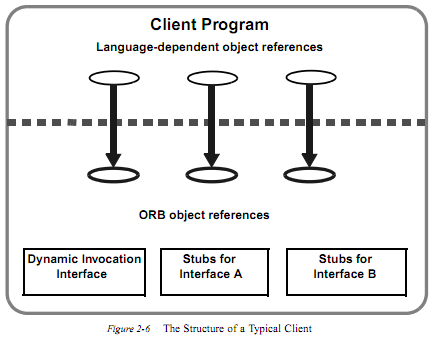
To make a request, the Client can use the Dynamic Invocation interface (the same interface independent of the target object’s interface) or an OMG IDL stub (the specific stub depending on the interface of the target object). The Client can also directly interact with the ORB for some functions.
Definitions of the interfaces to objects can be defined in two ways. Interfaces can be defined statically in an interface definition language, called the OMG Interface Definition Language (OMG IDL). Alternatively, or in addition, interfaces can be added to an Interface Repository service; this service represents the components of an interface as objects, permitting run-time access to these components. In any ORB implementation, the Interface Definition Language (which may be extended beyond its definition in this document) and the Interface Repository have equivalent expressive power.
Server(Object Implementation)
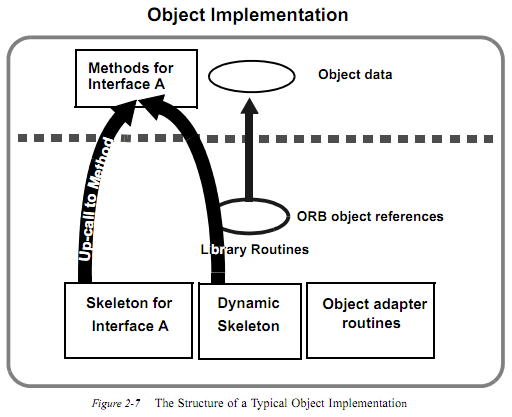
The Object Implementation receives a request as an up-call either through the OMG IDL generated skeleton or through a dynamic skeleton. The Object Implementation may call the Object Adapter and the ORB while processing a request or at other times.
The ORB locates the appropriate implementation code, transmits parameters, and transfers control to the Object Implementation through an IDL skeleton or a dynamic skeleton. Skeletons are specific to the interface and the object adapter. In performing the request, the object implementation may obtain some services from the ORB through the Object Adapter. When the request is complete, control and output values are returned to the client.

Object Request Broker
In the architecture, the ORB is not required to be implemented as a single component, but rather it is defined by its interfaces. Any ORB implementation that provides the appropriate interface is acceptable. The interface is organized into three categories:
- Operations that are the same for all ORB implementations
- Operations that are specific to particular types of objects
- Operations that are specific to particular styles of object implementations
Different ORBs may make quite different implementation choices, and, together with the IDL compilers, repositories, and various Object Adapters, provide a set of services to clients and implementations of objects that have different properties and qualities.There may be multiple ORB implementations (also described as multiple ORBs) which have different representations for object references and different means of performing invocations. It may be possible for a client to simultaneously have access to two object references managed by different ORB implementations. When two ORBs are intended to work together, those ORBs must be able to distinguish their object references. It is not the responsibility of the client to do so.
The ORB Core is that part of the ORB that provides the basic representation of objects and communication of requests. CORBA is designed to support different object mechanisms, and it does so by structuring the ORB with components above the ORB Core, which provide interfaces that can mask the differences between ORB Cores.
Client Stubs
For the mapping of a non–object–oriented language, there will be a programming interface to the stubs for each interface type. Generally, the stubs will present access to the OMG IDL-defined operations on an object in a way that is easy for programmers to predict once they are familiar with OMG IDL and the language mapping for the particular programming language. The stubs make calls on the rest of the ORB using interfaces that are private to, and presumably optimized for, the particular ORB Core. If more than one ORB is available, there may be different stubs corresponding to the different ORBs. In this case, it is necessary for the ORB and language mapping to cooperate to associate the correct stubs with the particular object reference.
Object-oriented programming languages, such as C++ and Smalltalk, do not require stub interfaces.
Dynamic Invocation Interface
An interface is also available that allows the dynamic construction of object invocations, that is, rather than calling a stub routine that is specific to a particular operation on a particular object, a client may specify the object to be invoked, the operation to be performed, and the set of parameters for the operation through a call or sequence of calls. The client code must supply information about the operation to be performed and the types of the parameters being passed (perhaps obtaining it from an Interface Repository or other run-time source). The nature of the dynamic invocation interface may vary substantially from one programming language mapping to another.
Implementation Skeleton
For a particular language mapping, and possibly depending on the object adapter, there will be an interface to the methods that implement each type of object. The interface will generally be an up-call interface, in that the object implementation writes routines that conform to the interface and the ORB calls them through the skeleton. The existence of a skeleton does not imply the existence of a corresponding client stub (clients can also make requests via the dynamic invocation interface). It is possible to write an object adapter that does not use skeletons to invoke implementation methods. For example, it may be possible to create implementations dynamically for languages such as Smalltalk.
Dynamic Skeleton Interface
An interface is available which allows dynamic handling of object invocations. That is, rather than being accessed through a skeleton that is specific to a particular operation, an object’s implementation is reached through an interface that provides access to the operation name and parameters in a manner analogous to the client side’s Dynamic Invocation Interface. Purely static knowledge of those parameters may be used, or dynamic knowledge (perhaps determined through an Interface Repository) may be also used, to determine the parameters.The implementation code must provide descriptions of all the operation parameters to the ORB, and the ORB provides the values of any input parameters for use in performing the operation. The implementation code provides the values of any output parameters, or an exception, to the ORB after performing the operation. The nature of the dynamic skeleton interface may vary substantially from one programming language mapping or object adapter to another, but will typically be an up-call interface.Dynamic skeletons may be invoked both through client stubs and through the dynamic invocation interface; either style of client request construction interface provides identical results.
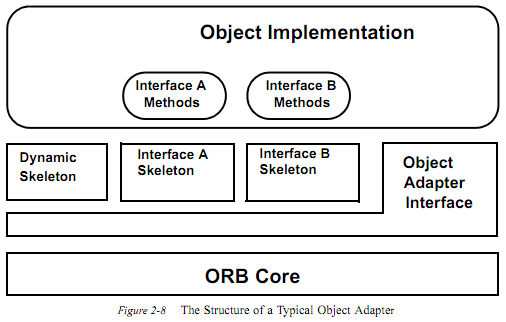
Object Adapters
An object adapter is the primary way that an object implementation accesses services provided by the ORB. There are expected to be a few object adapters that will be widely available, with interfaces that are appropriate for specific kinds of objects. Services provided by the ORB through an Object Adapter often include: generation and interpretation of object references, method invocation, security of interactions, object and implementation activation and deactivation, mapping object references to implementations, and registration of implementations. The wide range of object granularities, lifetimes, policies, implementation styles, and other properties make it difficult for the ORB Core to provide a single interface that is convenient and efficient for all objects. Thus, through Object Adapters, it is possible for the ORB to target particular groups of object implementations that have similar requirements with interfaces tailored to them.
ORB Interface
The ORB Interface is the interface that goes directly to the ORB which is the same for all ORBs and does not depend on the object’s interface or object adapter. Because most of the functionality of the ORB is provided through the object adapter, stubs, skeleton, or dynamic invocation, there are only a few operations that are common across all objects. These operations are useful to both clients and implementations of objects.
Interface Repository
The Interface Repository is a service that provides persistent objects that represent the IDL information in a form available at run-time. The Interface Repository information may be used by the ORB to perform requests. Moreover, using the information in the Interface Repository, it is possible for a program to encounter an object whose interface was not known when the program was compiled, yet, be able to determine what operations are valid on the object and make an invocation on it.In addition to its role in the functioning of the ORB, the Interface Repository is a common place to store additional information associated with interfaces to ORB objects. For example, debugging information, libraries of stubs or skeletons, routines that can format or browse particular kinds of objects might be associated with the Interface Repository.
Implementation Repository
The Implementation Repository contains information that allows the ORB to locate and activate implementations of objects. Although most of the information in the Implementation Repository is specific to an ORB or operating environment, the Implementation Repository is the conventional place for recording such information. Ordinarily, installation of implementations and control of policies related to the activation and execution of object implementations is done through operations on the Implementation Repository.In addition to its role in the functioning of the ORB, the Implementation Repository is a common place to store additional information associated with implementations of ORB objects. For example, debugging information, administrative control, resource allocation, security, etc., might be associated with the Implementation Repository.
Definitions of the interfaces to objects can be defined in two ways. Interfaces can be defined statically in an interface definition language, called the OMG Interface Definition Language (OMG IDL). Alternatively, or in addition, interfaces can be added to an Interface Repository service; this service represents the components of an interface as objects, permitting run-time access to these components. In any ORB implementation, the Interface Definition Language (which may be extended beyond its definition in this document) and the Interface Repository have equivalent expressive power.
Structure of a Client
Structure of an Object Implementation
Structure of an Object Adapter
转载于:https://www.cnblogs.com/brt3/p/9686265.html
Get on the CORBA的更多相关文章
- 客户端使用java,服务端使用c++的corba编程环境搭建
我们先用c++实现服务端和客户端,然后再用java编写客户端. 1. 首先安装omniORB,omniORB提供 omniidl命令,以及一些头文件和库. omniORB一般是需要你自己进行编译. 2 ...
- CORBA IOR学习
Interoperable Object References: IOR IOR用于表示一个对象引用,我们知道,当我们在客户端一个CORBA对象的时候,接触的并不是真正的对象,而是这个对象的代理(Pr ...
- CORBA GIOP消息格式学习
想要深入理解ORB的工作过程与原理,学习与了解GIOP消息格式必不可少.我们知道GIOP是独立于具体通信的更高级别的抽象,因此这里针对GIOP在TCP/IP上的实现IIOP协议进行学习与分析(IIOP ...
- 一个简单的CORBA例子
因为对CORBA分析的需要,这里写一个简单的CORBA例子.从JDK1.2开始,JDK中集成了ORB的实现,本例子使用了JDK1.7,对于JDK1.2+应该都没有问题.这个例子实现一个简单的加减乘除的 ...
- Corba概念(GIOP、IIOP、IOR、ORB、IDL)
CORBA公用对象请求代理(调度)程序体系结构(Common Object Request Broker Architecture),缩写为 CORBA,是对象管理组织(Object Manageme ...
- Corba、protocol buffer、SOA的区别 (转)
From: http://www.zhihu.com/question/20279489 Google的protocol buffers?这个跟corba.soa没啥关系,不同层次的概念,没法比.pr ...
- JavaIDL开发CORBA实例演示
转载 http://www.micmiu.com/opensource/corba/corba-javaidl-dev-demo/
- IDL简介与corba入门案例
IDL接口定义语言简介 IDL用中立语言的方式进行描述,能使软件组建(不同语言编写的)间相互通信. IDL提供了一个桥来连接不同的系统. Corba 上的服务用IDL描述,将被映射为某种程序设计语 ...
- protocol buffer和当年corba ,和现在SOA有啥异同点
CORBA是对象管理集团(OMG)的一个标准,使得不同语言编写的,运行在不同计算机上的能够协同工作.标准包括分布式计算的通讯协议(GIOP和IIOP),可映射到多种语言的接口描述语言(IDL),对象请 ...
- CORBA技术及实例
CORBA技术及实例 CORBA是一种规范,它定义了分布式对象如何实现互操作.在WorldWideWeb盛行之前,非凡是java编程语言风靡之前,C++开发者基本将CORBA作为其高端分布式对象的解决 ...
随机推荐
- 字符串操作 — Google Guava
前言 Java 里字符串表示字符的不可变序列,创建后就不能更改.在我们日常的工作中,字符串的使用非常频繁,熟练的对其操作可以极大的提升我们的工作效率,今天要介绍的主角是 Google 开源的一个核心 ...
- HDFS程序开发
占位
- postman 工具接口测试
一.get:请求多个参数时,需要用&连接 eg:http://api.***.cn/api/user/stu_info?stu_name=小黑&set=女 eg:接口请求参数放在b ...
- "浮动按钮"组件:<fab> —— 快应用组件库H-UI
    <import name="fab" src="../Common/ui/h-ui/basic/c_fab"></import ...
- split(resource,limit) 中limit 的含义
limit 参数控制模式应用的次数,因此影响结果数组的长度.如果该限制 n 大于 0,则模式将被最多应用 n - 1 次,数组的长度将不会大于 n,而且数组的最后项将包含超出最后匹配的定界符的所有输入 ...
- 自己模拟的ftl 用法:
基类 public class Ftl_object_data_model { //三种基本属性 private boolean canRead=true;//是否能读取 ;//长度 private ...
- 解决从服务器获取的数组是 __NSCFConstantString以及""没有空格字符串的问题
AJ分享,必须精品 问题 项目遇到了个bug,从服务器获取到的数据是这样的 { status = 1, data = [ { uid = 161, type = 2, id = 79, addtime ...
- AJ学IOS(45)之常用的小功能比如打电话、打开网址、发邮件、发短信打开其他应用。
AJ分享,必须精品 简介 iOS中的很多小功能都是非常简单的,几行代码就搞定了,比如打电话.打开网址.发邮件.发短信.打开其他应用等. 打电话 方法1 最简单最直接的方式:直接跳到拨号界面 NSURL ...
- 吾八哥学k8s(二):golang服务部署到kubernetes
本篇主要讲解如何将golang的服务部署到kubernetes集群里,附带相关的golang的demo和yml文件内容.纯新手入门方式,生产服务需要完整的CI/CD流程来支持. golang服务代码 ...
- 初识Cobalt Strike
简介 Cobalt Strike 一款以metasploit为基础的GUI的框架式渗透工具,集成了端口转发.服务扫描,自动化溢出,多模式端口监听,win exe木马生成,win dll木马生成,jav ...