
day05(Object,tostring(),equals(),System,Date,SimpleDateFormat,拆装箱,正则表达式)
Object类,
是所应类的父类;
拥有自己的方法:常用的 红颜色标记的为常用的方法
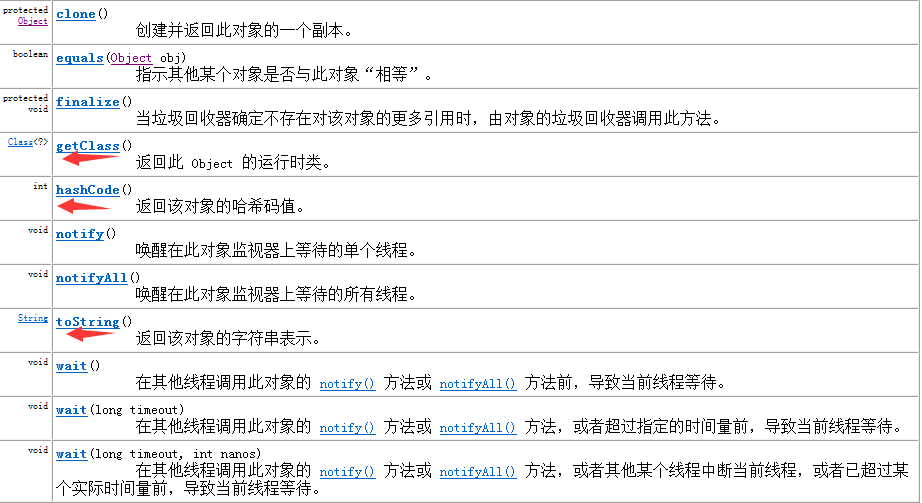
toString()
用法:打印对象的地址值
getClass()  获取当前类的字节码文件
getName()   获取字节码文件的名字
Integer.toHexString 返回指定参数的16进制字符串
hashCode()   返回该对象的哈希码值

public String toString() {   Object类中的tostring值  (地址值)

        return getClass().getName() + "@" + Integer.toHexString(hashCode());

    }
eg:01
如果是字符串 则打印的还是 字符串本身
public class toStringDemo {

	public static void main(String[] args) {

		String s="a";//如果是字符串则打印的是字符串

		String s1=new  String("a");

		System.out.println(s.toString());

		System.out.println(s1.toString());

	}

}
输出结果
a

a
问题:toString()在这里打的是字符串值本身 而不是地址值
查看源码:
public String toString() {

        return this;

    }
可知 String类中重写了 toString()方法 返回值为他本身的值
eg:02
public class Student {

	private String name;

	private int age;

	public Student() {

		super();

		// TODO Auto-generated constructor stub

	}

	public Student(String name, int age) {

		super();

		this.name = name;

		this.age = age;

	}

	public String getName() {

		return name;

	}

	public void setName(String name) {

		this.name = name;

	}

	public int getAge() {

		return age;

	}

	public void setAge(int age) {

		this.age = age;

	}
public class toStringDemo {

	public static void main(String[] args) {

		Student s=new Student(null,16);

		Student s1=new Student(null,15);

		System.out.println(s.toString());

		System.out.println(s1.toString());

	}

}
输出结果:

day05.Student@4d43691d

day05.Student@4aa168c
原因:
Student 类中没有重写toString()方法 所以实现的是Object类中的toString()方法
在Student类中重写toString();
	@Override

	public String toString() {

		return "Student [name=" + name + ", age=" + age + "]";

	}
输出结果:

Student [name=null, age=16]

Student [name=null, age=15]
总结 : 如果该类中没有重写toString ()方法 则输出该对象的地址值。
equals()
比较地址值 和"=="是一个作用(继承了父类的equals())
 public boolean equals(Object obj) {

        return (this == obj);

    }
如果相比较对象的内容,需要重写equals()
eg:03
public class StudentTest {

public static void main(String[] args) {

	Student s=new Student(null,15);

	Student s1=new Student(null,15);

	if (s.equals(s1)) {

		System.out.println(true);

	}else{

		System.out.println(false);

	}

}

}
(Student 没有重写equals方法)
比较的是地址值 ( s 和 s1 的地址值不一样)
输出结果:

false
Student 重写equals方法 (采用系统自动生成equals())
@Override

	public boolean equals(Object obj) {

		if (this == obj)

			return true;

		if (obj == null)

			return false;

		if (getClass() != obj.getClass())

			return false;

		Student other = (Student) obj;

		if (age != other.age)

			return false;

		if (name == null) {

			if (other.name != null)

				return false;

		} else if (!name.equals(other.name))

			return false;

		return true;

	}
重写后的方法可以看出 比较的是对象中存储的内容
输出结果:

true
System类
特点:1.不能创建对象
2.很工具类相似
成员方法:
//赋值数组
// static void arraycopy(Object src, int srcPos, Object dest, int destPos, int length)
src - 源数组。
srcPos - 源数组中的起始位置。
dest - 目标数组。
destPos - 目标数据中的起始位置。
length - 要复制的数组元素的数量。
public class Demo01 {

	public static void main(String[] args) {

		int[] arr={1,2,3,4,5};

		int[] arr1=new int[6];

		System.arraycopy(arr, 0, arr1, 0, 4);

		for (int i = 0; i < arr1.length; i++) {//没有赋值的会存在默认值   int在堆中 默认值是0

			System.out.print(arr1[i]+"  ");

		}

	}

}
输出结果:

1  2  3  4  0  0
//获取当前系统时间的毫秒值
static long currentTimeMillis()
public class Demo01 {

	public static void main(String[] args) {

	long l = System.currentTimeMillis();//获取系统时间的毫秒数

	long shi=l/1000/60/60;//转化为小时数

	long nian=shi/24/365;//转化为年

	System.out.println(nian+1970);//因为这个时间是由1970年开始算的  所以加1970

	}

}
输出结果:

2017
//终止当前正在运行的 Java 虚拟机。参数用作状态码;根据惯例,非 0 的状态码表示异常终止。
public static void exit(int status)
public class Demo01 {

	public static void main(String[] args) {

	for (int i = 0; i <100; i++) {

		if (i==10) {

			System.out.println(i);

			System.exit(0);//虚拟机关闭

		}

	}

	}

}

输出结果:
10
//垃圾回收器
public static void gc()
public class Demo01 {

	public static void main(String[] args) throws Throwable {

		for (int i = 0; i < 280000; i++) {

			new Test();

		}

	}

}

class Test{

	@Override

	protected void finalize() throws Throwable {

		System.out.println("垃圾回收器");

	}

}
输出结果:

垃圾回收器

垃圾回收器

垃圾回收器

垃圾回收器
日期类
Date
构造方法
Date();//获取当前系统时间的date对象;
Date(long date);//获取指定毫秒值得date对象
public class Demo01 {

	public static void main(String[] args) throws Throwable {

		Date d=new Date();

		System.out.println(d);

		long l=System.currentTimeMillis();//获取当前系统时间的毫秒值

		Date d1=new Date(l);

		System.out.println(d1);

	}

}
输出结果:

Sun Aug 27 19:11:14 GMT+08:00 2017

Sun Aug 27 19:11:14 GMT+08:00 2017
这样的格式看起来不是特别友好 所以我们就存在数据格式化:
SimpleDateFormat
/*

 * SimpleDateFormat:

 * 		格式化:

 * 			Date --- String

 * 			2049-8-26 2049年8月26日

 * 			String format(Date date)

 * 		解析:

 * 			String --- Date

 * 			"2049-8-26"

 * 			Date parse(String source)

 *

 * 构造方法:

 * 		SimpleDateFormat() :使用默认的模式进行对象的构建

 * 		SimpleDateFormat(String pattern) :使用的指定的模式进行对象的构建

 *

 * 注意:Exception in thread "main" java.text.ParseException: Unparseable date: "49年9月26日  下午1:29"

 * 	    解析的字符串,模式必须和构建对象的模式一样

 *

 */
格式化 把不是特别友好的时间进行格式化 格式化我们想要的格式 时间 转化为 字符串
public class Demo01 {

	public static void main(String[] args) throws Throwable {

		SimpleDateFormat format = new SimpleDateFormat("yyyy年MM月dd日 HH:mm:ss");

		//获取系统当前时间的Date对象d

		Date d=new Date();

		//格式化

		String str = format.format(d);

		System.out.println(str);

	}

}
解析 把字符串格式转化 时间对象
public class Demo01 {

	public static void main(String[] args) throws Throwable {

		SimpleDateFormat format = new SimpleDateFormat("yyyy年MM月dd日 HH:mm:ss");

		String str="2017年08月27日 19:22:23";

		Date date = format.parse(str);

		System.out.println(date.toLocaleString());

	}

}
输出结果:

2017-8-27 19:22:23
1.1.1 Calendar类概述
Calendar是日历类,在Date后出现,替换掉了许多Date的方法。该类将所有可能用到的时间信息封装为静态成员变量,方便获取。
Calendar为抽象类,由于语言敏感性,Calendar类在创建对象时并非直接创建,而是通过静态方法创建,将语言敏感内容处理好,再返回子类对象,
如下:
Calendar类静态方法

Calendar c = Calendar.getInstance(); //返回当前时间
public class Demo01 {

	public static void main(String[] args) throws Throwable {

		Calendar c=Calendar.getInstance();//获取1970年日历

		Date date=new Date();

		c.setTime(date);//设置日历为系统年的日历

		//查询

		int year=c.get(c.YEAR);//获取系统年份

		System.out.println(year);

		int mouth=c.get(c.MONTH)+1;//因为美国人是从0月开始的  所以加1

		System.out.println(mouth);

		int day=c.get(c.DAY_OF_MONTH);//获取系统的月份的第几天

		System.out.println(day);

		int weekday=c.get(c.DAY_OF_WEEK)-1;//获取这个星期的第几天   美国人一个星期的第一天是星期天

		if(weekday==0) { //如果是0则  让它返回为7

		    weekday=7;

		}

		System.out.println(weekday);
          System.out.println("------------");

		//修改

		c.set(c.YEAR, 2018);//修改年份为2018年

		System.out.println(c.get(c.YEAR));

		c.set(c.MONTH, 8);

		System.out.println(c.get(c.MONTH));

		c.set(c.DAY_OF_MONTH, 8);

		System.out.println(c.get(c.DAY_OF_MONTH));
          System.out.println("------------");

		//添加

		c.add(c.YEAR, -1);//给年份+(-1)

		System.out.println(c.get(c.YEAR));

		c.add(c.MONTH, 1);

		System.out.println(c.get(c.MONTH));

		c.add(c.DAY_OF_MONTH, 1);

		System.out.println(c.get(c.DAY_OF_MONTH));

	}

}
输出结果:

2017

8

27

7

------------

2018

8

8

------------

2017

9

9
拆装箱,
| 4种8类 | |
|
基本数据类型 装 箱 ↓↓ ↑↑ 箱 拆 包装类 |
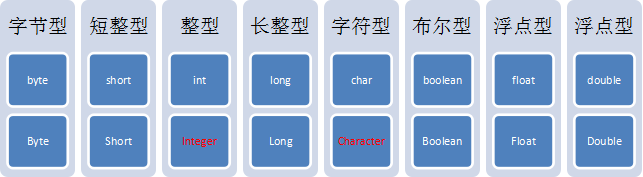 |
自动装箱 基本数据类型>>>>引用数据类型
拆箱 引用数据类型>>>>基本数据类型
public class Demo01 {

	public static void main(String[] args) throws Throwable {

			Integer i=10;//装箱

			int s=i;//拆箱

			System.out.println(s);

	}

}
正则表达式
正则表达式是专门解决字符串规则匹配的工具。
正则表达式也是一个字符串,用来定义匹配规则。
参照帮助文档,在Pattern类中有简单的规则定义,可以结合字符串类的方法使用。
字符

x 字符 x

\\ 反斜线字符

字符类

[abc] a、b 或 c(简单类)

[^abc] 任何字符,除了 a、b 或 c(否定)

[a-zA-Z] a 到 z 或 A 到 Z,两头的字母包括在内(范围

预定义字符类

. 任何字符(与行结束符可能匹配也可能不匹配)

\d 数字:[0-9]

\D 非数字: [^0-9]

\s 空白字符:[ \t\n\x0B\f\r]

\S 非空白字符:[^\s]

\w 单词字符:[a-zA-Z_0-9]

\W 非单词字符:[^\w]

Greedy 数量词

X? X,一次或一次也没有

X* X,零次或多次

X+ X,一次或多次

X{n} X,恰好 n 次

X{n,} X,至少 n 次

X{n,m} X,至少 n 次,但是不超过 m 次
public class Demo01 {

	public static void main(String[] args) throws Throwable {

			String s="012365489";

			/*判断qq号

			  8-13位

			不能以0开头

			不能含有字母*/

			boolean b = s.matches("[1-9][0-9]{7,12}");

			System.out.println(b);

	}

}
day05(Object,tostring(),equals(),System,Date,SimpleDateFormat,拆装箱,正则表达式)的更多相关文章
- Java基础 与时间日期相关的类:System -Date -SimpleDateFormat -Calendar类 -解决后缀.000Z 的时区问题
笔记总结: /**与时间相关的类:System_Date_SimpleDateFormat_Calendar类 * 1.system 类下的currentTimeMillis() * 输出从1970年 ...
- java基础1.5版后新特性 自动装箱拆箱 Date SimpleDateFormat Calendar.getInstance()获得一个日历对象 抽象不要生成对象 get set add System.arrayCopy()用于集合等的扩容
8种基本数据类型的8种包装类 byte Byte short Short int Integer long Long float Float double Double char Character ...
- Java连载78-深入自动拆装箱、Date类和SimpleDateFormat格式化
一.深入自动拆装箱 1.直接举例: public class D78_AutomaticUnpackingAndPacking{ public static void main(String[] ar ...
- JavaSE的包装类,自动装箱和自动拆箱 ,字符窜转换,toString(),equals(), hashCode()的区别
一.基本数据类型和包装类 包装类均位于Java.lang包,包装类和基本数据类型的对应关系如下表所示: Primitive-Type Wrapper-Class byte ...
- 03_10_Object类的toString equals等方法
03_10_Object类的toString equals等方法 1. toString方法 Object类中定义有public String toString()方法,其返回值是String类型,描 ...
- .net学习之继承、里氏替换原则LSP、虚方法、多态、抽象类、Equals方法、接口、装箱拆箱、字符串
1.继承(1)创建子类对象的时候,在子类对象中会为子类对象的字段开辟空间,也会为父类的所有字段开辟空间,只不过父类私有的成员访问不到(2)子类从父类继承父类所有的非私有成员,但是父类的所有字段也会创建 ...
- JAVA基础--toString, equals方法
==比较的是地址 equals比较的是内容. 所以要重写object的equals方法. public class TestEquals { public static void main(Strin ...
- Arrays类的运用,二分法,数组的复制,命令行参数的运用,二维数组,Object,equals
/*Arrays jdk中为了便于开发,给开发者提供了Arrays类, 其中包含了很多数组的常用操作.例如快速输出.排序.查找等.*/ import java.util.Arrays; public ...
- Object.toString()打印“地址”的原理
Object.toString()打印"地址"的原理 @(java) 首先,打印的绝不是地址 public native int hashCode(); public boolea ...
随机推荐
- VC中使用ADO操作数据库的方法
源地址:http://blog.csdn.net/xiaobai1593/article/details/7459862 准备工作: (1).引入ADO类 #import "c:\progr ...
- Social media users of the world unite!
Social media users of the world unite!全世界社交媒体用户联合起来!If Plato were alive today, he might well regard ...
- Mysql count+if 函数结合使用
Mysql count+if 函数结合使用 果林椰子 关注 2017.05.18 13:48* 字数 508 阅读 148评论 0喜欢 1 涉及函数 count函数 mysql中count函数用于统计 ...
- 有3D效果的进度条
// The Unofficial Newsletter of Delphi Users - Issue #12 - February 23rd, 1996 unit Percnt3d; (* TPe ...
- 基元线程同步构造之信号量(Semaphore)
信号量(semaphore)不过是由内核维护的 int32变量而已,(说通俗点就是好比一个线程容器里面允许执行的线程数,0计数就是允许执行的0个线程数,1就是允许执行的1个线程数,2就是允许执行的2个 ...
- exception keynote
[exception keynote] Note that the parentheses around this tuple are required, because except ValueEr ...
- mac下将根目录/更改组到普通用户,导致sudo不能用
背景:这是个很愚蠢的故事,我更改了根目录下所有文件的拥有者为普通用户[chown -R xxx / ].结果sudo/su命令都不能用了…… 问题:一旦用sudo命令或su命令就提示: sudo: ...
- 兼容谷歌、火狐、IE7.0以上浏览器div+css实现的带有蒙版的半透明弹窗效果[xyytit]
整个页面变暗的蒙版效果,带有半透明边框的弹窗,用在网站里一定很酷. 最初见与奢饰品购物网站YMALL,后边研究了下,自己做了这个实例. 技术要点:css中几种透明样式的使用.不同的样式在不同的浏览器中 ...
- 【校招面试 之 C/C++】第25题 C++ 智能指针(一)之 auto_ptr
1.智能指针背后的设计思想 我们先来看一个简单的例子: void remodel(std::string & str) { std::string * ps = new std::string ...
- java代码分析及分析工具
一个项目从搭建开始,开发的初期往往思路比较清晰,代码也比较清晰.随着时间的推移,业务越来越复杂.代码也就面临着耦合,冗余,甚至杂乱,到最后谁都不敢碰. 作为一个互联网电子商务网站的业务支撑系统,业务复 ...