
POJ 2528 Mayor's posters (线段树+离散化)
| Time Limit: 1000MS | Memory Limit: 65536K | |
| Total Submissions:75394 | Accepted: 21747 |
Description
- Every candidate can place exactly one poster on the wall.
- All posters are of the same height equal to the height of the wall; the width of a poster can be any integer number of bytes (byte is the unit of length in Bytetown).
- The wall is divided into segments and the width of each segment is one byte.
- Each poster must completely cover a contiguous number of wall segments.
They have built a wall 10000000 bytes long (such that there is enough place for all candidates). When the electoral campaign was restarted, the candidates were placing their posters on the wall and their posters differed widely in width. Moreover, the candidates started placing their posters on wall segments already occupied by other posters. Everyone in Bytetown was curious whose posters will be visible (entirely or in part) on the last day before elections.
Your task is to find the number of visible posters when all the posters are placed given the information about posters' size, their place and order of placement on the electoral wall.
Input
Output
The picture below illustrates the case of the sample input. 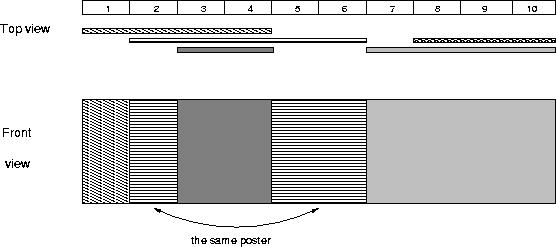
Sample Input
1

5

1 4

2 6

8 10

3 4

7 10
Sample Output
4

思路:
好久没有写博客了,做这个题,我写了一整天,就因为一句话没有写好,我实在是想骂人呀!
首先离散化,避免超时,避免超内存,这个我相信你在别的博客上可以看见,我就不多说,线段树的节点里面,存的是下面全部相同的数字,也就是说,如果这个节点,代表的是l到r的范围内的数,
如果l到r里面,数字完全相同,那么,这个节点就存下这个数,否则,那我们就存下-1.如果查询的时候遇到-1,那我们就继续向下查询就行了,直到查到不为-1或到达叶子节点为止。
我的错误是update的最后一行,忽略了下面两个节点都是-1的情况
AC代码
#include<iostream>

#include<algorithm>

#include<cstring>

#include<cstdio>

using namespace std;

int s[400086];

bool book[400086];

struct node

{

    int l,r,num;

    bool lazy;

}tree[1600099];

int x[100086],y[100086];

void build(int t,int l,int r)

{

    tree[t].l=l;tree[t].r=r;

    tree[t].num=-1;tree[t].lazy=false;

    if(l==r){return;}

    int mid=(l+r)/2;

    build(t<<1,l,mid);

    build((t<<1)|1,mid+1,r);

}

void push_down(int t)

{

    tree[t].lazy=false;

    tree[t<<1].num=tree[t].num;

    if(tree[t<<1].l!=tree[t<<1].r){tree[t<<1].lazy=true;}

    tree[(t<<1)|1].num=tree[t].num;

    if(tree[(t<<1)|1].l!=tree[(t<<1)|1].r){tree[(t<<1)|1].lazy=true;}

}

void update(int t,int l,int r,int e)

{

    if(tree[t].lazy){push_down(t);}

    if(tree[t].l==l&&r==tree[t].r){

        tree[t].num=e;

        if(l!=r){tree[t].lazy=true;}

        return;

    }

    int mid=(tree[t].l+tree[t].r)>>1;

    if(r<=mid){update(t<<1,l,r,e);}

    else if(l>mid){update((t<<1)|1,l,r,e);}

    else{

        update((t<<1),l,mid,e);

        update((t<<1)|1,mid+1,r,e);

    }

    if(tree[t<<1].num!=tree[(t<<1)|1].num||tree[t<<1].num==-1||tree[(t<<1)|1].num==-1){tree[t].num=-1;}

}

int query(int t)

{

    int ans=0;

    if(tree[t].num==-1){

        if(tree[t].lazy){push_down(t);}

        if(tree[t].l==tree[t].r){return 0;}

        ans+=query(t<<1);

        ans+=query((t<<1)|1);

    }

    else{

        if(!book[tree[t].num]){book[tree[t].num]=true;return 1;}

    }

    return ans;

}

int main()

{

    int T,n;

    scanf("%d",&T);

    while(T--){

        scanf("%d",&n);

        memset(book,0,sizeof(book));

        memset(s,0,sizeof(s));

        int nn=0;

        for(int i=1;i<=n;i++){

            scanf("%d%d",&x[i],&y[i]);

            s[++nn]=x[i];s[++nn]=y[i];

        }

        sort(s+1,s+nn+1);

        int siz=unique(s+1,s+nn+1)-s-1;

        int k=siz;

        for(int i=1;i<=k-1;i++){

            if(s[i+1]-s[i]>1){s[++siz]=s[i]+1;}

        }

        sort(s+1,s+siz+1);

        build(1,1,siz);

        int l,r;

        for(int i=1;i<=n;i++){

            l=lower_bound(s+1,s+siz+1,x[i])-s;

            r=lower_bound(s+1,s+siz+1,y[i])-s;

            update(1,l,r,i);

        }

        printf("%d\n",query(1));

    }

}
POJ 2528 Mayor's posters (线段树+离散化)的更多相关文章
- poj 2528 Mayor's posters 线段树+离散化技巧
poj 2528 Mayor's posters 题目链接: http://poj.org/problem?id=2528 思路: 线段树+离散化技巧(这里的离散化需要注意一下啊,题目数据弱看不出来) ...
- POJ 2528 Mayor's posters(线段树+离散化)
Mayor's posters 转载自:http://blog.csdn.net/winddreams/article/details/38443761 [题目链接]Mayor's posters [ ...
- poj 2528 Mayor's posters 线段树+离散化 || hihocode #1079 离散化
Mayor's posters Description The citizens of Bytetown, AB, could not stand that the candidates in the ...
- POJ.2528 Mayor's posters (线段树 区间更新 区间查询 离散化)
POJ.2528 Mayor's posters (线段树 区间更新 区间查询 离散化) 题意分析 贴海报,新的海报能覆盖在旧的海报上面,最后贴完了,求问能看见几张海报. 最多有10000张海报,海报 ...
- POJ 2528 Mayor's posters (线段树区间更新+离散化)
题目链接:http://poj.org/problem?id=2528 给你n块木板,每块木板有起始和终点,按顺序放置,问最终能看到几块木板. 很明显的线段树区间更新问题,每次放置木板就更新区间里的值 ...
- POJ 2528 Mayor’s posters (线段树段替换 && 离散化)
题意 : 在墙上贴海报, n(n<=10000)个人依次贴海报,给出每张海报所贴的范围li,ri(1<=li<=ri<=10000000).求出最后还能看见多少张海报. 分析 ...
- poj 2528 Mayor's posters 线段树区间更新
Mayor's posters Time Limit: 1 Sec Memory Limit: 256 MB 题目连接 http://poj.org/problem?id=2528 Descript ...
- poj 2528 Mayor's posters(线段树)
题目:http://poj.org/problem?id=2528 题意:有一面墙,被等分为1QW份,一份的宽度为一个单位宽度.现在往墙上贴N张海报,每张海报的宽度是任意的, 但是必定是单位宽度的整数 ...
- POJ 2528 Mayor's posters (线段树)
题目链接:http://poj.org/problem?id=2528 题目大意:有一个很上的面板, 往上面贴海报, 问最后最多有多少个海报没有被完全覆盖 解题思路:将贴海报倒着想, 对于每一张海报只 ...
随机推荐
- ECharts在柱状图的柱子上方显示数量的方法
在setOption()方法中的series配置中加上itemStyle配置 如下: series: [{ name: '人数', type: 'bar', data: [], //x轴对应列的值 i ...
- 二、kubernetes
一.kubernetes(简称k8s) 集群示意图 Kubernetes工作模式server-client,Kubenetes Master提供集中化管理Minions.部署1台Kubernetes ...
- Learning to Rank(转)
https://blog.csdn.net/kunlong0909/article/details/16805889 Table of Contents 1 前言 2 LTR流程 3 训练数据的获取4 ...
- c#处理json数据最好的方式,没有之一。
c#处理json数据最好的方式,没有之一. 引用Json.Net(需要.NET 4.5及以上版本) using Newtonsoft.Json.Linq; 使用非常简单 JObject result ...
- 读取jar文件的sha1码,请求maven官方的solrsearch接口查询该jar文件所对应的maven坐标信息
版权声明:本文为博主原创文章,未经博主允许不得转载. import com.google.gson.JsonObject; import com.google.gson.JsonParser; imp ...
- D - Mayor's posters POJ - 2528 离散化+线段树 区间修改单点查询
题意 贴海报 最后可以看到多少海报 思路 :离散化大区间 其中[1,4] [5,6]不能离散化成[1,2] [2,3]因为这样破坏了他们的非相邻关系 每次离散化区间 [x,y]时 把y+1点也加入 ...
- Jury Compromise POJ - 1015 dp (标答有误)背包思想
题意:从 n个人里面找到m个人 每个人有两个值 d p 满足在abs(sum(d)-sum(p)) 最小的前提下sum(d)+sum(p)最大 思路:dp[i][j] i个人中 和 ...
- HDU1505 City Game(算竞进阶习题)
写了1506顺便写下1505.. 还是求矩形面积,不过要预处理一下以每一个F为底的高度,然后想左右扩展到最大长度即为矩形的长.. 计算方法有点绕,令l[i]表示i的左边界,那么初始化l[i] = i. ...
- 【XSY1538】连在一起的幻想乡 数学 无向连通图计数
题目大意 给你\(n,p\),求\(n\)个点组成的所有无向连通图的边数的平方和模\(p\) \(n\leq 2000,p\leq {10}^9\) 题解 设\(m=\frac{n(n-1 ...
- CCPC-Wannafly Winter Camp Day1 (Div2, onsite) A B C E F I J
A 机器人 链接:https://www.cometoj.com/contest/7/problem/A?problem_id=92 思路: 分两大类讨论: 1. B区没有点: (1)点都在起点左边 ...