
吴裕雄 python 神经网络——TensorFlow 自定义损失函数
import tensorflow as tf

from numpy.random import RandomState

batch_size = 8

x = tf.placeholder(tf.float32, shape=(None, 2), name="x-input")

y_ = tf.placeholder(tf.float32, shape=(None, 1), name='y-input')

w1= tf.Variable(tf.random_normal([2, 1], stddev=1, seed=1))

y = tf.matmul(x, w1)

# 定义损失函数使得预测少了的损失大,于是模型应该偏向多的方向预测。

loss_less = 10

loss_more = 1

loss = tf.reduce_sum(tf.where(tf.greater(y, y_), (y - y_) * loss_more, (y_ - y) * loss_less))

train_step = tf.train.AdamOptimizer(0.001).minimize(loss)

rdm = RandomState(1)

X = rdm.rand(128,2)

Y = [[x1+x2+(rdm.rand()/10.0-0.05)] for (x1, x2) in X]

with tf.Session() as sess:

    init_op = tf.global_variables_initializer()

    sess.run(init_op)

    STEPS = 5000

    for i in range(STEPS):

        start = (i*batch_size) % 128

        end = (i*batch_size) % 128 + batch_size

        sess.run(train_step, feed_dict={x: X[start:end], y_: Y[start:end]})

        if i % 1000 == 0:

            print("After %d training step(s), w1 is: " % (i))

            print sess.run(w1), "\n"

    print "Final w1 is: \n", sess.run(w1)
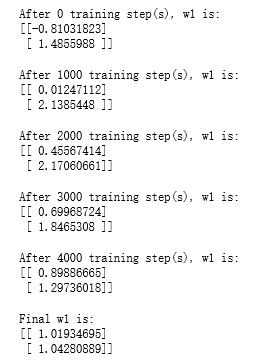
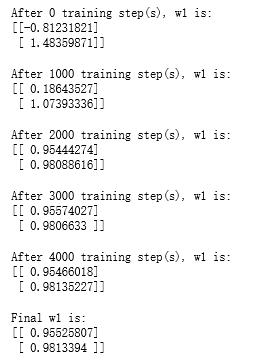
loss_less = 1

loss_more = 10

loss = tf.reduce_sum(tf.where(tf.greater(y, y_), (y - y_) * loss_more, (y_ - y) * loss_less))

train_step = tf.train.AdamOptimizer(0.001).minimize(loss)

with tf.Session() as sess:

    init_op = tf.global_variables_initializer()

    sess.run(init_op)

    STEPS = 5000

    for i in range(STEPS):

        start = (i*batch_size) % 128

        end = (i*batch_size) % 128 + batch_size

        sess.run(train_step, feed_dict={x: X[start:end], y_: Y[start:end]})

        if i % 1000 == 0:

            print("After %d training step(s), w1 is: " % (i))

            print sess.run(w1), "\n"

    print "Final w1 is: \n", sess.run(w1)
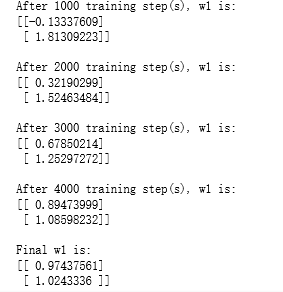
loss = tf.losses.mean_squared_error(y, y_)

train_step = tf.train.AdamOptimizer(0.001).minimize(loss)

with tf.Session() as sess:

    init_op = tf.global_variables_initializer()

    sess.run(init_op)

    STEPS = 5000

    for i in range(STEPS):

        start = (i*batch_size) % 128

        end = (i*batch_size) % 128 + batch_size

        sess.run(train_step, feed_dict={x: X[start:end], y_: Y[start:end]})

        if i % 1000 == 0:

            print("After %d training step(s), w1 is: " % (i))

            print sess.run(w1), "\n"

    print "Final w1 is: \n", sess.run(w1)
吴裕雄 python 神经网络——TensorFlow 自定义损失函数的更多相关文章
- 吴裕雄 python 神经网络——TensorFlow 循环神经网络处理MNIST手写数字数据集
#加载TF并导入数据集 import tensorflow as tf from tensorflow.contrib import rnn from tensorflow.examples.tuto ...
- 吴裕雄 python 神经网络——TensorFlow 使用卷积神经网络训练和预测MNIST手写数据集
import tensorflow as tf import numpy as np from tensorflow.examples.tutorials.mnist import input_dat ...
- 吴裕雄 python 神经网络——TensorFlow 训练过程的可视化 TensorBoard的应用
#训练过程的可视化 ,TensorBoard的应用 #导入模块并下载数据集 import tensorflow as tf from tensorflow.examples.tutorials.mni ...
- 吴裕雄 python 神经网络TensorFlow实现LeNet模型处理手写数字识别MNIST数据集
import tensorflow as tf tf.reset_default_graph() # 配置神经网络的参数 INPUT_NODE = 784 OUTPUT_NODE = 10 IMAGE ...
- 吴裕雄 python 神经网络——TensorFlow 数据集高层操作
import tempfile import tensorflow as tf train_files = tf.train.match_filenames_once("E:\\output ...
- 吴裕雄 python 神经网络——TensorFlow 输入数据处理框架
import tensorflow as tf files = tf.train.match_filenames_once("E:\\MNIST_data\\output.tfrecords ...
- 吴裕雄 python 神经网络——TensorFlow 花瓣分类与迁移学习(2)
import glob import os.path import numpy as np import tensorflow as tf from tensorflow.python.platfor ...
- 吴裕雄 python 神经网络——TensorFlow 花瓣识别2
import glob import os.path import numpy as np import tensorflow as tf from tensorflow.python.platfor ...
- 吴裕雄 python 神经网络——TensorFlow训练神经网络:不使用滑动平均
import tensorflow as tf from tensorflow.examples.tutorials.mnist import input_data INPUT_NODE = 784 ...
随机推荐
- 关于BaiduPSC-Go的一些bug的更正
首先说下操作步骤 下载是在GutHub,这个不赘述,网上很多资料 下载之后配置环境变量,在path的后面加上一个分号,然后加上你下载的目录,目录名最好为英文 然后通过命令行CMD工具,输入BaiduP ...
- Attribute "resultType" must be declared for element type "update" or "insert"
仔细查看错误如图所示: 解决错误就是把resultType去掉,因为在insert和update语句中是没有返回值的.小坑小坑 转自:https://blog.csdn.net/u013144287/ ...
- DFA 简易正则表达式匹配
一个只能匹配非常简单的(字母 . + *)共 4 种状态的正则表达式语法的自动机(注意,仅限 DFA,没考虑 NFA): 好久之前写的了,记得有个 bug 一直没解决... #include < ...
- The entity type XXX is not part of the model for the current context.
今天遇到了一个奇葩问题,虽然解决了,但还是一脸懵,先附赠一下别人的解决方案:https://www.cnblogs.com/zwjaaron/archive/2012/06/08/2541430.ht ...
- [lua]紫猫lua教程-命令宝典-L1-01-05. if判断结构
L1[if]01. 简单的if判断结构 没什么说得 if得基本结构如下 xxx= ) then testlib.traceprint("1-100") ) then testlib ...
- CSS3的一个伪类选择器:nth-child()
CSS3的一个伪类选择器“:nth-child()”. Table表格奇偶数行定义样式: 语法: :nth-child(an+b) 为什么选择她,因为我认为,这个选择器是最多学问的一个了.很可惜,据我 ...
- Servlt入门
Servlt入门 java的两种体系结构 C/S (客户端/服务器)体系结构 通讯效率高且安全,但系统占用多 B/S (浏览器/服务器)体系结构 节约开发成本 C/S (客户端/服务器)体系结 ...
- C语言程序设计(二)
目录: 1.算法基本概念 2.认识循环语句 3.算法的表示法 4.求素数 5.求闰年 6.判断一个数是否为回文数 算法基本概念: (一)一个程序主要包含的2方面信息: 1.对数据的描述,在程序中要 ...
- TM1638控制
原理图图纸: 显示控制与读按键与寄存器的对应 驱动代码:码云:
- contextField 键盘只允许输入数字和小数点,并且现在小数点后位数
- (BOOL)textField:(UITextField *)textField shouldChangeCharactersInRange:(NSRange)range replacementS ...