
使用yocs_velocity_smoother对机器人速度进行限制
yocs_velocity_smoother是一个速度、加速度限制器,用来防止robot navigation的速度/转速过快,加速度/快减速过大。Bound incoming velocity messages according to robot velocity and acceleration limits. The velocity smoother nodelet runs together with the kobuki_node to apply robot's velocity and acceleration limits to the incoming commands before resending them to the robot. It will however also work for any other generic ros mobile base driver.
输入下面命令安装yocs_velocity_smoother或者从GitHub上下载源代码进行编译。
sudo apt-get install ros-kinetic-yocs-velocity-smoother
订阅的话题
- raw_cmd_vel:Input velocity commands. 原始速度指令
- odometry:We compare the output velocity commands to measured velocity to ensure we don't create very big jumps in the velocity profile.
- robot_cmd_vel:Alternatively, we can also compare the output velocity commands to end robot velocity commands to ensure we don't create very big jumps in the velocity profile. See robot_feedback parameter description below for more details.
发布的话题
- smooth_cmd_vel:Smoothed output velocity commands respecting velocity and acceleration limits. 限制幅度后的速度
launch文件
standalone.launch文件先运行一个名为nodelet_manager的nodelet manager节点,然后加载velocity_smoother.launch文件:
<!--

  Example standalone launcher for the velocity smoother

 -->

<launch>

  <arg name="node_name"             value="velocity_smoother"/>

  <arg name="nodelet_manager_name"  value="nodelet_manager"/>

  <arg name="config_file"           value="$(find yocs_velocity_smoother)/param/standalone.yaml"/>

  <arg name="raw_cmd_vel_topic"     value="raw_cmd_vel"/>

  <arg name="smooth_cmd_vel_topic"  value="smooth_cmd_vel"/>

  <arg name="robot_cmd_vel_topic"   value="robot_cmd_vel"/>

  <arg name="odom_topic"            value="odom"/>

  <!-- nodelet manager -->

  <node pkg="nodelet" type="nodelet" name="$(arg nodelet_manager_name)" args="manager"/>

  <!-- velocity smoother -->

  <include file="$(find yocs_velocity_smoother)/launch/velocity_smoother.launch">

    <arg name="node_name"             value="$(arg node_name)"/>

    <arg name="nodelet_manager_name"  value="$(arg nodelet_manager_name)"/>

    <arg name="config_file"           value="$(arg config_file)"/>

    <arg name="raw_cmd_vel_topic"     value="$(arg raw_cmd_vel_topic)"/>

    <arg name="smooth_cmd_vel_topic"  value="$(arg smooth_cmd_vel_topic)"/>

    <arg name="robot_cmd_vel_topic"   value="$(arg robot_cmd_vel_topic)"/>

    <arg name="odom_topic"            value="$(arg odom_topic)"/>

  </include>

</launch>
在standalone.launch中使用nodelet_manager加载yocs_velocity_smoother/VelocitySmootherNodelet.
<!--

  YOCS velocity smoother launcher

  -->

<launch>

  <arg name="node_name"             default="velocity_smoother"/>

  <arg name="nodelet_manager_name"  default="nodelet_manager"/>

  <arg name="config_file"           default="$(find yocs_velocity_smoother)/param/standalone.yaml"/>

  <arg name="raw_cmd_vel_topic"     default="raw_cmd_vel"/>

  <arg name="smooth_cmd_vel_topic"  default="smooth_cmd_vel"/>

  <arg name="robot_cmd_vel_topic"   default="robot_cmd_vel"/>

  <arg name="odom_topic"            default="odom"/>

  <node pkg="nodelet" type="nodelet" name="$(arg node_name)"

        args="load yocs_velocity_smoother/VelocitySmootherNodelet $(arg nodelet_manager_name)">

    <!-- parameters -->

    <rosparam file="$(arg config_file)" command="load"/>

    <!-- velocity commands I/O -->

    <remap from="$(arg node_name)/raw_cmd_vel"    to="$(arg raw_cmd_vel_topic)"/>

    <remap from="$(arg node_name)/smooth_cmd_vel" to="$(arg smooth_cmd_vel_topic)"/>

    <!-- Robot velocity feedbacks -->

    <remap from="$(arg node_name)/robot_cmd_vel"  to="$(arg robot_cmd_vel_topic)"/>

    <remap from="$(arg node_name)/odometry"       to="$(arg odom_topic)"/>

  </node>

</launch>
standalone.yaml文件用于配置速度平滑参数:
# Example configuration:

# - velocity limits are around a 10% above the physical limits

# - acceleration limits are just low enough to avoid jerking

# Mandatory parameters

speed_lim_v: 0.8  # Linear velocity limit

speed_lim_w: 5.4  # Angular velocity limit

accel_lim_v: 0.3  # Linear acceleration limit

accel_lim_w: 3.5  # Angular acceleration limit

# Optional parameters

frequency: 20.0   # Output messages rate. The velocity smoother keeps it regardless incoming messages rate, interpolating whenever necessary

decel_factor: 1.0 # Deceleration/acceleration ratio. Useful to make deceleration more aggressive

# Robot velocity feedback type:

#  0 - none

#  1 - odometry

#  2 - end robot commands

robot_feedback: 2
速度限制测试
yocs_velocity_smoothe包的源文件中有一个测试程序,可以测试速度限制的效果。测试launch文件test_translational_smoothing.launch如下:
<!--Tests the velocity smoother with varied translational inputs.-->

<launch>

    <!-- Launch a nodelet manager node -->

      <node pkg="nodelet" type="nodelet" name="nodelet_manager" args="manager"/>

    <!--  Launch a nodelet of type pkg/Type on manager manager -->

    <node pkg="nodelet" type="nodelet" name="velocity_smoother" args="load yocs_velocity_smoother/VelocitySmootherNodelet nodelet_manager" output="screen">

        <rosparam file="$(find yocs_velocity_smoother)/param/standalone.yaml" command="load"/>

        <!-- Subscribed Topics -->

        <remap from="velocity_smoother/odometry" to="odom"/>

        <remap from="velocity_smoother/robot_cmd_vel" to="cmd_vel/output"/>

        <remap from="velocity_smoother/raw_cmd_vel" to="cmd_vel/input"/>

        <!-- Published Topics -->

        <remap from="velocity_smoother/smooth_cmd_vel" to="cmd_vel/output"/>

    </node>

    <!-- Launch test node -->

    <node pkg="yocs_velocity_smoother" type="test_translational_input.py" name="test_translational_input" output="screen">

        <remap from="test_translational_input/cmd_vel" to="cmd_vel/input"/>

        <remap from="test_translational_input/odom" to="odom"/>

        <!--<param name="velocity_maximum" value="0.50"/> -->

        <param name="ramp_increment" value="0.01"/>

        <param name="ramp_decrement" value="0.01"/>

    </node>

</launch>
test_translational_input.py程序中根据加速度参数(ramp_increment、ramp_decrement)周期性的调整X方向的移动速度,并将cmd_vel和odom信息发布出去。注意在launch文件中又分别将test_translational_input/cmd_vel和test_translational_input/odom重映射为cmd_vel/input与odom.
#!/usr/bin/env python

import roslib

roslib.load_manifest('yocs_velocity_smoother')

import rospy

import os

import sys

import time

from geometry_msgs.msg import Twist

from nav_msgs.msg import Odometry

'''

  Varied translational input for a velocity smoother test.

'''

STATE_RAMP_UP = 0

STATE_RAMP_LEVEL = 1

STATE_RAMP_DOWN = 2

STATE_ZERO = 3

STATE_UP = 4

STATE_DOWN = 5

STATE_UP_AGAIN = 6

STATE_NOTHING = 7

def main():

    rospy.init_node("test_velocity_smoother_input")

    cmd_vel_publisher = rospy.Publisher("~cmd_vel", Twist)

    odom_publisher = rospy.Publisher("~odom", Odometry)

    param = {}

    param['velocity_maximum'] = rospy.get_param("~velocity_maximum", 0.50)

    param['ramp_increment'] = rospy.get_param("~ramp_increment", 0.02)

    rospy.loginfo("Test Input : ramp increment [%f]",param['ramp_increment'])

    param['ramp_decrement'] = rospy.get_param("~ramp_decrement", 0.02)

    rospy.loginfo("Test Input : ramp decrement [%f]",param['ramp_decrement'])

    cmd_vel = Twist()

    cmd_vel.linear.x = 0

    cmd_vel.linear.y = 0

    cmd_vel.linear.z = 0

    cmd_vel.angular.x = 0

    cmd_vel.angular.y = 0

    cmd_vel.angular.z = 0

    odom = Odometry()

    odom.header.frame_id = "base_link"

    odom.pose.pose.position.x = 0.0

    odom.pose.pose.position.y = 0.0

    odom.pose.pose.position.z = 0.0

    odom.pose.pose.orientation.x = 0.0

    odom.pose.pose.orientation.y = 0.0

    odom.pose.pose.orientation.z = 0.0

    odom.pose.pose.orientation.w = 1.0

    odom.pose.covariance[0]  = 0.1

    odom.pose.covariance[7]  = 0.1

    odom.pose.covariance[35] = 0.2

    odom.pose.covariance[14] = 10.0

    odom.pose.covariance[21] = 10.0

    odom.pose.covariance[28] = 10.0

    odom.twist.twist.linear.x = 0.0

    odom.twist.twist.linear.y = 0.0

    odom.twist.twist.linear.z = 0.0

    odom.twist.twist.angular.x = 0.0

    odom.twist.twist.angular.y = 0.0

    odom.twist.twist.angular.z = 0.0

    state = STATE_RAMP_UP

    count = 0

    count_max = 100

    publish = True

    #period = 0.01

    timer = rospy.Rate(100) # 10hz

    rospy.loginfo("Test Input : STATE_RAMP_UP")

    while not rospy.is_shutdown():

        if state == STATE_RAMP_UP:

            cmd_vel.linear.x = cmd_vel.linear.x + param['ramp_increment']

            if cmd_vel.linear.x >= param['velocity_maximum']:

                state = STATE_RAMP_LEVEL

                count = 0

                rospy.loginfo("Test Input : STATE_RAMP_UP -> STATE_RAMP_LEVEL")

        elif state == STATE_RAMP_LEVEL:

            if count > count_max: # 0.5s

                state = STATE_RAMP_DOWN

                count = 0

                rospy.loginfo("Test Input : STATE_RAMP_LEVEL -> STATE_RAMP_DOWN")

            else:

                count = count + 1

        elif state == STATE_RAMP_DOWN:

            cmd_vel.linear.x = cmd_vel.linear.x - param['ramp_decrement']

            if cmd_vel.linear.x <= 0.0:

                cmd_vel.linear.x = 0.0

                state = STATE_ZERO

                count = 0

                rospy.loginfo("Test Input : STATE_RAMP_DOWN -> STATE_ZERO")

        elif state == STATE_ZERO:

            if count > count_max: # 0.5s

                state = STATE_UP

                cmd_vel.linear.x = param['velocity_maximum']

                count = 0

                rospy.loginfo("Test Input : STATE_ZERO -> STATE_UP")

            else:

                count = count + 1

        elif state == STATE_UP:

            if count > count_max: # 0.5s

                state = STATE_DOWN

                cmd_vel.linear.x = 0.0

                count = 0

                rospy.loginfo("Test Input : STATE_UP -> STATE_DOWN")

            else:

                count = count + 1

        elif state == STATE_DOWN:

            if count > count_max: # 0.5s

                #state = STATE_UP_AGAIN

                #cmd_vel.linear.x = param['velocity_maximum']

                #rospy.loginfo("Test Input : STATE_DOWN -> STATE_UP_AGAIN")

                state = STATE_RAMP_UP

                cmd_vel.linear.x = 0.0

                rospy.loginfo("Test Input : STATE_DOWN -> STATE_RAMP_UP")

                count = 0

            else:

                count = count + 1

        elif state == STATE_UP_AGAIN:

            if count > count_max: # 0.5s

                state = STATE_NOTHING

                count = 0

                publish = False

                rospy.loginfo("Test Input : STATE_UP_AGAIN -> STATE_NOTHING")

            else:

                count = count + 1

        elif state == STATE_NOTHING:

            if count > count_max: # 0.5s

                state = STATE_RAMP_UP

                cmd_vel.linear.x = 0.0

                count = 0

                publish = True

                rospy.loginfo("Test Input : STATE_NOTHING -> STATE_RAMP_UP")

            else:

                count = count + 1

        if publish:

            odom.twist.twist.linear.x = cmd_vel.linear.x

            cmd_vel_publisher.publish(cmd_vel)

        else:

            # How to fake it when it's not publishing a cmd velocity? Up to the velocity controller there

            odom.twist.twist.linear.x = cmd_vel.linear.x

        odom.header.stamp = rospy.Time().now()

        odom_publisher.publish(odom)

        timer.sleep()

if __name__ == "__main__":

  main()
输入下面的命令运行测试程序:
roslaunch yocs_velocity_smoother test_translational_smoothing.launch
可以使用rqt_plot工具绘制速度变化曲线,在终端中输入下面的命令进行绘制:
rqt_plot /cmd_vel/output/linear/x
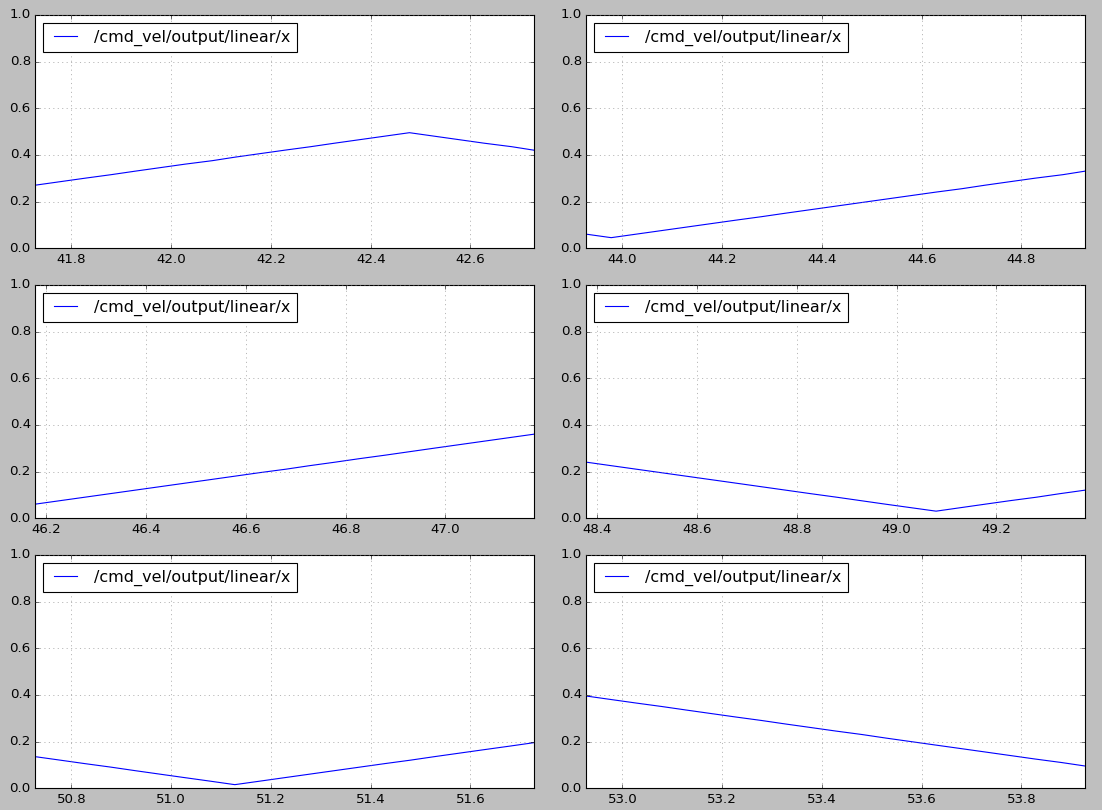
可以将默认配置文件中的速度上限(speed_lim_v)从0.8改为0.4,再次运行测试程序。从速度曲线图中可以看出,最大速度已经被限制在0.4m/s

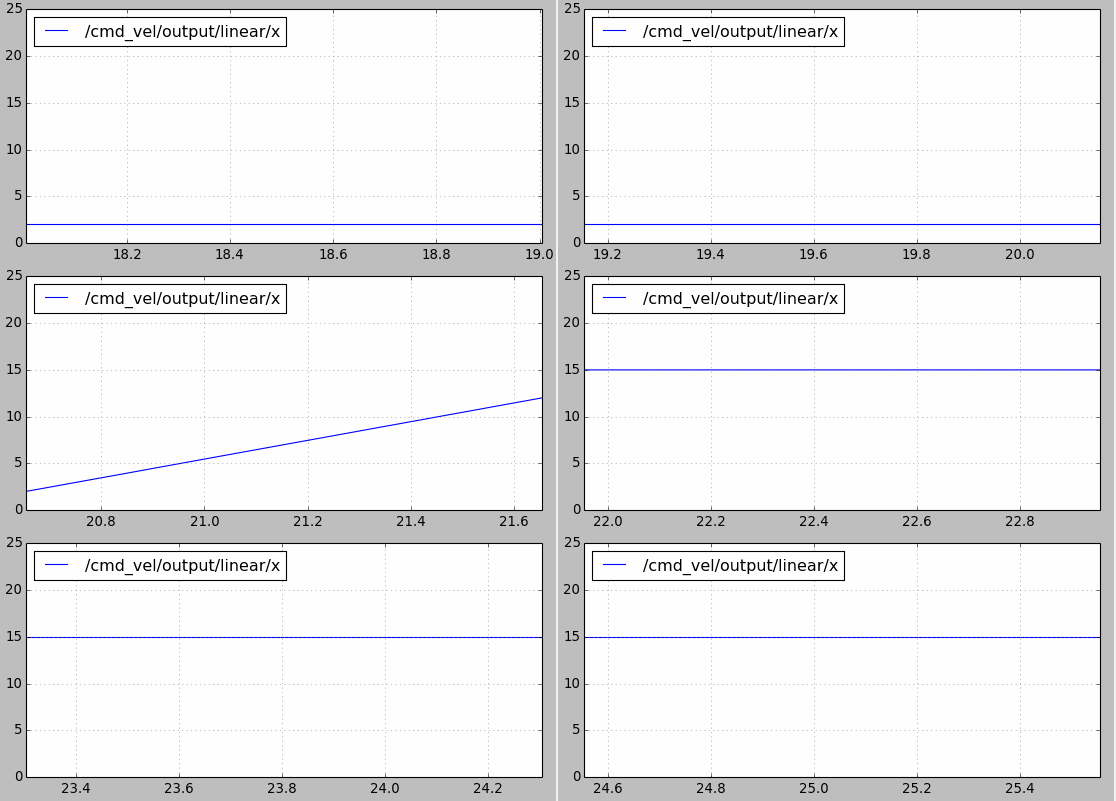
velocity_smoother还可以防止速度指令的跳变引起机器人的抖动。比如使用cmd_vel_mux进行速度切换时,前一个控制速度为2m/s,某一时刻切换到另一个速度假设为15m/s,如果不做处理瞬时加速度会很大。如下图所示,使用velocity_smoother对加速度进行限制,在速度指令跳变时能够使其不超出限制:
另外要注意yocs_velocity_smoother包中使用了动态参数配置的功能(参考ROS的参数应用以及动态调整),在yocs_velocity_smoother/cfg文件夹下的params.cfg文件如下。注意standalone.yaml配置文件中的速度和加速度参数不要超过cfg文件中动态参数的最大值。
#!/usr/bin/env python

PACKAGE = "yocs_velocity_smoother"

from dynamic_reconfigure.parameter_generator_catkin import *

gen = ParameterGenerator()

gen.add("speed_lim_v", double_t, 0, "Maximum linear velocity", 1.0, 0.0, 100.0)

gen.add("speed_lim_w", double_t, 0, "Maximum angular velocity", 5.0, 0.0, 100.0)

gen.add("accel_lim_v", double_t, 0, "Maximum linear acceleration", 0.5, 0.0, 100.0)

gen.add("accel_lim_w", double_t, 0, "Maximum angular acceleration", 2.5, 0.0, 100.0)

gen.add("decel_factor", double_t, 0, "Deceleration to acceleration ratio", 1.0, 0.0, 10.0)

# Second arg is node name it will run in (doc purposes only), third is generated filename prefix

exit(gen.generate(PACKAGE, "velocity_smoother_configure", "params"))
params.cfg其实是一个基于python的模块,首先创建一个ParameterGenerator对象,然后调用其add()函数将参数添加到参数列表中。add()的参数含义分别是:参数名,参数类型,级别,描述,缺省值,最小值,最大值。
参考:
使用yocs_velocity_smoother对机器人速度进行限制的更多相关文章
- ROS探索总结(十九)——如何配置机器人的导航功能
1.概述 ROS的二维导航功能包,简单来说,就是根据输入的里程计等传感器的信息流和机器人的全局位置,通过导航算法,计算得出安全可靠的机器人速度控制指令.但是,如何在特定的机器人上实现导航功能包的功能, ...
- ROS中测试机器人里程计信息
在移动机器人建图和导航过程中,提供相对准确的里程计信息非常关键,是后续很多工作的基础,因此需要对其进行测试保证没有严重的错误或偏差.实际中最可能发生错误的地方在于机器人运动学公式有误,或者正负号不对, ...
- ROS探索总结(十九)——怎样配置机器人的导航功能
1.概述 ROS的二维导航功能包.简单来说.就是依据输入的里程计等传感器的信息流和机器人的全局位置,通过导航算法,计算得出安全可靠的机器人速度控制指令. 可是,怎样在特定的机器人上实现导航功能包的功能 ...
- 基于 Mathematica 的机器人仿真环境(机械臂篇)[转]
完美的教程,没有之一,收藏学习. 目的 本文手把手教你在 Mathematica 软件中搭建机器人的仿真环境,具体包括以下内容(所使用的版本是 Mathematica 11.1,更早的版本可能缺少某些 ...
- RPA简介
开篇: 公司正在全面推广RPA,正好借此机会学习一下,发现国内对RPA的了解较少,萌生了在博客园开博,同时锻炼一下自己的输出能力,纯笔记,如有不足之处,请指正,共勉. 阅读目录: 1. 什么是RPA ...
- [转]RPA简介
本文转自:https://www.cnblogs.com/wendyzheng/articles/9211530.html 开篇: 公司正在全面推广RPA,正好借此机会学习一下,发现国内对RPA的了解 ...
- 全向轮运动学与V-rep中全向移动机器人仿真
Wheeled mobile robots may be classified in two major categories, omnidirectional and nonholonomic. O ...
- Track and Follow an Object----4
原创博文:转载请标明出处(周学伟):http://www.cnblogs.com/zxouxuewei/tag/ ntroduction: 在本示例中,我们将探索包含Kinect摄像头的自主行为. 这 ...
- ROS导航包的介绍
博客转载自:https://blog.csdn.net/handsome_for_kill/article/details/53130707#t3 ROS导航包的应用 利用ROS Navigation ...
随机推荐
- 正确停止线程的方式三 使用Thread类中的内置的中断标记位-----------不熟悉
package charpter10; public class Processor implements Runnable { @Override public void run() { for ( ...
- 里氏代换原则(Liskov Substitution Principle,LSP)
第一种定义: 如果对每一个类型为S的对象o1,都有类型为T的对象o2,使得以T定义的所有程序P在所有的对象o1都代换为o2,程序P的行为没有发生变化,那么类型S是类型T的子类型. 第二种定义: 所有引 ...
- 迪米特法则(Law of Demeter, LoD)
一个软件实体应当尽可能少地与其他实体发生相互作用 未完待续
- 《Kafka技术内幕》学习笔记
第一章 Kafka入门 1.1 Kafka流式数据平台 Kafka作为流式数据平台的特点: 消息系统:两种消息模型:队列和发布订阅. 队列模型:将处理工作平均分给消费组中的消费者成员. 发布订阅模型: ...
- HashTable、HashMap、ConcurrentHashMap的区别
HashTable是做了同步的,HashMap未考虑同步.所以HashMap在单线程情况下效率较高:HashTable在的多线程情况下,同步操作能保证程序执行的正确性. HashMap是非线程安全的, ...
- PostgreSQL 列出所有表名和数据库名, 删除session被占用的数据库
https://blog.csdn.net/Michael_Lbs/article/details/57509940
- 只有在配置文件或 Page 指令中将 enableSessionState 设置为 true 时
HttpContext context = HttpContext.Current; //而后,再使用: if (context.Session["user"] != null) ...
- CF868 F. Yet Another Minimization Problem 决策单调优化 分治
目录 题目链接 题解 代码 题目链接 CF868F. Yet Another Minimization Problem 题解 \(f_{i,j}=\min\limits_{k=1}^{i}\{f_{k ...
- Xdebug、XHProf 、OneAPM 和 SocketLog
DevOps 生活变得美好的神器.分别是 Xdebug.XHProf .OneAPM 和 SocketLog 方法很简单,从 Xdebug 下载最新版的源代码. wget 解压: tar –zxvf ...
- [CF241E]Flights
[CF241E]Flights 题目大意: 给一张\(n(n\le1000)\)个点\(m(m\le5000)\)条边的DAG,确定每条边的边权\(w_i(w_i\in\{1,2\})\),使得所有从 ...