
MYBATIS 简单整理与回顾
这两天简单整理了一下MyBatis
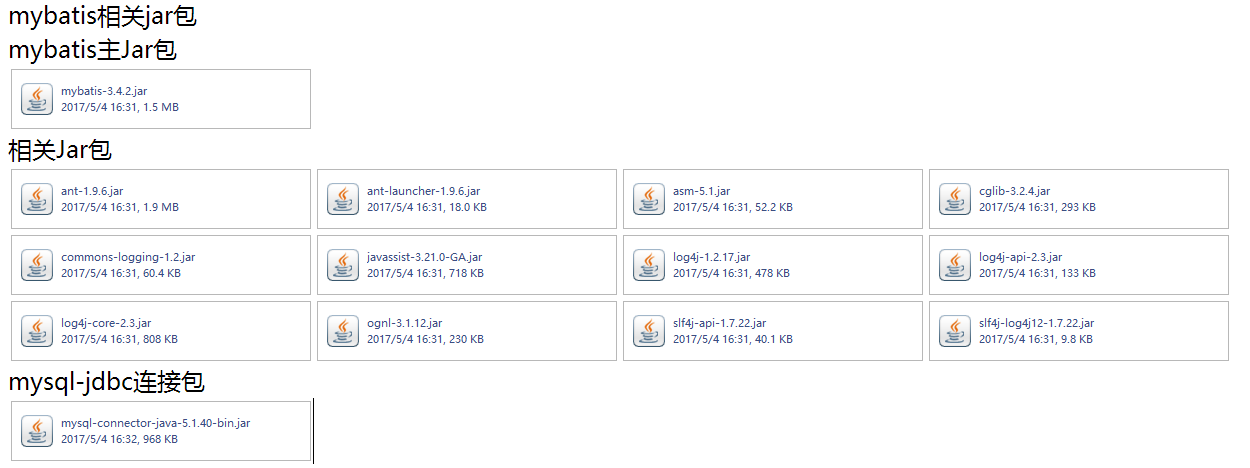
相关api和jar包这里提供一个下载地址,免得找了
链接:http://pan.baidu.com/s/1jIl1KaE 密码:d2yl
A.简单搭建跑项目
2.进行相关xml配置
放在根目录下

<?xml version="1.0" encoding="UTF-8" ?>

<!DOCTYPE mapper PUBLIC "-//mybatis.org//DTD Mapper 3.0//EN" "http://mybatis.org/dtd/mybatis-3-mapper.dtd">

<mapper namespace="com.jhdx.mapper.T_CustomerMapper">

      <!-- 通过编号查询用户 -->

      <select id="getAllCustomer"  resultType="Customer">

            select * from t_customer

      </select>

      <select id="getCustomerById" parameterType="java.lang.Integer" resultType="Customer">

      select * from t_customer where id=#{id}

      </select>

      <select id="getCustomerByName" parameterType="java.lang.String" resultType="Customer">

      select * from t_customer where name like "%"#{name}"%"

      </select>

      <insert id="insertCustomer"  parameterType="Customer">

      insert into t_customer(name,age,tel) values(#{name},#{age},#{tel})

      </insert>

</mapper>
      String resource = "mybatis-config.xml";

      InputStream inputStream=null;

      inputStream = Resources.getResourceAsStream(resource);

      SqlSessionFactory sqlSessionFactory = new SqlSessionFactoryBuilder().build(inputStream);

      //创建session工厂

      SqlSession session=sqlSessionFactory.openSession();

      //调用接口方法

      T_CustomerMapper t_CustomerMapper=session.getMapper(T_CustomerMapper.class);

      T_Customer t_Customer = new T_Customer();

      t_Customer=t_CustomerMapper.getCustomerByName("1");

      System.out.println(t_Customer.getName());

      <mappers>

            <!-- 配置映射文件 -->

            <mapper resource="com/jhdx/mapper/T_customerMapper.xml" />

            <mapper class="com.jhdx.mapper.T_customerMapper" />

      </mappers>
<select id="getCustomerByName" parameterType="java.lang.String" resultType="Customer">

      select * from t_customer where name like "%"#{name}"%"

</select>


  <resultMap id="BaseResultMap" type="com.jhdx.model.entity.User">

    <id column="userId" jdbcType="INTEGER" property="userid" />

    <result column="userName" jdbcType="VARCHAR" property="username" />

    <result column="userPwd" jdbcType="VARCHAR" property="userpwd" />

    <collection property="contents" ofType="Content" column="userId" select="selectAllContents"></collection>

  </resultMap>

  <select id="selectAllContents" resultType="Content" parameterType="java.lang.Integer">

  select * from content where userId=#{userId}

  </select>
<select id="selectUsers" resultType="map">

select

<include refid="userColumns"><property name="alias" value="t1"/></include>,

<include refid="userColumns"><property name="alias" value="t2"/></include>

from some_table t1

cross join some_table t2

</select>
<sql id="sometable">

${prefix}Table

</sql>

<sql id="someinclude">

from

<include refid="${include_target}"/>

</sql>

<select id="select" resultType="map">

select

field1, field2, field3

<include refid="someinclude">

<property name="prefix" value="Some"/>

<property name="include_target" value="sometable"/>

</include>

</select>
DAO层的函数方法

Public User selectUser(String name,String area);

对应的Mapper.xml

<select id="selectUser" resultMap="BaseResultMap">

    select  *  from user_user_t   where user_name = #{0} and user_area=#{1}

</select>
此方法采用Map传多参数.

Dao层的函数方法

Public User selectUser(Map paramMap);

对应的Mapper.xml

<select id=" selectUser" resultMap="BaseResultMap">

  select  *  from user_user_t  where user_name = #{userName,jdbcType=VARCHAR} and user_area=#{userArea,jdbcType=VARCHAR}

</select>

Service层调用

Private User xxxSelectUser(){

Map paramMap=new hashMap();

paramMap.put(“userName”,”对应具体的参数值”);

paramMap.put(“userArea”,”对应具体的参数值”);

User user=xxx. selectUser(paramMap);}
Dao层的函数方法

Public User selectUser(@param(“userName”)Stringname,@parm(“userArea”String area);

对应的Mapper.xml

<select id=" selectUser" resultMap="BaseResultMap">

   select  *  from user_user_t   where user_name = #{userName,jdbcType=VARCHAR} and user_area=#{userArea,jdbcType=VARCHAR}

</select>
- • 映射语句文件中的所有select 语句将会被缓存。
- • 映射语句文件中的所有insert,update 和delete 语句会刷新缓存。
- • 缓存会使用Least Recently Used(LRU,最近最少使用的)算法来收回。
- • 根据时间表(比如no Flush Interval,没有刷新间隔), 缓存不会以任何时间顺序来刷新。
- • 缓存会存储列表集合或对象(无论查询方法返回什么)的1024 个引用。
- 缓存会被视为是read/write(可读 /可写 )的缓存,意味着对象检索不是共享的 ,而 且可以 安全地被调用者修改 ,而不干扰其他调用者或线程所做的潜在修改。
- • LRU– 最近最少使用的:移除最长时间不被使用的对象。
- • FIFO– 先进先出:按对象进入缓存的顺序来移除它们。
- • SOFT– 软引用:移除基于垃圾回收器状态和软引用规则的对象。
- • WEAK– 弱引用:更积极地移除基于垃圾收集器状态和弱引用规则的对象。
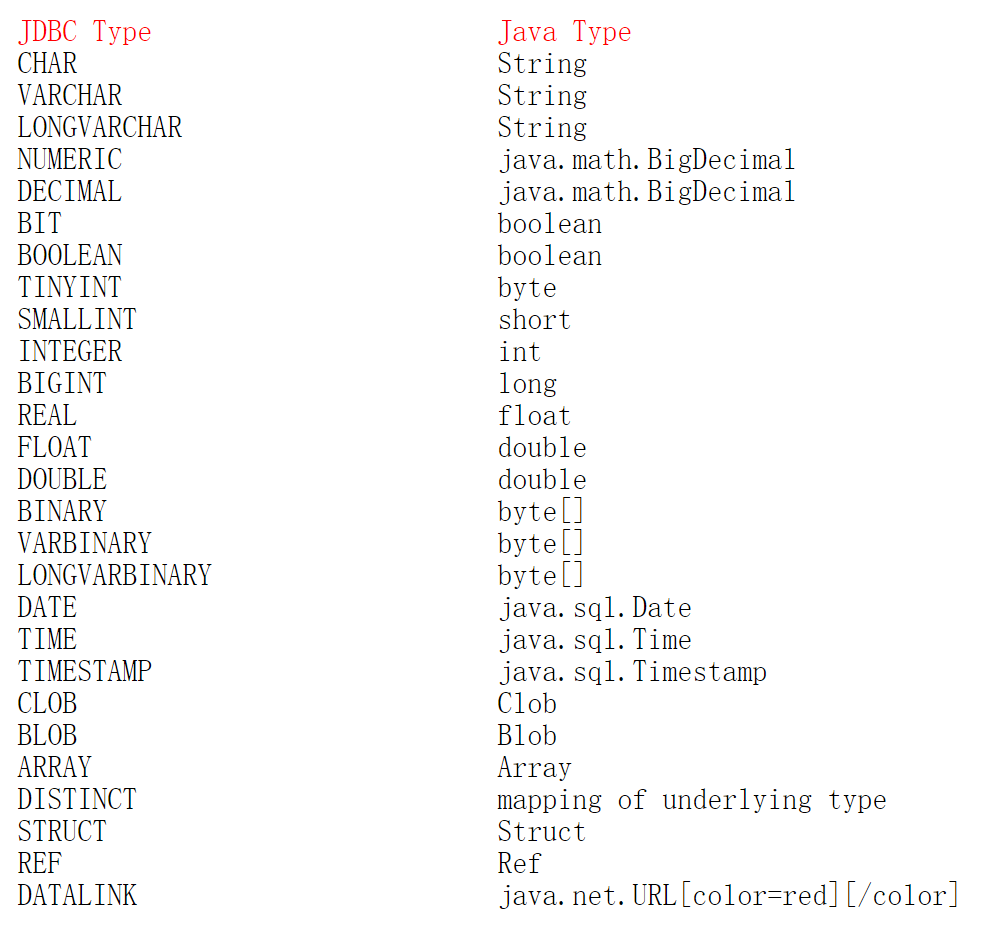
1. mybatis中 jdbcType 时间类型
当jdbcType = DATE 时, 只传入了 年月日
jdbcType = TIMESTAMP , 年月日+ 时分秒
使用时, 没有加jdbcType 正常,
1. #将传入的数据都当成一个字符串,会对自动传入的数据加一个双引号。如:order by #user_id#,如果传入的值是111,那么解析成sql时的值为order by "111", 如果传入的值是id,则解析成的sql为order by "id".
2. $将传入的数据直接显示生成在sql中。如:order by $user_id$,如果传入的值是111,那么解析成sql时的值为order by user_id, 如果传入的值是id,则解析成的sql为order by id.
3. #方式能够很大程度防止sql注入。
4.$方式无法防止Sql注入。
5.$方式一般用于传入数据库对象,例如传入表名.
6.一般能用#的就别用$.
MYBATIS 简单整理与回顾的更多相关文章
- 浅析MyBatis(二):手写一个自己的MyBatis简单框架
在上一篇文章中,我们由一个快速案例剖析了 MyBatis 的整体架构与整体运行流程,在本篇文章中笔者会根据 MyBatis 的运行流程手写一个自定义 MyBatis 简单框架,在实践中加深对 MyBa ...
- .NET Web开发技术简单整理
在最初学习一些编程语言.一些编程技术的时候,做的更多的是如何使用该技术,如何更好的使用该技术解决问题,而没有去关注它的相关性.关注它的理论支持,这种学习技术的方式是短平快.其实工作中有时候也是这样,公 ...
- 转载:.NET Web开发技术简单整理
在最初学习一些编程语言.一些编程技术的时候,做的更多的是如何使用该技术,如何更好的使用该技术解决问题,而没有去关注它的相关性.关注它的理论支持,这种学习技术的方式是短平快.其实工作中有时候也是这样,公 ...
- MyBatis简单的增删改查以及简单的分页查询实现
MyBatis简单的增删改查以及简单的分页查询实现 <? xml version="1.0" encoding="UTF-8"? > <!DO ...
- 哪些CSS是可以被继承的--简单整理
那些CSS是可以被继承的--简单整理1.文本相关属性是继承的:font-size,font-family,line-height,text-index等2.列表相关属性是继承的:list-style- ...
- spring+springMVC+mybatis简单整合
spring+springMVC+mybatis简单整合, springMVC框架是spring的子项目,所以框架的整合方式为,spring+Mybatis或springMVC+mybatis. 三大 ...
- .NET Web开发技术简单整理 转
.NET Web开发技术简单整理 原文:http://www.cnblogs.com/SanMaoSpace/p/3157293.html 在最初学习一些编程语言.一些编程技术的时候,做的更多的是如何 ...
- MyBatis简单使用方式总结
MyBatis简单使用方式总结 三个部分来理解: 1.对MyBatis的配置部分 2.实体类与映射文件部分 3.使用部分 对MyBatis的配置部分: 1.配置用log4J显式日志 2.导入包的别名 ...
- Spring Boot Mybatis简单使用
Spring Boot Mybatis简单使用 步骤说明 build.gradle:依赖添加 application.properties:配置添加 代码编写 测试 build.gradle:依赖添加 ...
随机推荐
- 【HTML5】选项卡
效果图: HTML: <!DOCTYPE html> <html> <head> <meta charset="utf-8" /> ...
- SpringMVC基础学习(一)—初识SpringMVC
一.HelloWorld 1.导入SpringMVC所需的jar包 2.配置web.xml 配置DispatcherServlet.DispatcherServlet默认加载/ ...
- WebGL 创建和初始化着色器过程
1.编译GLSL ES代码,创建和初始化着色器供WebGL使用.这些过程一般分为7个步骤: 创建着色器对象(gl.createBuffer()); 向着色器对象中填充着色器程序的源代码(gl.shad ...
- 什么是javascript中的静态方法?一个例子让你懂~!
function Foo(){ this.age = 28};var a = new Foo();alert(a.age);//28alert(a.name);//undifined Foo.name ...
- 优化php性能的一点总结
图示为100个并发,请求1000次目标地址 进行测试 最重要的两个参数:Requests per second :每秒接受请求数,这里每秒接收101个请求 Time per request:一个请求用 ...
- ZOJ 3195 Design the city 题解
这个题目大意是: 有N个城市,编号为0~N-1,给定N-1条无向带权边,Q个询问,每个询问求三个城市连起来的最小权值. 多组数据 每组数据 1 < N < 50000 1 < Q ...
- 【Spark2.0源码学习】-2.一切从脚本说起
从脚本说起 在看源码之前,我们一般会看相关脚本了解其初始化信息以及Bootstrap类,Spark也不例外,而Spark我们启动三端使用的脚本如下: %SPARK_HOME%/sbin/st ...
- html5表单元素详解
表单是Html中获取用户输入的手段.此文对表单的元素进行了详细整理. 表单基本元素 form input button form元素 html4中,form元素相当于表单的外包装,其他都要在里面.ht ...
- stm32之USART学习
首先,我是看着这位博主的文章受到的启发,进而加深了自己对USART的理解.下面是自己改装并实验过的程序. 原文:http://www.cnblogs.com/greatwgb/archive/2011 ...
- HTML5常用标签总结
一.常用的标签 <h1>~<h6> 表示是一个标题 <p> 段落标签 <hr/> 水平线标签 <br/> 换行标签 <sub> ...